

5 Key Elements of a Successful Sales Campaign: Insights, Tools & Tips
You don’t need me to tell you that the business landscape has always been, and remains, highly competitive. With this being the case, the extent to which you’re able to run a highly effective and successful sales campaign will ultimately determine how far you go in reaching your business goals and targets.
Why is a sales campaign important to your business?
From a results standpoint, a highly effective and successful sales campaign is dependent on a number of factors, including your ability to understand your buyer’s purchasing motive. Once you’ve understood this, the remaining elements of your sales campaign become easier as you now have a foundation from which to work from. We’ll discuss these elements shortly.
Asking yourself the following question is a useful place to begin:
As a business, what is it that I want most?
Understanding ‘what is sales‘ beyond the basics—recognizing it as the art of meeting needs through valuable offerings—is essential for crafting messages that resonate deeply with both prospective and existing customers.
Whether it’s lead generation, conversions, or an increase in online traffic, an effective sales campaign can certainly help achieve all three. Not just sales. Whichever goals and targets you have, know that they’re well within your reach, but only if you are willing to put in the effort towards an effective sales campaign.
How does a business put together an effective sales campaign?
So far, we’ve established what a well-run sales campaign can do for your business. Yet, your business goals and targets can only be met if you follow a strategic plan. Otherwise, your sales campaign will only lead to it falling flat on its face, resulting in an ineffective budget allocation – money down the drain. I’m sure you wouldn’t want this for your business.
A good sales campaign strategy alone is not enough, though. This has to be coupled with a solid plan; one that is well-thought-out. Next, we’ll delve into the key tools, tactics, create sales material, and strategies, including the utilization of a QR Code Generator, you need to deliver a successful sales campaign.
Let’s dive in.
Here are the 5 key elements of a successful sales campaign.
Above, we established the two key requirements for a successful sales campaign:
- A well-thought-out strategy
- and a solid plan
The above takes significant time and effort, so please don’t rush through these stages. If it all becomes overwhelming, involve your team in this process. Doing it alone can take its toll. If you are a one-man army, ensure that you educate yourself through marketing books, marketing events and online content, as well as this article, of course. Having material to refer to is always extremely useful.
Once you nailed down the above, it’s time to put some meat onto the bones of your sales campaign; this ensures that you can maximise its potential.
Let’s begin with step number one.
1. Don’t fall short of identifying your target audience
Thoroughly understanding who your target audience is should not be an alien concept to you. In the early stages of setting up your business, I’m confident that you would have already gone through the process of establishing your target audience. This will serve as a base for establishing a target audience for your specific sales campaign.
There are two scenarios here:
- Your business has always had one target audience.
OR
- If your services cater to more than one audience, the need to be specific becomes very important.
For example, a company that sells apparel and footwear will cater to a significantly wider audience and demographic than a company that sells sports sneakers alone. You can relate this concept to your respective company and industry.
Let’s move on to step number two.
2. Set yourself very clear objectives
It’s vitally important not to confuse strategy and plan with objectives. Essentially, here you want to clearly define what it is that you are aiming to achieve with your sales campaign. Often, companies make the mistake of being extremely vague with their objectives. They will say things like:
“We want more leads”
“We want more conversions”
“We want a better turnover”
As I’m sure you’ve recognised, these objectives are far too vague and will never serve you well for any sales campaign. If you find yourself thinking along similar lines, I cannot stress enough the importance of wiping the slate clean and starting over. Remember, you must be specific.
As I mentioned earlier in the article, there is no shame whatsoever in admitting when you need help and assistance. It’s common for company owners to spend weeks, if not months trying to establish clear objectives. If this sounds like you, work on this task with your team or a sales agency. Multiple minds coming together to solve a problem can often prove pivotal.
When it comes to setting clear objectives for a sales campaign, SMART is a very well-established marketing model used by thousands of businesses across the world. Broken down, SMART stands for:
Specific
Measurable
Actionable
Relevant
Time-bound
(see graphic below)
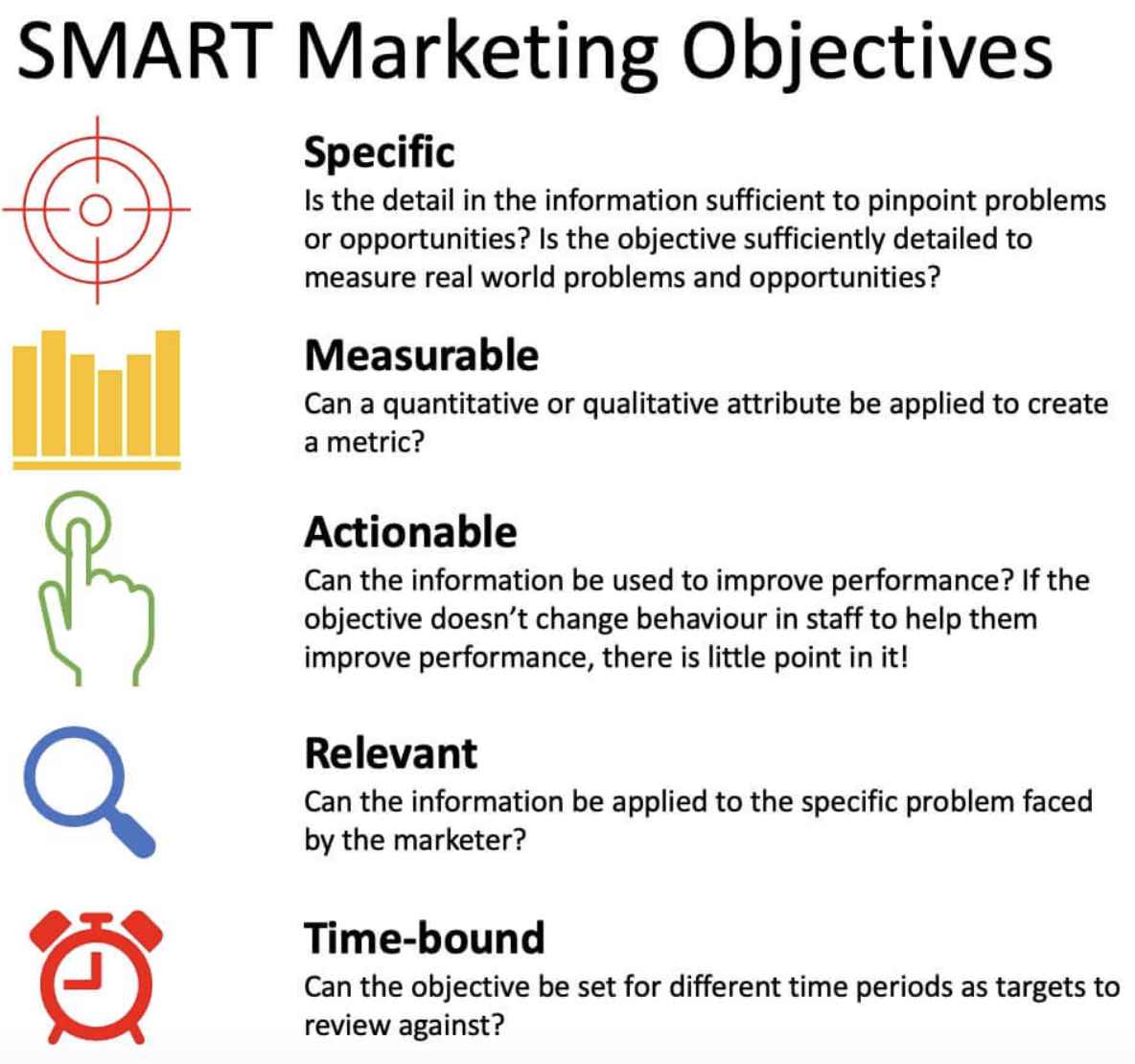
While the above model is popular in Marketing, it can sometimes be challenging to ascertain its meaning without going into detail. So, let’s elaborate further by delving into the SMART model and what it looks like from a practical standpoint.
How can we define the SMART model?
As mentioned earlier, the SMART model is one of the most popular marketing tools. Companies rely on it daily for their sales and marketing campaigns. Before we dissect the model, in case you missed the graphic above, your sales campaign must be Specific, Measurable, Achievable, Relevant, and Time-bound. If you follow these marketing principles closely, you’ll be on your way to achieving a successful sales campaign.
Let’s begin with Specific
By being specific with your objectives, you stand a greater chance of bringing clarity and precision to your sales campaign. It also helps you answer the following concerning your preferred outcomes:
- Who
- What
- Where
- and Why
If you can answer the above four, you and your team will be better equipped to aligning your efforts and resources accordingly.
Now the turn of Measurable
Any business objective(s) related to a sales campaign must be measurable. Without being able to measure, you never have the tools to know the effectiveness of a sales campaign. In turn, informed decisions about whether or not a sales campaign requires a midcourse correction becomes challenging. Placing quantifiable metrics such as (KPIs) will help you do this.
This isn’t the only benefit of being able to measure your sales campaign. It also allows your marketing team to be realistic from a goal-setting standpoint.
Don’t confuse being realistic with being unambitious, though. Being ambitious is important for scalability. However, by being too unrealistic with expectations, the goals and targets attached to your sales campaign may not be aligned with the current capabilities and resources at your disposal.
Again, this doesn’t mean that you are not ambitious. It simply means that you are controlled and measured; these are admirable traits to have when taking on a sales campaign which you hope will be a successful one.
Let’s talk about Actionable
As well as a careful and considered assessment of your capabilities and resources, the objectives you set must still be able to challenge you and your team. Taking on a challenge invigorates the mind, pushing it beyond what you think is possible. In a nutshell, you must create a balance between realistic and unrealistic.
Next is Relevant
You may remember we discussed the importance of your goals and objectives being vague. Instead, they must be relevant. By being relevant, they hold more meaning to your marketing endeavours. So the likelihood of your sales campaign bearing fruit increases significantly. Why? Because you take immense care and thought when establishing your goals and objectives.
What do we mean by Time-bound?
As the name suggests, time-bound refers to a deadline or timeline you set for a marketing-related project. In this case, it would be the completion timeline for your sales campaign. The benefit of this is twofold:
- It helps create individual and team accountability.
- And also a sense of urgency. Helping all involved to stay focused.
It’s highly advisable to set clear deadlines and timeframes. By doing so, you are providing a canvas from which the team can allocate its resources effectively. In turn, they are more likely to hit their targets.
3. Don’t underestimate your value proposition
All businesses must have the ability to attract prospective customers. Without doing so, you don’t have a business to run.
In order to attract prospective customers, your value proposition must be enticing to your prospects; this is where your value proposition takes centre stage by clearly articulating the unique selling proposition (USP) of the service(s) you provide.
You can do this by being very specific about how to solve your prospects pain points. You can even go one step further by demonstrating how your service compares to your competitors.
Crafting a compelling value proposition is no easy feat; it takes immense time and effort. Start by deeply analysing the features of your product, the extent to which it solves prospects pain points and your competitive advantages. Consult product proposal examples online to make sure you cover all the questions your prospects may have. When explaining how you solve their pain points, be thorough here by articulating effectively the tangible outcomes they should expect. By painting them a clear picture of what they can expect, they are more likely to engage with you. To further strengthen your offering, consider using SAP CPQ to quickly generate accurate, branded quotes for your prospective clients.
4. Embrace the art of storytelling
Your value proposition is just the starting point. Once you have this nailed, the extent to which you can communicate this through persuasive messaging and storytelling will ultimately dictate how forthcoming or otherwise your target audience is to your sales campaign.
We touched on the pain points earlier. Your messaging must be able to convey these confidently; in a language style that is understood well by your prospects. Above all, your messaging must resonate with them.
Ensure that you avoid using complex language; this can be an easy trap to fall into because the tendency sometimes is to speak in industry jargon; this never works and will always result in your prospects becoming disengaged from the beginning.
Remember, storytelling can strike an emotional connection with your prospect. As consumers, we often make purchases based on how a message made us feel, not what it told us to do. If you can stick to this principle, it will set you up nicely for your storytelling process.
5. Make use of modern-day communication mediums
Here are the most popular marketing channels used today:
- Paid advertising
- Social media
- Email marketing
- Content marketing
- Online appointment scheduling software
To effectively manage these various communication channels, many businesses are turning to sales automation platforms. For example, La Growth Machine helps sales teams automate and coordinate their outreach across LinkedIn, email, and other channels while maintaining personalization. This type of tool can significantly improve the efficiency of your sales campaigns by automating repetitive tasks while ensuring consistent messaging across all touchpoints. By leveraging automation intelligently, your team can focus more on building relationships and closing deals rather than manual outreach tasks.
With numerous avenues of communication available, you must consider all of them for your marketing efforts. There is no harm whatsoever in using all of them if your resources allow for it. But only do so if your insights from the SMART model point towards it.
Remember, each of the marketing channels has its intrinsic advantages and reachability. So when you create the strategy for your sales campaign, you can decide how best to position them to gain maximum effectiveness. Once your sales campaign begins, you can alter them based on the analytical feedback you receive. (Refer to Measurable discussed earlier).
To conclude
The proposition of running a sales campaign, let alone a successful one, presents many challenges. If you fall short of the required preparation and implementation techniques in this article, the likelihood of your sales campaign bearing fruit may decrease. With that being said, you don’t need to follow every step down to the tee. Instead, use it as a guide to form the backbone of your sales campaign while leaving room for slight experimentation with additional ideas that you and your team wish to explore.
Above all, you must take your sales campaign(s) seriously, especially when you deploy a significant budget. Therefore, you must give your investment the best possible chance of succeeding. You can only do this by paying attention to the details of every task and decision you make.
If you require a marketing template to follow, the SMART model discussed earlier will be your greatest ally. Be open to teamwork, feedback, as well as constructive criticism. A sales campaign will be one of the best professional learning experiences you will go through.


Leave a Reply