
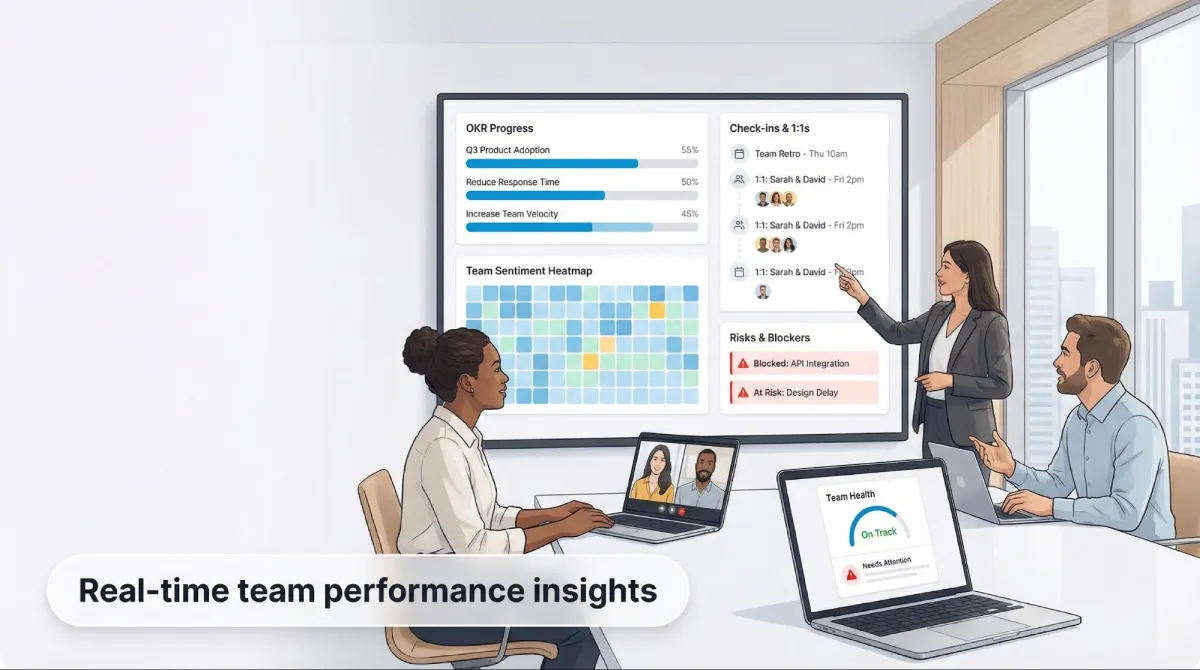
9 Management Software for Team Effectiveness Measurement & Team Performance Software
Modern teams juggle more tools, time zones, and dependencies than any one manager can track. According to Gartner, 80 percent of large enterprises had already moved to continuous performance management by 2024, replacing once-a-year appraisals with weekly check-ins and live dashboards. Yet the 2025 *State of the Team* A report from behavior-diagnostic platform TeamDynamics found that only 34 percent of managers can accurately describe their squad’s core ways of working, proving that visibility gaps persist despite the dashboards. That reality demands software that pinpoints who is on target, where collaboration stalls, and which goals are slipping, all in real time.
This guide compares nine standout platforms, grouped into three common needs:
- fast behavioral diagnostics
- enterprise-scale OKR + feedback suites
- lightweight starters for small teams
Scan the category that matches your context, then pick a tool that can lift team effectiveness before your next sprint review.
How we selected the nine stand-out platforms
We started with every product in G2’s Performance Management category and applied a five-step filter to narrow the field. First, each contender had to provide the modern essentials: goal or OKR tracking, continuous feedback, and analytics that highlight trends rather than raw data dumps. Second, the tool needed to fit easily into daily work through native Slack or Teams commands, HRIS sync, and project-tool plug-ins. Third, we judged analytics depth, favoring dashboards that combine real-time metrics with AI prompts such as sentiment heat maps or coaching nudges. Fourth, we tested scalability by reviewing public case studies for teams of 50, 500, and 5,000 users. Finally, we checked real-world satisfaction by sampling user feedback from G2’s database of more than two million verified ratings across 150,000 products in over 2,100 categories, according to G2’s Spring 2023 reports. Nine platforms met all five criteria; those are the ones you’ll see next.
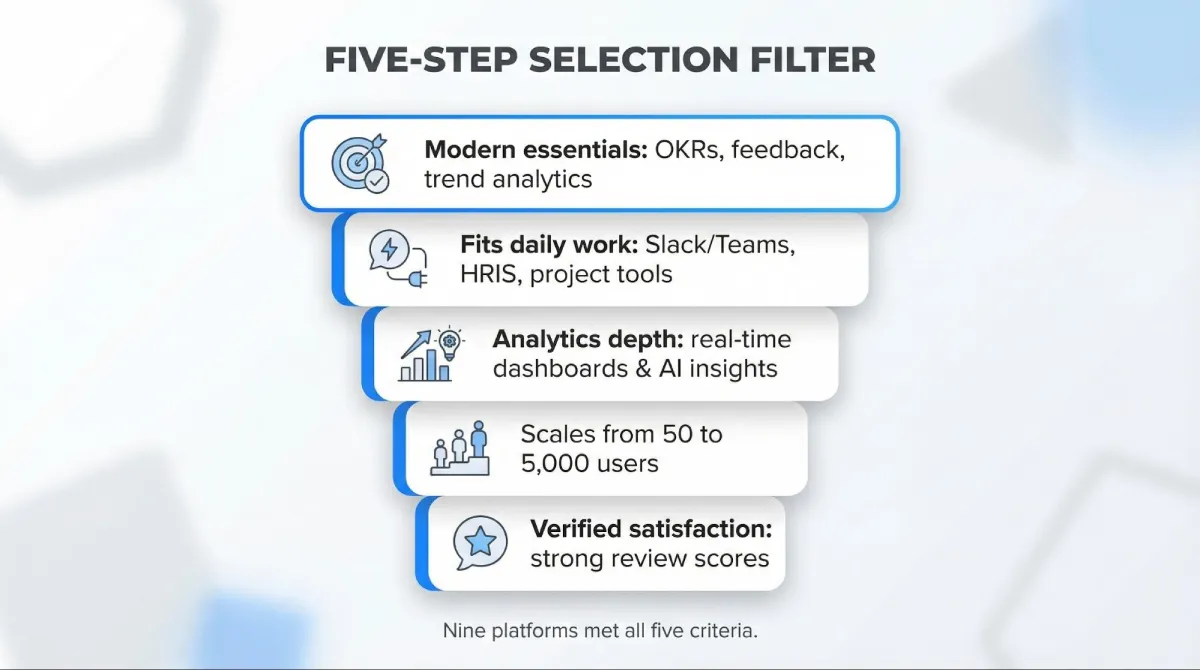
A clear five-step selection filter ensures only the strongest team performance tools make this list
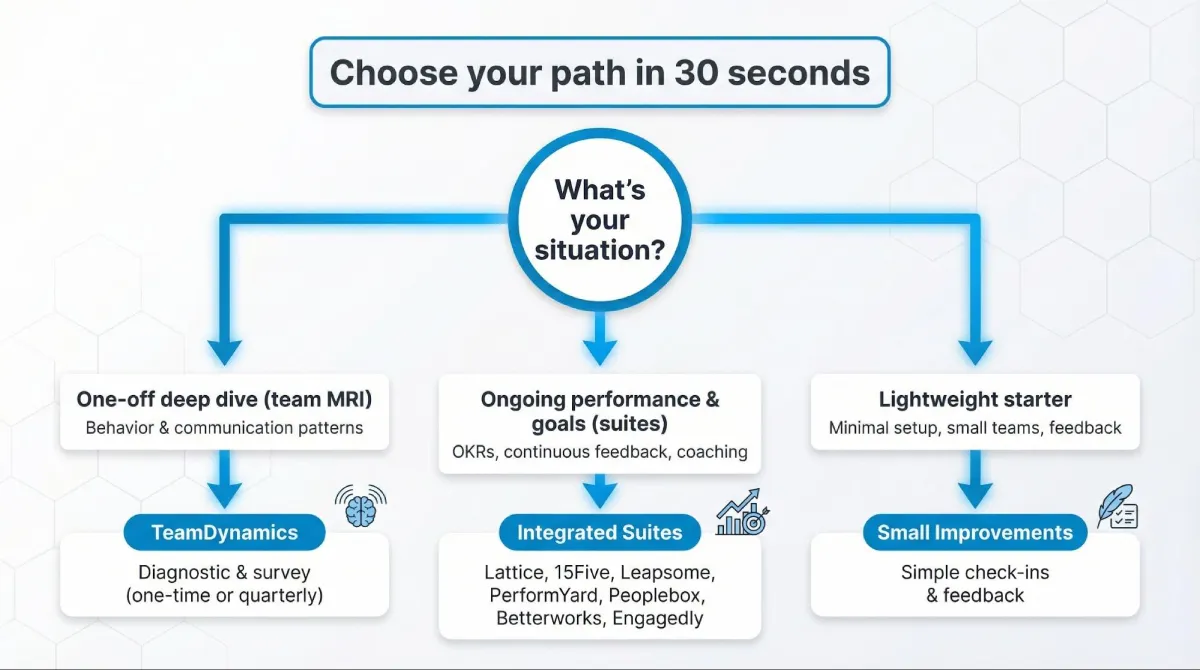
Choose your path in 30 seconds
Three situations cover almost every reader:
- “We need a team MRI before new processes.”
Choose the single behavior-first diagnostic in the next section. - “We must align every squad to company OKRs while keeping weekly coaching on track.”
Jump to the performance-suite lineup; five enterprise-ready platforms live there. - “We’re a lean crew with no time for heavy admin.”
Head to the lightweight solutions. They deliver reviews, goals, and feedback without an implementation project.
Lock onto the scenario that matches your reality, then skim straight to that segment so your shortlist forms quickly.
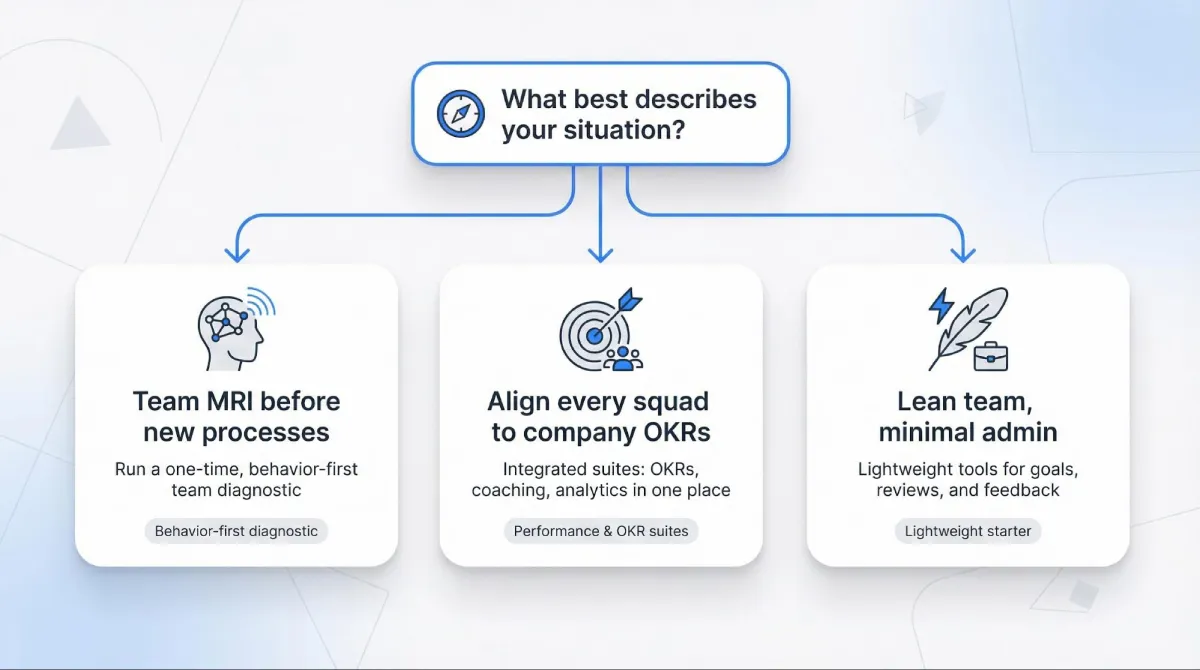
Use this simple decision tree to jump straight to the team performance tool category that fits your situation
Behavior-first insight: TeamDynamics
Most performance tools dissect individuals; TeamDynamics looks at the entire team. Each teammate completes a 10–15-minute survey, and the platform returns a map of how the group communicates, decides, and ships work. Instead of vague “let’s collaborate better” chatter, you’ll see statements such as “We default to rapid decisions but under-share context,” plus bite-sized coaching moves you can test in the next retro.
TeamDynamics team behavior diagnostic dashboard
The product is a one-time purchase starting at $29 per person for the Solo version and scaling up for full-team reports. Leaders can rerun the diagnostic whenever the roster or charter shifts, without another subscription approval. Think of it as an MRI you order before any new performance plan: clarify rituals, adjust roles, or confirm whether you need one of the heavier suites that follow.
Integrated performance and OKR suites (five options for mid-market and enterprise)
Below are five platforms that bundle goal alignment, continuous feedback, and deep analytics into one workspace, ideal when you want a single system that scales from a 50-person squad to a 5,000-employee enterprise.
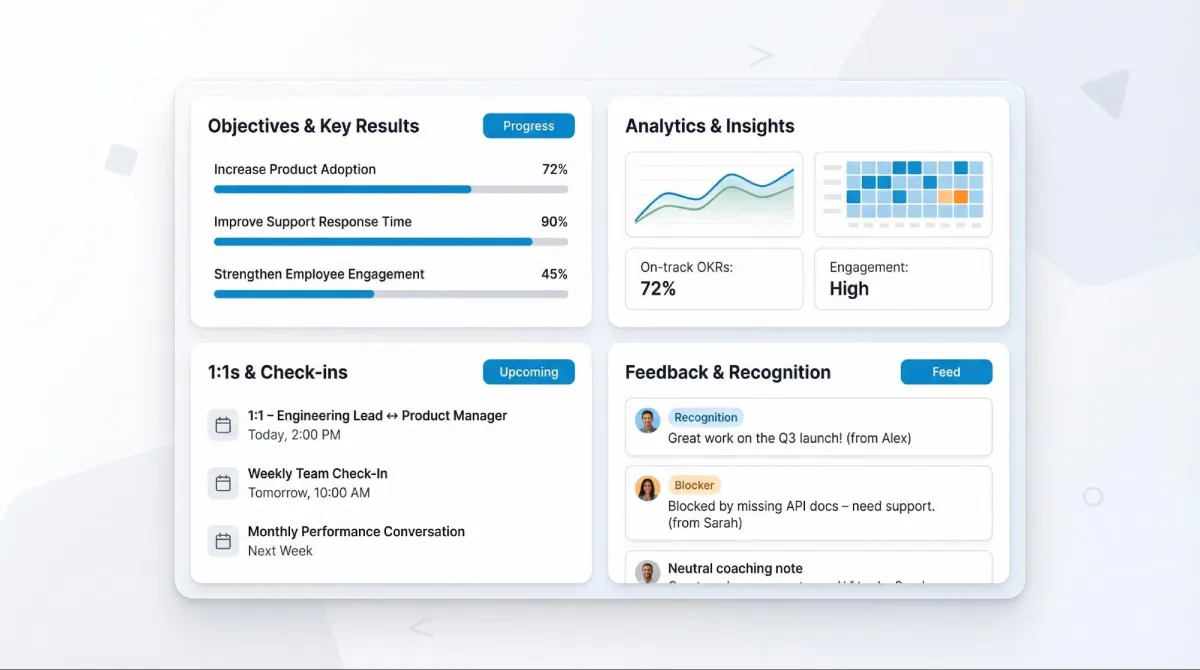
Integrated performance and OKR suites bring goals, coaching, feedback, and analytics into a single workspace
Lattice
Lattice acts as a single pane for performance conversations: OKR dashboards, guided 1-on-1 agendas, calibration workflows, and pulse surveys appear side by side so leaders can read strategy and sentiment on one screen. Managers value that each 1-on-1 agenda pulls talking points from live goal progress, avoiding last-minute prep.
The suite connects with Slack, Microsoft Teams, Jira, and more than 50 HRIS systems. It also joined the Workday Partner Program in October 2025 to deepen data syncs, according to an October 2025 press release. Entry-level “Performance” or “Goals & OKRs” modules start at $11 per user per month with a $4,000 annual minimum, and the full bundle averages $10–$11 depending on mix. On G2, Lattice holds a 4.7 / 5 rating across more than 4,000 verified reviews, the highest in its mid-market peer set.
Choose Lattice when you need enterprise-grade analytics for board decks and an interface employees can finish without nudges. Seat-based pricing keeps it accessible for a 50-person startup while scaling cleanly past 5,000 users.
15Five
15Five turns continuous feedback into a weekly ritual: each employee spends two to three minutes on a Check-In, and each manager reviews the responses and pulls talking points into the next 1-on-1. That rhythm ties goals, recognition (“High Fives”), and roadblock flags into a single thread instead of scattered docs.
The platform links those Check-Ins to OKRs, engagement surveys, and a talent matrix. Built-in question banks and micro-learning nudges help managers ask coaching questions rather than status updates.
Pricing starts at $4 per user per month for the Engage plan and $11 for the Perform suite, billed annually. On G2, 15Five holds a 4.6 / 5 rating across more than 1,800 verified reviews, evidence that the light footprint still delivers strong results.
Choose 15Five if you’re a growth-stage company that values “no surprises” culture; the software surfaces blockers before they snowball and keeps progress visible without the heft of a full HRIS.
Leapsome
Leapsome treats performance and learning as one loop. Employees set OKRs, gather 360-degree feedback, then receive personalized learning paths that close gaps flagged in the review. The cycle is simple: measure → discuss → grow, all inside one workspace.
Managers use an analytics console with heat maps and drill-downs that tie dips in engagement to factors such as recognition or workload, turning “morale chatter” into a ranked action list. Flexibility helps too: teams can run quarterly engineering reviews, project-end design evaluations, or ad-hoc pulse surveys in the same account, each with its own question set and rating scale. Integrations with Personio, BambooHR, Slack, and Jira keep data flowing.
Pricing is quote based, but customers report an average of $8–$12 per user per month for the full suite, with startup discounts at lower volumes (company figures, 2025). On G2, Leapsome holds a 4.8 / 5 rating across more than 2,100 verified reviews, the highest score among platforms in this guide.
Choose Leapsome if your growth plan depends on closing skill gaps as quickly as you find them; its “feedback-to-upskilling” conveyor keeps learning in lockstep with performance.
PerformYard
PerformYard treats “our process is unique” as an advantage, not a problem. Drag-and-drop builders let you run quarterly peer reviews for sales, project-end retros for product, and annual 360s for leadership, all in one timeline without custom code. Templates, due-date rules, and automated nudges keep managers coaching instead of chasing forms.
Beyond reviews, teams get a goal tracker and an always-on feedback thread, while lean analytics surface high performers and at-risk squads through trend charts and heat maps. Exportable reports drop straight into exec decks.
Seat pricing ranges from $5 to $10 per employee per month with no implementation fees. The platform holds a 4.7 / 5 rating from more than 1,100 verified reviews on G2. PerformYard suits midsize organisations that have outgrown spreadsheets but prefer to avoid enterprise bloat.
Peoplebox
Peoplebox puts performance workflows directly into Slack or Microsoft Teams, so updating an OKR or answering a Check-In feels as simple as posting a GIF. That “no new logins” design lifts adoption rates to 80 percent within the first 60 days, according to the vendor’s 2025 customer data sheet.
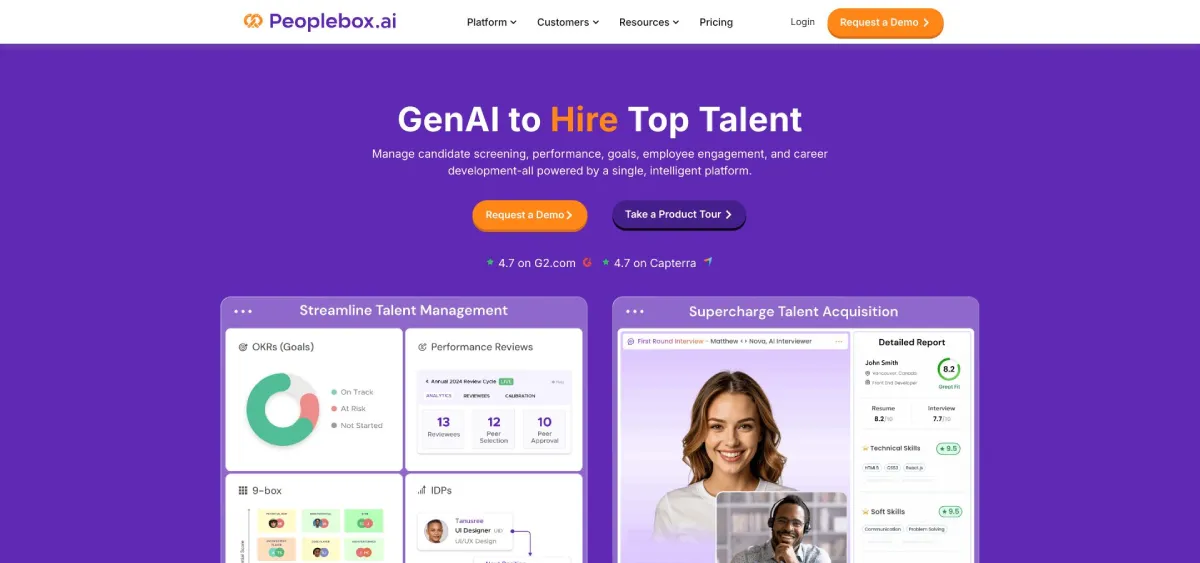
Peoplebox OKR and performance workflows inside Slack and Teams
The suite links personal objectives to team and company goals, then uses AI nudges and one-sentence summaries to keep progress visible, even for leaders who never open the dashboard. One-on-one agendas, pulse surveys, and a nine-box talent matrix feed real-time reports that flag at-risk objectives or disengaged teams before they reach the board deck.
Pricing starts at $7 per user per month for Talent Management, $8 for the OKR platform, and $12 for the full suite, billed annually. On G2, Peoplebox scores 4.5 / 5 from 360 verified reviews, with buyers citing “goal updates inside chat” as the top adoption driver.
Choose Peoplebox if your organisation already lives in Slack or Teams and you want OKR alignment built into every conversation without opening another browser tab.
Betterworks
Betterworks serves enterprises where a missed OKR can cost millions. Company-level objectives cascade to every team and employee, and progress stays visible through live dashboards and conversation–feedback–recognition check-ins that managers hold monthly instead of waiting for quarter end.
Leaders can slice results by department, region, or demographic segment, then lock access with role-based permissions that clear CIO security audits. Median implementation time is two months and median ROI is 13 months, according to 217 verified G2 reviews that average 4.4 / 5. Pricing is quote based, but reviewers report an average first-year contract of $70–$90 per employee for enterprises with more than 1,000 staff.
If your board wants a clear line from top-level OKRs to sprint tickets, and your HR team plans to retire annual reviews, Betterworks belongs on your shortlist.
Engagedly
Engagedly rolls performance, engagement, learning, and succession planning into one workspace, then layers in “Marissa” AI that scans feedback threads, survey comments, and goal updates to nudge managers with next-step suggestions.
The core suite covers OKR alignment, continuous feedback, 360 reviews, and recognition. Its standout hand-off: a skills gap flagged during a review can automatically enrol the employee in a learning module, which feeds the next 1-on-1 agenda.
Pricing is modular. The Performance bundle starts at $5–$8 per user per month, billed annually, and add-ons such as the Learning Experience Platform or Mentoring Suite range from $2–$10. On G2, Engagedly scores 4.3 / 5 across more than 540 verified reviews, with a median two-month implementation time and a 21-month ROI.
Choose Engagedly when you want AI-powered insights without stitching together point solutions; it offers one workspace that scales from midsize teams to global enterprises.
Small Improvements
Small Improvements is built for teams that want reviews and feedback without red tape. Launch a review cycle in minutes; most employees finish their part in fewer than five clicks, according to customer usage data.
The interface shows only essential fields, not sprawling corporate forms, so adoption stays high. Objectives feel more like Trello cards than HR databases, and kudos land in a chat-style thread that keeps recognition and coaching together. Analytics stay intentionally light: skipped reviews, lopsided praise, and basic trend lines, enough to steer without overwhelm. For leaders who’d like a quick, low-lift snapshot of working styles before launching a full review cycle, this comparison of leading team assessment tools shows which diagnostics surface interpersonal dynamics in under 30 minutes.
Pricing starts at $3 per user per month for the Launch plan and rises to $6 for Grow and $9 for Elevate, all billed annually with a 30-day free trial. On G2, the platform scores 4.3 / 5 across 76 verified reviews, with buyers citing “quick setup” as the top benefit.
If you’re introducing performance management to a 15-person startup or rebooting an outdated process, Small Improvements offers a straightforward path that teams complete before lunch.
Conclusion
Team effectiveness measurement isn’t just about tracking individual output anymore—it’s about understanding how a team works together, where collaboration breaks down, and whether goals are moving forward in real time. Even with the shift toward continuous performance management, visibility gaps remain, especially in how managers interpret team behaviors and operating rhythms. That’s why the best tools today do more than collect feedback—they translate signals into actionable insights.
If you need a fast, behavior-first snapshot before changing rituals or roles, TeamDynamics stands out as the clearest “team MRI.” If your priority is enterprise-wide alignment with OKRs, coaching, and analytics in one unified system, platforms like Lattice, 15Five, Leapsome, PerformYard, and Peoplebox offer the strongest end-to-end suites. And if you want a lightweight, low-admin way to run reviews and feedback cycles without heavy implementation, Small Improvements is a strong starter choice.
Your best move is to match the tool to your team’s context—diagnose first, align next, then scale only as needed. The right platform can surface what’s working, spotlight what’s stuck, and improve team effectiveness before performance issues show up in sprint reviews or quarterly outcomes.
FAQ
1. What is team effectiveness measurement software?
Team effectiveness measurement software helps leaders track and improve how a team performs—not just through goals and outcomes, but through behaviors, collaboration patterns, communication, feedback loops, and engagement. The best tools provide insights that connect performance signals to coaching actions and workflow improvements.
2. What’s the difference between team performance software and individual performance management tools?
Individual performance tools focus on one employee’s goals, feedback, and reviews. Team performance software goes further by identifying shared operating patterns—like decision-making speed, communication clarity, or alignment—so leaders can improve how the whole team functions, not just how individuals perform.
3. Which tool is best if we want to understand team behavior quickly?
TeamDynamics is the top pick for behavior-first diagnostics. It’s designed to map how a team communicates, decides, and ships work, making it ideal if you need insight before implementing new processes or OKR frameworks.
4. Which platforms work best for OKR alignment across the whole company?
For enterprise-level OKR alignment and performance workflows, Lattice, Leapsome, Betterworks, and Peoplebox are strong options. These tools support cascading goals, continuous feedback, analytics, and integration across departments and regions.
5. What’s the best software for continuous feedback and weekly check-ins?
15Five is built around weekly check-ins and manager 1-on-1 workflows. It works well for growth-stage companies that want to prevent blockers and misalignment early through lightweight, consistent rituals.
6. Which tools are best for integrating learning with performance improvement?
Leapsome and Engagedly stand out here. They connect feedback and reviews to learning paths or skills development programs, making performance management a loop that improves capability—not just tracks progress.
7. What should small teams or startups use?
If you want something simple, low-lift, and fast to roll out, Small Improvements is a solid choice. It’s designed for teams that want structured feedback and reviews without heavy HR workflows or complicated implementation.
8. How do I choose the right team performance platform?
Start by identifying your primary need:
- Behavior diagnosis before process changes → TeamDynamics
- Enterprise OKRs + coaching + analytics → Lattice, Leapsome, Betterworks, Peoplebox
- Weekly check-ins with strong adoption → 15Five
- Custom review cycles and flexibility → PerformYard
- Lightweight starter for small teams → Small Improvements
Choosing based on the team’s stage and maturity will prevent tool fatigue and improve adoption.
9. What features should I prioritize in 2026?
Look for:
- OKR or goal tracking
- Continuous feedback and 1-on-1 workflows
- Analytics that show trends (not raw dumps)
- Integrations (Slack/Teams, Jira, HRIS)
- Role-based permissions and security (for enterprise teams)
- AI coaching prompts or sentiment signals (optional but increasingly valuable)
10. Will these tools replace managers?
No—good tools don’t replace leadership, they amplify it. They help managers spot blind spots, find patterns faster, and coach with more context. The most effective platforms turn performance management into a consistent, lightweight habit rather than an annual event.


Leave a Reply