
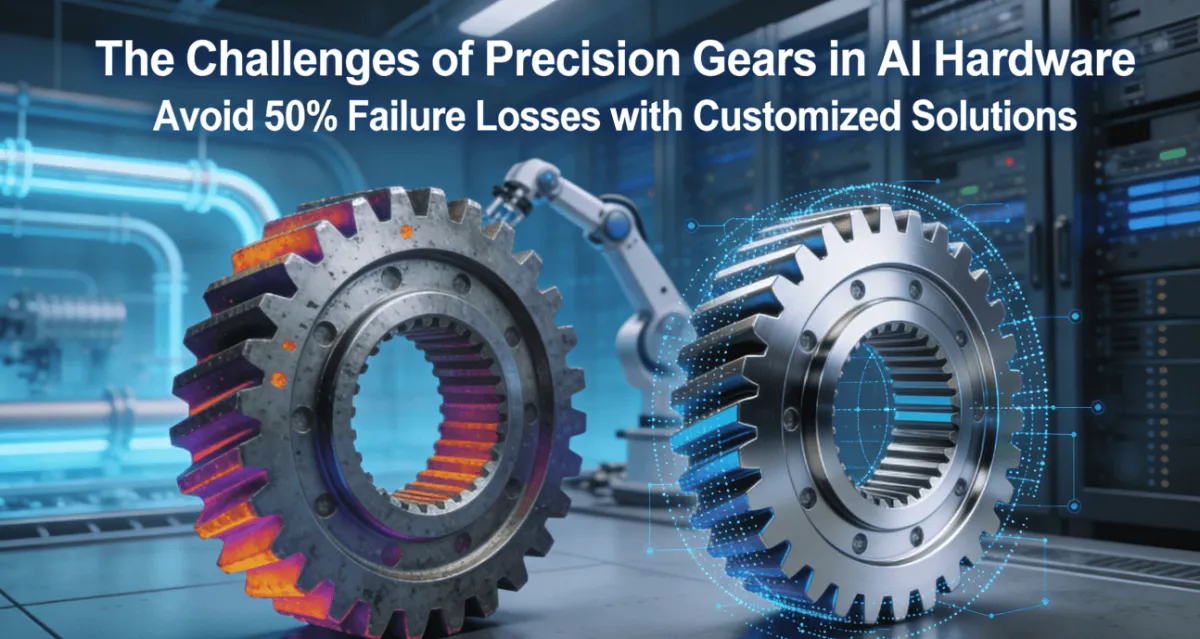
The Challenges of Precision Gears in AI Hardware Manufacturing: How to Avoid 50% Failure Losses Through Customized Solutions?
Introduction
In the fields of AI hardware manufacturing and robotic component processing, failures of industrial gears often lead to unplanned downtime and soaring maintenance costs, severely impacting corporate innovation and production schedules. The core of the problem lies in the fact that traditional standardized gear manufacturing struggles to meet the stringent demands of cutting-edge technology in terms of precision, durability, and system compatibility.
By introducing application-oriented customized design, manufacturing, and strict quality control for precision gears, gear lifespan and system efficiency can be significantly enhanced, thereby effectively avoiding up to 50% of potential failure losses. The following sections will provide an in-depth analysis of how to comprehensively optimize the industrial gear manufacturing process.
Why does AI hardware manufacturing require high-precision industrial gears?
AI hardware manufacturing, such as server clusters and chip manufacturing equipment, requires nanometer level motion control precision. In such systems, the Industrial Gear, as the core of transmission and heat dissipation, directly determines system stability. Minor tooth profile errors or meshing gaps can be amplified under high-speed, high-load operation, leading to vibration, noise, overheating, and even mechanical failure. Industry data shows that unplanned downtime caused by failures of key transmission components can account for over 50% of total losses.
In AI server cooling systems, the gears driving the fans need to be quiet, efficient, and long-lasting; in chip manufacturing equipment, the precision of the positioning gear pairs directly affects the line width and yield of lithography. By utilizing customized precision gears provided by a precision gear manufacturing company, optimized for specific loads, space constraints, and material compatibility, near-perfect meshing can be achieved, thereby significantly improving system stability and energy efficiency. This highlights the indispensable value of professional companies in AI Hardware Manufacturing. Relevant standards from the International Organization for Standardization (ISO), such as ISO 1328, provide a clear quality benchmark for precision manufacturing. To learn more about professional solutions, please refer to: industrial gear manufacturing solutions.
How to choose a gear manufacturing company suitable for robotic components?
Robotic Component Machining presents the dual challenges of extreme light weighting and ultra-high strength for gears. Selecting the correct gear manufacturing partner is key to ensuring robotic performance, lifespan, and cost-effectiveness.
Evaluating Supplier Technical and Certification Qualifications
Selecting a supplier should not be limited solely to geographical location. A qualified gear manufacturing companies should possess internationally recognized quality management system certifications, such as ISO 9001. For high-demand applications, certifications like AS9100D (Aerospace) better demonstrate superior process control capabilities. Furthermore, assessing whether they possess advanced manufacturing and inspection equipment (such as CNC hobbing machines, gear measuring centers) and the ability to process high-strength special materials is crucial.
Strategic Trade-offs Between Local and Global Suppliers
Many engineers searching for suppliers use terms like “custom gears near me” hoping for faster response times. This is a viable strategy for simple, urgent prototypes or repair parts. However, for precision industrial gearboxes that determine the core performance of robots, the selection should transcend geographical boundaries. Top global manufacturers often have deeper expertise in special materials, advanced heat treatment processes, and complex tooth profile machining technologies, offering technical consistency and innovative solutions unattainable by local workshops. An efficient global supply chain, combined with digital collaboration, can potentially offer comprehensive costs and benefits far exceeding those limited to local options.
Supply Chain Efficiency and Cost Case Analysis
- Case Background:A collaborative robot company faced challenges with gearbox lifespan not meeting standards.
- Challenge and Solution:The initial local supplier had bottlenecks in material heat treatment. The company then switched to a global precision gear manufacturer with complete heat treatment lines and strict inspection processes. Through collaborative optimization of gear design parameters and heat treatment curves, the lifespan issue was resolved.
- Results and Benefits:While the cost per individual gear increased slightly, the overall gearbox lifespan increased threefold, significantly reducing the robot’s lifecycle maintenance costs and downtime risks, achieving substantial cost savings. Reports from the Robotic Industries Association (RIA) also emphasize that optimizing the core component supply chain is key to enhancing competitiveness.
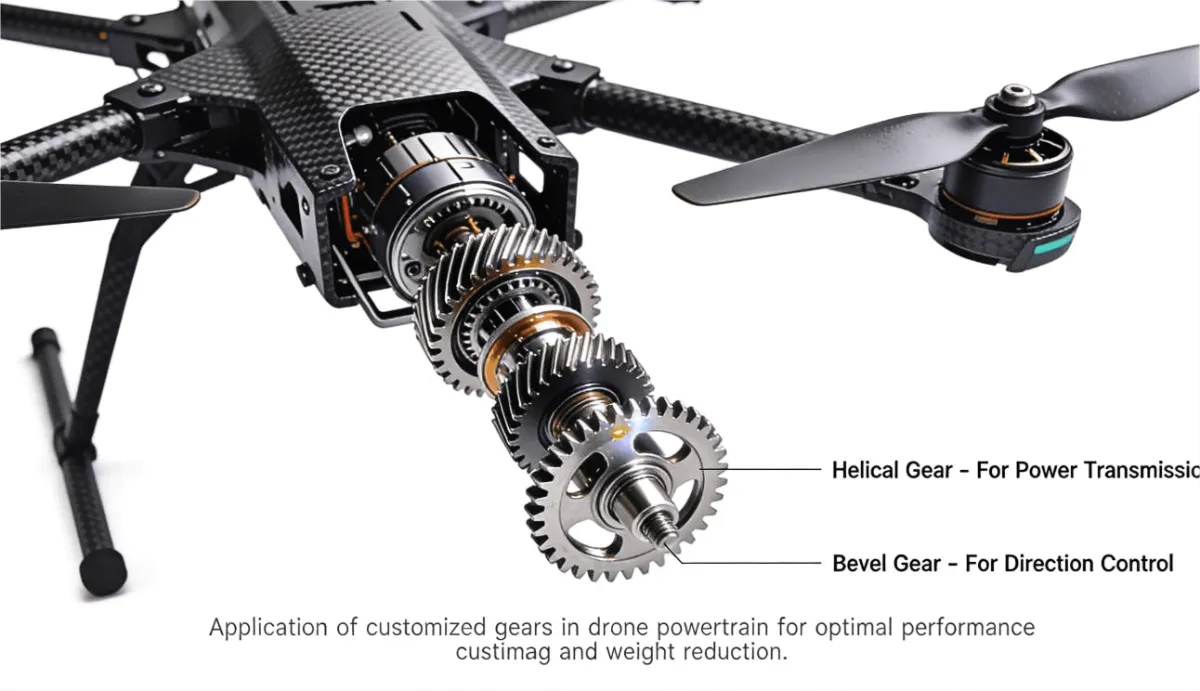
How are different sized and shaped gears applied in drone component manufacturing?
In Drone Component Manufacturing, space and weight are two golden constraints. To optimize performance, reliability, and endurance, different sized and shaped gears are used to achieve specific transmission functions. For example, helical gears are often used for main power transmission; their helical tooth design enables smoother, quieter meshing and can withstand higher loads. Bevel gears are used in gimbal or servo systems that require changing the direction of power transmission to achieve efficient inter-shaft power conversion.
Customized design is crucial here. By precisely calculating loads and spatial constraints, designers can specify non-standard modules, special pressure angles, or optimized tooth profiles to maximize space utilization and transmission efficiency. Data indicates that for every 10% reduction in the weight of the transmission system, endurance can be increased by 5%-8% with a fixed battery capacity. Conversely, if poor gear design or manufacturing leads to inefficiency or premature wear, it not only increases energy consumption but may also cause transmission jamming leading to failure. Therefore, partnering with an experienced industrial gearbox manufacturer is fundamental to ensuring drone reliability.
How can industrial gearboxes improve reliability in new energy technology manufacturing?
New Energy Technology Manufacturing, such as wind and solar power equipment, operates in extreme environments with very high maintenance costs. The industrial gearboxes in wind turbine nacelles must withstand massive, unstable wind load torques and year-round harsh environmental erosion. These place nearly requirement on the durability of gearboxes.
The main challenges come from fatigue caused by high loads and corrosion from the environment. The core to improving reliability lies in customized solutions. This includes selecting high-quality alloy steel materials and applying precise heat treatment processes like controlled atmosphere carburizing and quenching to simultaneously impart high surface hardness and good core toughness to the gears. A precision gear manufacturing company with authoritative certifications like AS9100D will implement strict full-process quality control to ensure each gear’s accuracy and performance meet design specifications.
From a cost-benefit analysis, although the upfront investment in customized R&D and high-quality manufacturing costs is higher, compared to the power generation losses, expensive hoisting maintenance costs, or even safety accidents caused by gearbox failures, the long-term return on investment is extremely high, making it the most economical choice to avoid significant losses. Explore professional gear machining capabilities: precision gear machining.
What are the key considerations for precision gear manufacturing in medical device prototyping?
Medical Device Prototyping imposes requirements on gears that go beyond industrial fields, as their reliability is directly linked to patient safety. Precision, biocompatibility, and traceability are core considerations.
Medical-Grade Precision and Biocompatibility
Gears in medical devices need to achieve micron-level or even tighter tolerances to ensure absolutely precise motion. Any components that might contact the human body must be made from biocompatible materials (complying with standards like ISO 10993) and withstand repeated high-temperature, high-pressure sterilization. This is fundamentally different from the standards faced by ordinary gear manufacturing companies.
Flexibility and Quality Management in the Prototyping Stage
Medical device development involves rapid iteration, requiring suppliers to respond quickly to design changes and support very low-volume pilot production. This demands that manufacturers not only have high-precision equipment but also strong engineering support and flexible rapid prototyping processes. Merely searching for “custom gears near me” makes it difficult to find partners with these capabilities.
Quality System Centered on Risk Management
- Adherence to ISO 13485:This is the entry threshold for quality management systems for medical devices, emphasizing risk management and traceability.
- Full-process Quality Data Recording:All data, from raw material certificates and processing records to final full-size inspection reports, must be completely documented and retrievable.
- Application Case:In surgical robots, the manufacturing process for the micro-gear sets driving the robotic arms adheres to such stringent standards, passing through multiple inspection checkpoints to minimize medical risks.
Conclusion
The precision, reliability, and level of customization of industrial gears have become core factors affecting the performance and cost of AI hardware, robotics, drones, new energy, and medical equipment. Faced with high potential failure losses, companies must inevitably shift towards customized precision gear solutions based on deep engineering collaboration. Selecting professional partners with authoritative certifications (like ISO systems) and full-process quality control capabilities is crucial. For example, LS Manufacturing, leveraging its ISO-certified manufacturing system, provides comprehensive and reliable services from design to precision machining for global high-tech clients.
For professional industrial gear manufacturing solutions tailored to your specific project, to obtain an instant quote, or to consult with an expert, please contact them immediately.
Author Biography
The author of this article is a senior expert in the field of precision manufacturing with over ten years of industry experience, specializing in innovative gear transmission solutions for frontier areas such as AI hardware, advanced robotics, and medical technology. This article is based on objective industry data, technical standards, and long-term engineering practice, aiming to provide valuable reference for industry peers.
FAQs
Q1: What are the common failures of industrial gears in high-tech manufacturing?
A1: Common failures include tooth surface wear, pitting, tooth breakage, and abnormal noise, which directly lead to loss of transmission accuracy and equipment downtime. Through precision manufacturing and material optimization, such failures can be reduced by over 50%, significantly extending gear service life.
Q2: How to quickly find a local custom gear supplier?
A2: Searching for “custom gears near me” may yield limited results and make it difficult to assess technical capabilities. It is recommended to prioritize evaluating whether suppliers have international certifications like ISO 9001, combined with their past project cases in the precision field for a comprehensive assessment to ensure quality.
Q3: What are the special requirements for industrial gearboxes in the new energy industry?
A3: They require extremely high corrosion resistance and fatigue strength to cope with the high loads and harsh environments faced by wind and solar power equipment in the field. Custom industrial gearboxes, utilizing special materials, deep heat treatment, and strict testing, can significantly extend their service life in harsh environments.
Q4: How do gear manufacturing companies guarantee quality for small-batch orders?
A4: Professional companies guarantee quality through a full-process quality control system (such as first-article inspection, in-process inspection, CMM final inspection), maintaining consistent standards regardless of order size. Their flexible production lines also ensure that small-batch orders receive the same level of quality attention as large orders while being delivered efficiently.
Q5: How important is gear accuracy in medical device prototyping?
A5: Accuracy is directly related to the safety and effectiveness of device operation. Medical-grade precision gears often need to achieve micron-level tolerances and pass strict biocompatibility testing to ensure zero failure during invasive or high-precision diagnosis and treatment, avoiding medical risks.


Leave a Reply