
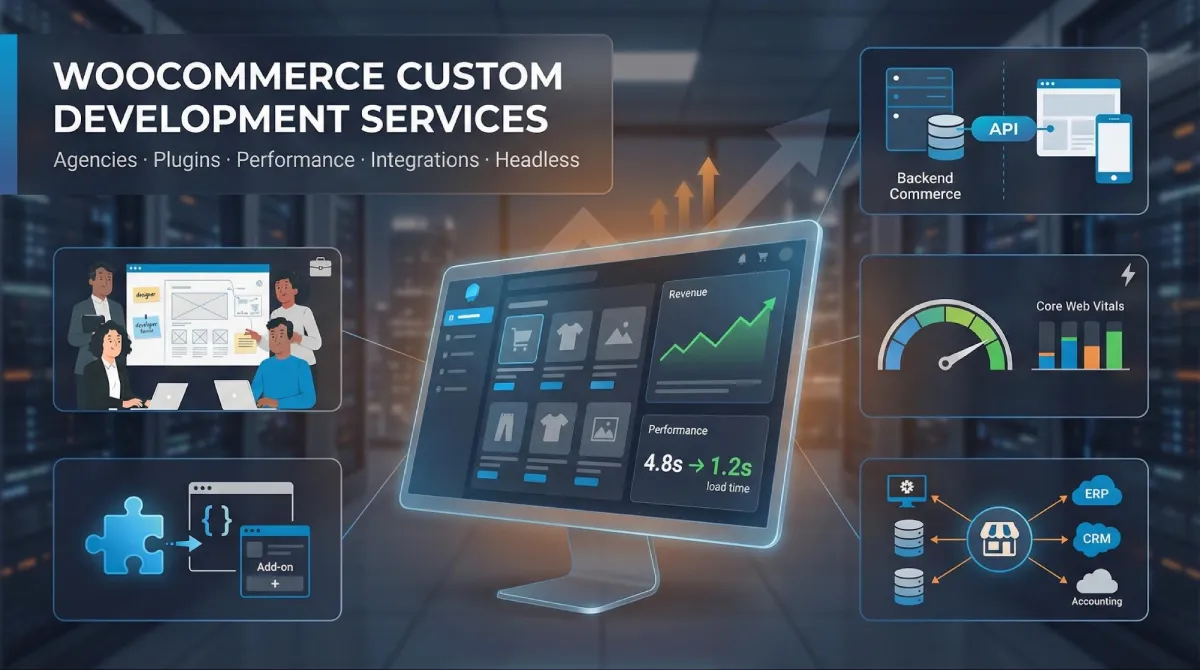
5 Woocommerce Custom Development Services For High-Growth Ecommerce Solutions
WooCommerce powers about one-third of all online stores, 34% as of June 2025, according to Red Stag Fulfillment. But growth brings friction: pages slow down, plugins collide, and data splinters across tools. This guide compares five custom WooCommerce development services, full-service agencies, plugin specialists, performance tuners, integration experts, and headless architects so you can choose the right partner before bottlenecks eat into revenue.
How To Choose The Right Woocommerce Development Solution
Scope. Do you need a partner to rebuild the entire store or fine-tune one feature? A wide scope usually points to a full-service agency or an experienced e-commerce app development company, while a narrow brief fits a specialist. A wide scope usually points to a full-service agency, while a narrow brief fits a specialist.
Urgency. If pages linger at six seconds today, bring in performance experts now. Strategic projects (such as a headless rebuild slated six months out) allow time for deep discovery and a phased rollout.
Budget. Global hourly rates run from $20–$50 for junior freelancers to $100–$150 for senior WooCommerce engineers (Flexiple, April 2025). Map potential ROI to those bands. Portent found that stores loading in one second convert nearly three times more visitors than sites at five seconds (InstantBundle, February 2025), so a speed sprint often pays for itself.
Complexity. Integrating a legacy ERP or building a React storefront calls for senior engineers comfortable with APIs and modern stacks. If that skill set is missing in-house, outsourcing avoids costly trial and error.
Maintenance. Custom code lives beyond launch. Decide whether your team will update it or keep a developer on retainer, especially when WooCommerce ships major core updates.
1. Full-Service Woocommerce Development Agencies
Imagine your store needs everything at once: fresh design, faster checkout, airtight integrations, and a two-year roadmap. Coordinating five freelancers will slow you down. A full-service WooCommerce agency unites designers, backend engineers, DevOps pros, and growth strategists in one team. They deliver discovery workshops, UX wireframes, custom themes and plugins, performance tuning, and post-launch support as a single package.
Because one team owns the whole stack, hand-offs disappear and every decision targets the same growth metrics. Seasoned agencies turn on High-Performance Order Storage (HPOS) on day one. WooCommerce benchmarks report that HPOS cuts median order-query time by up to 30% and trims the 95th-percentile by 43% while shortening checkout latency (WooCommerce developer blog, March 7, 2023). They also set up staging pipelines and automated tests so future updates ship safely.
Cost sits at the higher end. Clutch’s 2026 data shows U.S. WordPress commerce agencies charging $100–$149 per hour. Most full builds land between $10,000 and $50,000, and enterprise projects can exceed $150,000 (Clutch, 2026). The premium buys faster launches and fewer emergency fixes, often cheaper than patching issues after they start eating revenue.
One example is Never Settle, a full-service WooCommerce agency. According to their published WooCommerce case results, one enterprise client saw a 24% improvement in site speed, a 70% reduction in plugin count, and a 30% lift in ADA accessibility scores after a full rebuild. That kind of multi-layer gain shows up as faster pages, leaner stacks, and more accessible UX when a single team owns design, development, and optimization end to end.
Choose a full-service agency when growth is complex, timelines are tight, and you prefer a single accountable partner over a patchwork of vendors. It is the closest thing to adding an eCommerce department without adding headcount.
2. Custom Plugin And Extension Development Services
Off-the-shelf plugins cover most needs, but when your catalog, pricing, or tax logic drifts outside that comfort zone, generic tools turn into a brake pedal. In a 2024 audit of stores running more than fifty plugins, BlazeCommerce found that trimming redundant add-ons cut average load time from 8.6 seconds to 1.0 second (BlazeCommerce, May 2024). That performance gap alone justifies a lean, purpose-built extension.
Plugin specialists live inside WooCommerce hooks and filters. They map your business rules, write code that follows core standards, and leave you with functionality that feels native to WooCommerce, without the five overlapping plugins that used to slow every page.
Ask three questions before commissioning custom work:
- Is the feature unique to your business model?
- Will plugin overlap or query bloat hurt conversion at your order volume?
- Can the change deliver measurable revenue or operational savings within six months?
If you answer “yes” to two or more, a custom plugin usually pays for itself. Otherwise, stick with marketplace options and invest budget elsewhere. Engage a specialist for surgical precision, not a full remodel. They build the one feature that lifts your customer experience while letting the rest of your stack breathe.
3. Performance Optimization And Scaling Services
Slow pages drain revenue. In an August 2025 study, Queue-it reported that 40% of shoppers leave when a site lingers beyond three seconds (Queue-it, 2025).
Performance consultants close that gap by auditing every layer, following these best practices for speed and performance, theme code, database queries, and hosting, then tuning until clicks feel instant.
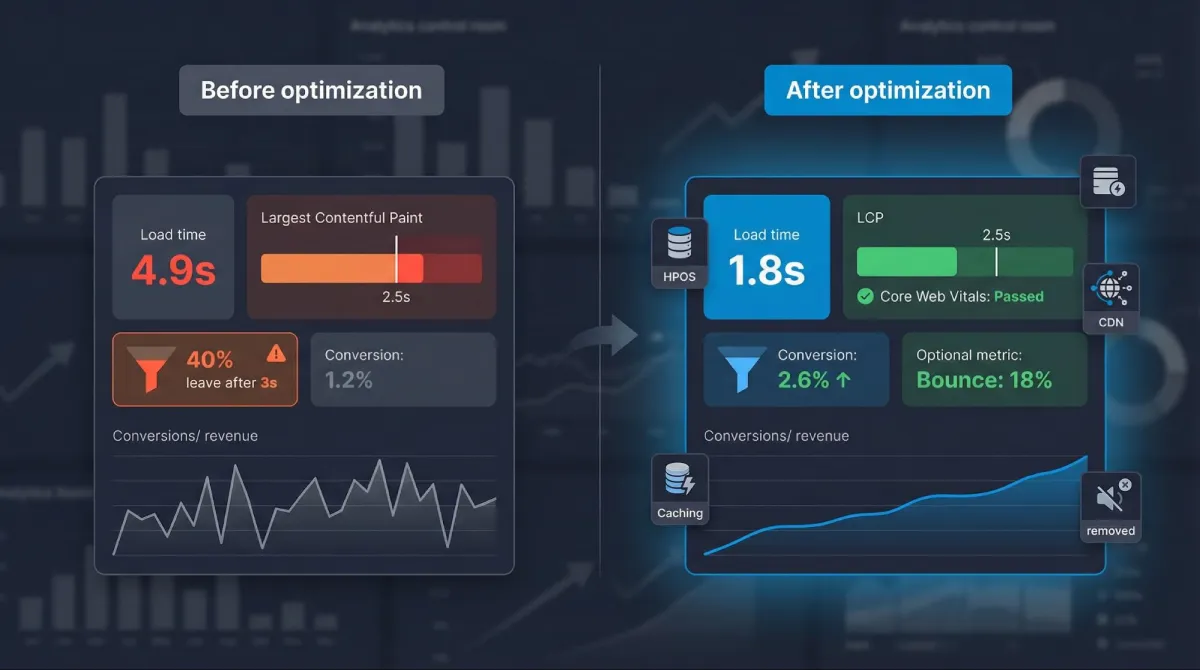
Performance optimization services turn slow WooCommerce stores into fast, conversion-focused experiences
A common first move is turning on High-Performance Order Storage (HPOS), which cuts median WooCommerce order-query time by about 30% and trims the 95th-percentile by 43% (WooCommerce developer blog, March 7 2023). Consultants also hunt for rogue plugins, add object caching, push assets to a CDN, and lazy-load media. In many client audits, these steps shrink Largest Contentful Paint to under Google’s 2.5-second target and can halve total load time when heavy imagery is involved.
Beyond speed, optimization lifts Core Web Vitals scores, boosts conversion rates, and lets you ride Black Friday traffic without an emergency server upgrade. Call these specialists when pages creep past two seconds, flash-sale checkouts stall, or admin screens choke under rising order volume; they will make existing code run at full potential so growth no longer trips over lag.
4. Woocommerce Integration And Migration Services
Growth slows when orders, inventory, and customer data sit in silos. Integration specialists link WooCommerce to the rest of your stack: mapping APIs, configuring webhooks, and building middleware so stock levels from your ERP post to the storefront within minutes and new orders flow straight into accounting or CRM screens.
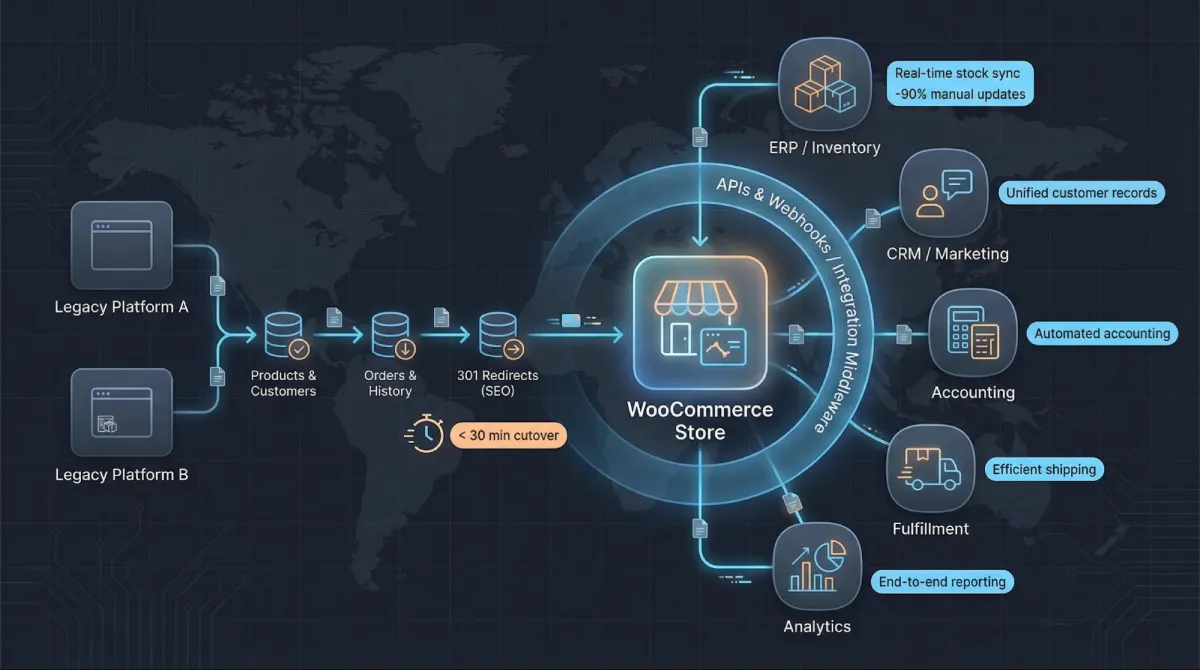
Integration and migration specialists connect WooCommerce to ERP, CRM, accounting, and more while moving data cleanly from legacy platforms
Migrations demand the same precision. Moving 10 000 products from Shopify or Magento is not drag-and-drop. Engineers script data transfers, preserve order history, and set up 301 redirects to protect SEO. In a December 2024 case study, Inpsyde finished an enterprise cutover with under 30 minutes of downtime (Inpsyde, 2024). They schedule changes during low-traffic windows and run test drills so customers never notice the switch.
The payoff is tangible. Retailers that sync WooCommerce with their ERP cut manual stock updates by as much as 90% (Brightpearl Automation Survey, 2025). Real-time inventory prevents oversells, automated accounting frees staff hours, and unified customer records sharpen marketing. A clean migration also lays a stable base for future optimization.
Call these pros when spreadsheets delay fulfillment, reporting gaps hide revenue leaks, or your current platform cannot keep pace. They will connect every system so your team can focus on growth instead of data wrangling.
5. Headless Woocommerce And Advanced Front-End Development
When page builders hit their ceiling, a headless setup keeps WooCommerce in the back room while a modern JavaScript front end (Next.js, Nuxt, or Remix) delivers an app-like storefront through the Store API.
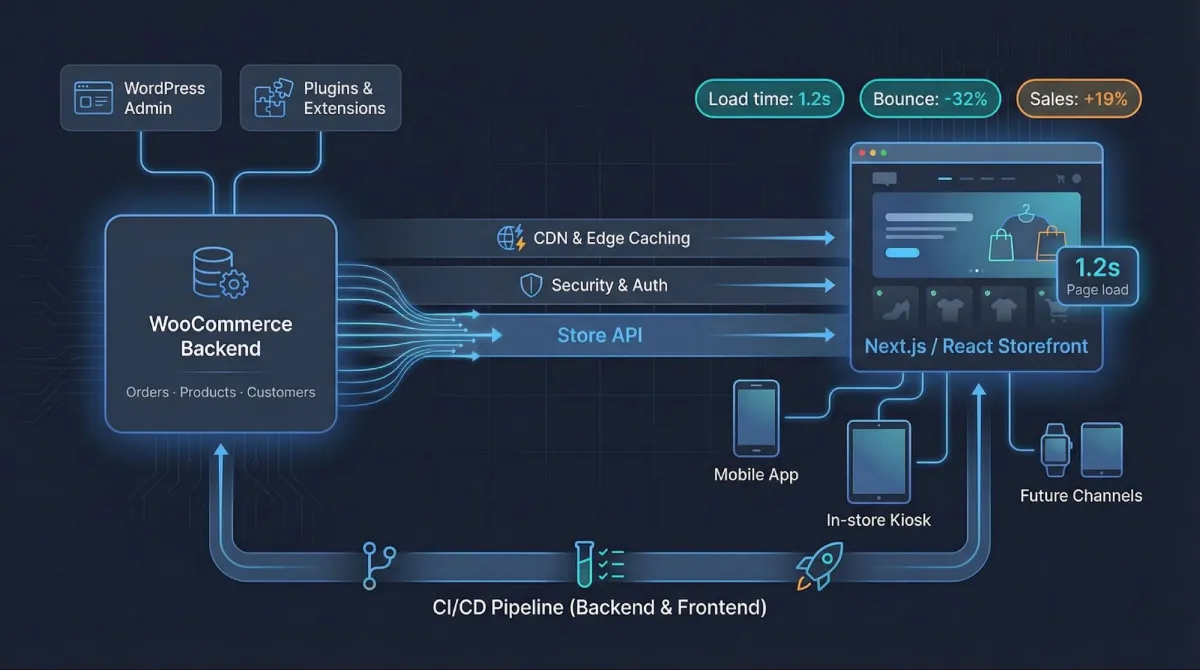
Headless WooCommerce keeps the backend in WordPress while modern JavaScript front ends deliver sub-second storefront experiences
Why consider it? In a June 2025 case study of a 20 000-product bookstore, moving to Next.js cut product-page load time from 4–5 seconds to 1.2 seconds, dropped bounce rate by 32 percent, and lifted sales 19% (ScaleFront, 2025). Faster pages are only the start. Decoupling removes WordPress theme limits, letting designers build rich experiences and reuse the same product data across kiosks, mobile apps, and future channels.
Complexity rises, too. You maintain two codebases, rebuild plugin interfaces for the new front end, and rethink caching and security. Agencies that focus on headless WooCommerce scaffold the React or Vue app, expose any missing endpoints, and set up CI/CD so both layers deploy in lockstep.
Choose this path when sub-second performance and differentiated UX are strategic, and your team (or an agency partner) can handle deeper engineering. Done right, headless turns WooCommerce into a lean commerce engine that scales cleanly to every screen your customers use next.
Comparing Your Options At A Glance
| Service type | Core deliverable | Best for | Indicative cost range* | Primary benefit | Key trade-off |
| Full-service agency | End-to-end design, build, optimization, and support | Brands needing a complete rebuild or ongoing evolution | $50k–$150k+ project budgets; $100–$150/hr (Clutch, 2026) | One accountable partner handles everything | Highest price tag |
| Plugin or extension specialist | A single custom feature or integration | Stores with a unique requirement no marketplace plugin solves | $1k–$15k per plugin; $25–$100/hr | Lean code solves the problem without bloat | Feature-only scope; maintenance still needed |
| Performance and scaling | Speed audits, database tuning, caching, load-test hardening | Sites where slow pages hurt conversion | $3k–$10k audits; $75–$150/hr | Faster pages lift revenue and SEO | Adds no new customer-facing features |
| Integration and migration | API connections or platform moves with data integrity | Growth brands syncing ERP/CRM or moving to WooCommerce | $5k–$50k depending on data volume | Real-time data, fewer manual tasks | Up-front complexity and extensive testing |
| Headless and advanced front-end | React or Vue storefront decoupled from WooCommerce back end | Experience-driven retailers chasing sub-second loads and design freedom | $20k–$150k+; $100–$180/hr | Sub-second speed and full UX control | Two codebases mean higher upkeep |
*Cost ranges come from 2026 Clutch and GoodFirms agency rate cards and recent United States WooCommerce project quotes.
Conclusion
Use this grid as a quick gut check: match your biggest pain point, speed, feature gap, integration trouble, or the need for a full rebuild, to the row that solves it, then discuss numbers and timelines with shortlisted partners.


Leave a Reply