

How to Choose an SEO-Friendly WordPress Theme in 2026
Choosing an SEO-friendly WordPress theme used to be simple. Most beginners focus on visual design, loading speed, and mobile responsiveness. If the demo looked professional and performed well, it felt like a safe choice.
But today, your WordPress theme does more than determine how your website looks. It influences how search engines interpret your content, how AI systems understand your expertise, and whether your brand becomes visible inside AI-generated answers.
If you are building a website in 2026, selecting the right WordPress theme for SEO is no longer just a technical step. It is a strategic foundation.
What Is an SEO-Friendly WordPress Theme?
An SEO-friendly WordPress theme is built with clean code, logical structure, fast performance, and mobile-first design in mind. It supports proper heading hierarchy, lightweight scripts, and compatibility with structured data and SEO tools.
In simple terms, it makes it easier for search engines to crawl, index, and rank your content.
Many beginners assume SEO is mostly about keywords and plugins. However, your theme controls the structural framework of your site, including HTML markup, navigation clarity, heading order (H1, H2, H3), and layout hierarchy. If that foundation is messy, even well-written content can struggle to perform.
Think of your theme as the architecture of a building. Design enhances appearance, but structure determines long-term stability.
Why Your WordPress Theme Affects SEO More Than You Think
Search engines evaluate more than just content. They measure performance, mobile usability, page experience, and structural clarity.
For example, Google’s Core Web Vitals focus on loading performance, interactivity, and visual stability as ranking signals.
A bloated theme, riddled with unnecessary scripts, can slow down your website and negatively affect both rankings and user experience. Poor heading structure can confuse crawlers. Limited support for structured data can reduce your chances of appearing in rich results.
Standards like Schema.org structured data help search engines and AI systems better understand the context of your pages.
When comparing options, it helps to review examples of high-performing WordPress themes for 2026 to see how modern themes balance structure, flexibility, and speed in real-world use cases. A well-built theme reduces technical friction and allows your SEO strategy to scale more effectively.
But technical optimization is only one layer of visibility today.
SEO in the Age of AI: Rankings Are No Longer the Only Goal
Search engines are increasingly evolving into answer engines. Instead of presenting only a list of links, AI systems now analyze multiple sources and generate summarized responses directly within search results or conversational interfaces.
This shift changes what visibility means.
Your website is no longer competing solely for ranking positions. It is competing to be referenced, summarized, and trusted within AI-generated answers.
AI systems attempt to understand who you are, what you specialize in, and whether your information is credible enough to cite. If your website lacks clarity, consistency, or signals of credibility, it becomes harder for machines to interpret your brand with confidence.
And this is where a deeper strategic layer becomes important.
The Missing Layer Between SEO and AI Answers
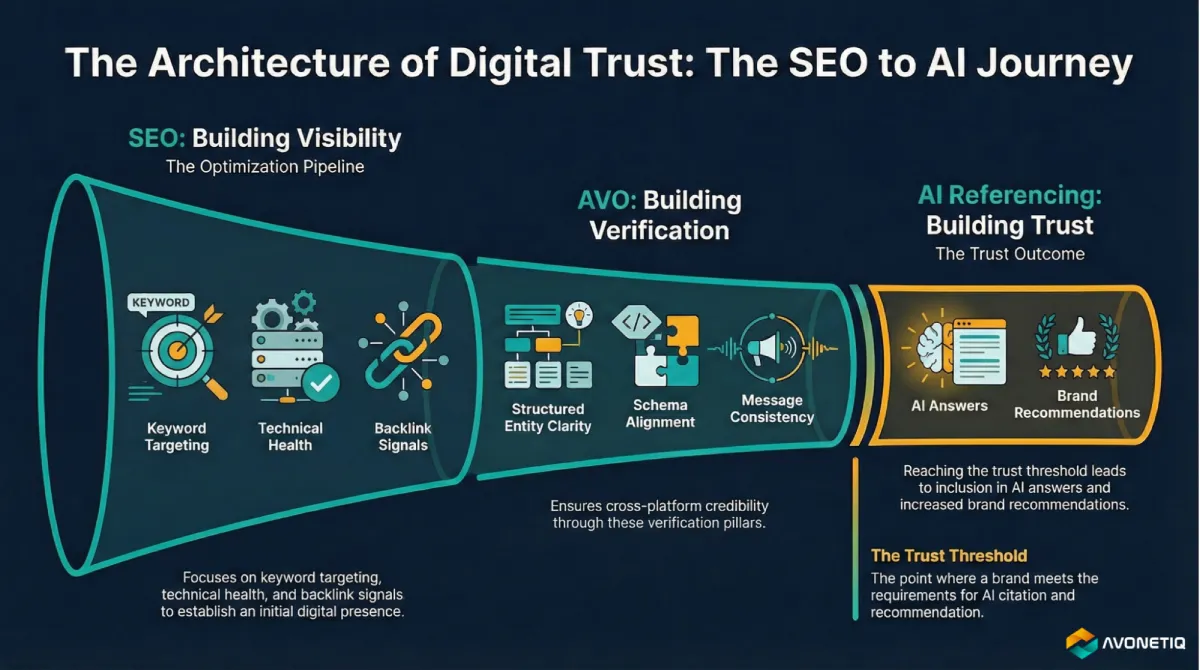
SEO helps you make a claim about your expertise. You optimize your pages, target keywords, and signal relevance. But between making that claim and being referenced by AI systems lies a verification stage known as AI Visibility Optimization (AVO), a strategic framework introduced by Avonetiq.
As reported by SWA, AI Visibility Optimization (AVO) is a strategic approach to increase the likelihood that a brand appears in AI-generated answers.
Unlike traditional SEO, which focuses on search engine algorithms, AVO emphasizes an AI-readable content structure, brand credibility across multiple sources, consistent messaging across digital platforms, and contextual relevance to user queries.
In practical terms, SEO says, “This is who we are.” AVO ensures that every digital signal is consistently verified in a way that AI systems can verify and trust.
Alexandro Wibowo, Co-Founder of Avonetiq, explains:
“AVO helps brands build an integrated digital footprint that can be read and trusted by AI systems. It is not merely technical optimization, but a transformation in how brands build their digital presence.”
As AI systems become more sophisticated in filtering and summarizing information, brands without strong positioning risk becoming invisible, even if their websites are technically optimized for SEO.

As Alexandro further emphasizes:
“In the AI era, the winners are not only those who appear the most, but those who are trusted by the system. Brands must ensure they are not just discoverable, but recommendable.”
Your WordPress theme plays a subtle but critical role in this process. It determines how clearly your expertise is structured, how consistently your entity signals appear, and how easily AI systems can interpret your authority.
7 Things to Check Before Choosing an SEO-Friendly WordPress Theme
If you want to choose a WordPress theme that supports both SEO and long-term AI visibility, look for these essentials:
- Clean, Lightweight Code. Avoid themes that rely too heavily on unnecessary animations or scripts. Lightweight code improves speed and crawl efficiency.
- Fast Loading Speed. Performance directly affects rankings and conversions. Test demo versions using reliable performance tools before making a decision.
- Logical Heading Structure. Your theme should support a clear H1 and structured subheadings. This helps both users and search engines understand content hierarchy.
- Mobile Responsiveness. With mobile-first indexing, your website must perform seamlessly across all devices.
- Structured Data Compatibility. Your theme should allow easy integration of schema markup and other structured signals.
- Clear Author and Company Pages. Authority matters more in the AI era. Themes that make it easy to build strong author profiles and transparent company pages help reinforce credibility.
- Flexible Internal Linking and Scalable Architecture. Long-term visibility often depends on how web design and development decisions influence scalability, performance, and structured growth. Choose a theme that allows you to organize content logically as your website expands.
Choosing a Theme for Long-Term Visibility
Design trends evolve quickly. What looks modern today may feel outdated in a few years. Structure, however, compounds over time.
A well-built theme supports scalability, clarity, and performance from the beginning. It enables you to publish consistently, organize your expertise logically, and strengthen your authority as your content library grows.
In the AI era, visibility is no longer just about ranking. It is about being understood and trusted.
An SEO-friendly WordPress theme provides the structural foundation that allows your expertise to be recognized by both humans and machines.
Design attracts attention. Speed keeps visitors engaged. But structure builds credibility.
And credibility is what sustains visibility in the long run.

Writer: Anangga Gunawan
About the Writer: Anangga Gunawan is the Head of Authority at Avonetiq, where he focuses on how brands build credibility and trust in an AI-driven internet. His work explores digital authority, AI-mediated decision systems, and why visibility alone is no longer enough to earn trust.


Leave a Reply