
Higgsfield vs Loova in 2026: Which AI Video Platform Actually Saves You Time?
If you’re searching for the best Higgsfield alternative in 2026, chances are you’re not casually browsing. You’re measuring productivity.
The AI video space has matured. Visual quality is no longer the only differentiator. Most leading tools can generate impressive cinematic clips.
The real question today is different:
Which platform actually saves you time in real-world content production?
After using both Higgsfield and Loova extensively, the difference became clear. This isn’t just about visuals. It’s about workflow efficiency.
And in 2026, workflow is everything.
The Hidden Cost of AI Video Tool Stacking
At first glance, Higgsfield is powerful. It produces cinematic AI video with strong visual depth and dramatic framing.
But video generation is only the first 30% of content creation.
After generating a scene, creators typically need to:
- Adjust minor details
- Replace characters
- Modify camera framing
- Remove unwanted objects
- Generate thumbnails
- Upscale resolution
- Create social variations
If your tool only handles generation, you’re forced to export files and move to another platform.
That process introduces:
- Context switchin
- File management friction
- Additional subscription costs
- Time delays
Individually, these delays feel small. Collectively, they slow your entire production cycle.
That’s where the difference between Higgsfield and Loova becomes structural.
Generation vs Complete Workflow
Higgsfield excels at cinematic generation. If your only goal is producing dramatic AI visuals, it performs well. But Loova approaches the problem differently.
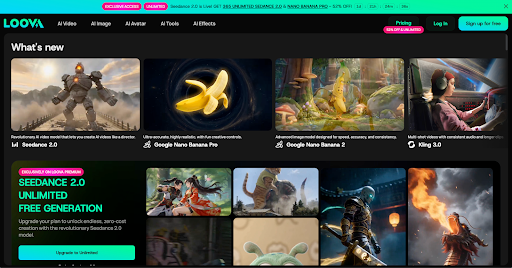
Instead of focusing only on video output, Loova integrates:
- Text-to-video
- Image-to-video
- AI image generation
- Character swap
- Mimic motio
- Scene editing
- Object removal
- Background replacement
- HD upscaling
- Thumbnail creation
All within the same workspace.
The difference is not the feature quantity. It is workflow continuity.
Inside Loova, generation and refinement happen in one environment. There is no export-import cycle between tools.
That alone changes daily production speed.
Time Comparison: A Practical Scenario
Let’s break this down into a realistic creator workflow.
Scenario: Creating a 60-Second YouTube Short Campaign
Using Higgsfield:
- Generate main clip
- Export video
- Import into editing software
- Fix minor character inconsistencies
- Remove an unwanted object
- Generate thumbnail in separate image tool
- Upscale final version
- Create variation with different character
- Repeat process
Estimated time with switching: 2–3 hours
Using Loova:
- Generate main clip
- Replace character using character swap
- Adjust camera framing
- Remove object directly
- Generate thumbnail inside same workspace
- Upscale resolution
- Export final variations
Estimated time: under 1 hour
The gap widens as content volume increases.
Character Swap: Eliminating Full Regenerations
One of the biggest time drains in AI video creation is regeneration.
If one detail is wrong, many creators restart the entire render.
Loova’s character swap feature removes that bottleneck.
Instead of rebuilding a scene, you replace the subject while preserving:
- Lighting
- Motion
- Camera angle
- Environmental consistency
That single capability dramatically reduces wasted renders.
For marketers running A/B tests, this means creating multiple versions without starting from scratch.
Higgsfield does not provide the same level of post-generation flexibility.
Mimic Motion: Controlled Realism Without Rebuilding
Motion realism impacts engagement.
Loova’s mimic motion feature allows creators to transfer movement patterns from reference footage to new characters.
This avoids:
- Unnatural body mechanics
- Floating movement
- Repetitive motion artifacts
Instead of experimenting with new prompts repeatedly, you guide motion intentionally.
That precision reduces trial-and-error cycles.
In high-volume production, fewer trial cycles equal faster turnaround.
Editing Without Leaving the Platform
Most creators underestimate how much time they spend correcting minor issues.
Small changes like:
- Removing background clutter
- Replacing scene elements
- Adjusting style tone
Often trigger full regenerations in single-function tools.
Loova’s integrated AI video editor allows these corrections directly.
That shift moves AI video from “generate and hope” to “generate and refine.”
When refinement replaces regeneration, productivity increases.
Image and Asset Creation in One Pipeline
Content creation extends beyond video.
You need:
- Thumbnails
- Social banners
- Promotional posters
- Product mockups
- Cover images
Higgsfield focuses primarily on video.
Loova handles the entire visual pipeline.
Inside the same system, creators can:
- Remove backgrounds
- Expand images to new aspect ratios
- Enhance resolution
- Generate stylized variations
- Create e-commerce product visuals
That integration eliminates tool stacking.
Tool stacking is one of the biggest productivity killers in 2026.
Why All-in-One Platforms Are Gaining Ground
The AI ecosystem has exploded with specialized tools.
But specialization creates fragmentation.
Every additional subscription introduces:
- Learning curves
- UI inconsistency
- Asset management issues
- Increased monthly costs
Creators increasingly prefer fewer tools with broader capabilities.
Loova functions less like a single AI video generator and more like a creative operating system.
Higgsfield remains strong in the cinematic AI generation.
But when evaluated through a time-efficiency lens, integration often beats specialization.
Who Should Switch?
Switching makes the most sense for creators who:
- Publish weekly or daily
- Run ad variations
- Manage multiple formats
- Produce both video and image assets
- Care about minimizing friction
If you generate one cinematic clip per month, Higgsfield may be sufficient.
If you operate a high-output content system, efficiency compounds.
That’s where Loova provides structural advantages.
You can explore its integrated workflow at loova.ai and evaluate whether consolidation improves your process.
Final Verdict: Which Platform Saves More Time?
Higgsfield delivers a strong cinematic generation.
Loova delivers workflow compression.
In 2026, speed is not only about render time. It is about eliminating unnecessary steps.
When generation, editing, enhancement, and asset creation exist inside one environment, creative momentum increases.
The difference is not dramatic in a single project.
It becomes dramatic over 50 projects.
For creators serious about efficiency, fewer tools and fewer regeneration cycles translate directly into more output.
And in today’s content economy, output velocity often determines growth.


Leave a Reply