
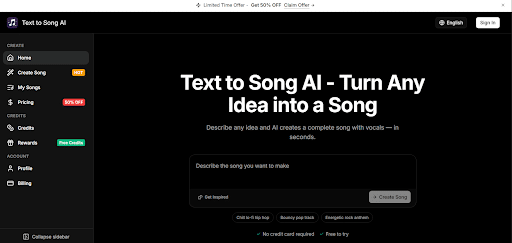
Understanding Text to Song AI and How It Works
In recent years, artificial intelligence has made remarkable progress in creative fields, including music production. One of the most exciting developments is the rise of tools that can transform written text into complete songs. This technology, often referred to as Text to Song AI, is changing how individuals and businesses approach music creation. Whether you’re a content creator, marketer, or simply someone curious about AI, understanding how this technology works can open up new creative possibilities.
What Is Text to Song AI?
At its core, Text to Song AI is a type of artificial intelligence that converts written words into music. Users can input lyrics, ideas, or even short prompts, and the AI generates a song complete with melody, rhythm, and sometimes even vocals.
This technology relies on advanced machine learning models trained on vast datasets of music, lyrics, and sound patterns. By analyzing these patterns, the AI learns how songs are structured and how different elements, like melody and harmony—work together.
Unlike traditional music production, which requires instruments, software, and technical expertise, text-to-song tools simplify the process. You don’t need to be a musician to create something that sounds professional.
How Does Text to Song AI Work?
Understanding how this technology operates can help you appreciate its capabilities and limitations. The process generally involves several key steps:
1. Input Processing
The journey begins when a user enters text into the system. This could be:
- A full set of lyrics
- A short phrase or idea
- A theme or mood (e.g., “happy pop song”)
The AI analyzes this input using natural language processing (NLP). It identifies keywords, emotional tone, and structure to understand what kind of song to create.
2. Lyrics Enhancement (Optional)
Some systems go beyond simply using your text—they refine it. The AI may:
- Adjust rhyme schemes
- Improve flow and rhythm
- Expand short ideas into full verses
This step ensures that the lyrics fit naturally into a musical format.
3. Melody Generation
Once the lyrics are ready, the AI generates a melody. This involves:
- Matching the emotional tone of the text
- Choosing a musical scale and key
- Creating a rhythm that complements the words
The AI uses patterns learned from existing music to compose melodies that sound familiar yet unique.
4. Music Composition
Next comes the instrumental arrangement. The AI selects:
- Instruments (e.g., piano, guitar, drums)
- Tempo and style (pop, rock, hip-hop, etc.)
- Chord progressions
This is where the song begins to feel complete, as all musical elements come together.
5. Voice Synthesis (If Included)
Some advanced tools also generate vocals. Using voice synthesis technology, the AI can:
- Sing the lyrics
- Adjust pitch and tone
- Mimic different singing styles
While AI-generated vocals are improving rapidly, they may still sound slightly artificial in some cases.
AI Song Generator Overview
An AI Song Generator makes music creation incredibly simple by transforming your ideas into fully produced tracks within moments. Instead of relying on traditional instruments or complex software, you can just describe your concept, whether it’s a mood, theme, or a few lines of lyrics and the AI takes care of the rest. It analyzes your input, selects a suitable genre, builds melodies, and arranges instruments to create a cohesive and original song. This means anyone, regardless of musical background, can experiment with different styles and bring creative visions to life quickly and efficiently.
Key Technologies Behind Text to Song AI
Several advanced technologies power these tools:
Machine Learning Models
AI systems are trained on large datasets of songs and audio files. These models learn patterns in:
- Melody structures
- Rhythm and timing
- Lyric composition
Natural Language Processing (NLP)
NLP allows the AI to understand human language. It helps the system interpret:
- Meaning
- Emotion
- Context
This ensures that the generated music aligns with the intent behind the text.
Generative AI
Generative AI is responsible for creating new content. Instead of copying existing songs, it produces original compositions based on learned patterns.
Benefits of Using Text to Song AI
The growing popularity of these tools is no surprise. They offer several advantages:
Accessibility
You don’t need musical training to create songs. Anyone can experiment and produce music within minutes.
Speed
Traditional music production can take hours or even days. AI tools can generate a song in a fraction of that time.
Creativity Boost
These tools can spark new ideas. Even experienced musicians use them to overcome creative blocks.
Cost-Effective
Hiring composers, singers, and producers can be expensive. AI reduces or eliminates these costs.
Common Use Cases
Text-to-song technology is being used across various industries:
Content Creation
YouTubers, podcasters, and social media creators use AI-generated songs for intros, background music, and more.
Marketing and Advertising
Brands create catchy jingles and promotional songs quickly and efficiently.
Education
Teachers and students use music to make learning more engaging and memorable.
Personal Projects
From birthday songs to creative storytelling, individuals use AI for fun and personal expression.
Limitations to Consider
While impressive, this technology isn’t perfect:
- Emotional depth: AI may not fully capture human emotion
- Originality concerns: Some outputs may feel repetitive
- Voice realism: Synthesized vocals can still sound artificial
- Customization limits: Advanced control may be limited in some tools
Understanding these limitations helps set realistic expectations.
The Role of AI Song Generator Tools
Modern platforms often combine multiple features into one solution, commonly referred to as an AI Song Generator. These tools streamline the entire process, allowing users to go from text input to finished song in just a few clicks.
They typically offer:
- Style selection (genre, mood, tempo)
- Customizable lyrics
- Instrumental and vocal options
- Downloadable audio files
As these tools continue to evolve, they are becoming more sophisticated and user-friendly, making music creation more accessible than ever.
The Future of Text to Song AI
The future of this technology looks promising. As AI models improve, we can expect:
- More realistic vocals
- Better emotional expression
- Greater customization options
- Seamless integration with other creative tools
In the coming years, text-to-song AI could become a standard tool in music production, content creation, and even everyday communication.
Final Thoughts
Text-to-song AI represents a major shift in how music is created and consumed. By combining natural language processing, machine learning, and generative AI, these tools make it possible for anyone to turn ideas into music.
Whether you’re exploring Text to Song AI for professional use or just for fun, it offers a powerful and accessible way to bring your creativity to life. As technology continues to advance, the line between human and AI-generated music will become increasingly blurred, opening up exciting opportunities for innovation in the world of sound.


Leave a Reply