
Choosing the Best Keyword Research API for Generative and Answer Engine Environments
Modern search visibility requires a departure from traditional ranking metrics. Large companies in SaaS, e-commerce, and IT outsourcing find that maintaining a number one spot on Google no longer guarantees traffic. Users frequently find answers directly within AI interfaces like ChatGPT, Perplexity, or Google AI Overviews without clicking any external links. This transformation creates a visibility gap where traditional analytics show steady rankings but declining sessions. Experts in GEO, AEO, and SERM must now prioritize citation frequency and brand sentiment within Large Language Model responses.
Selecting an API keyword tool is the first step for any technical team building an automated monitoring system. This API keyword tool must provide more than simple volume data; it needs to identify the conversational prompts that drive AI citations. The following analysis evaluates the leading providers based on their ability to support large-scale operations in 2026. Every piece of data used in this evaluation originates from verified technical documentation and industry reports.
1. SE Ranking: Balancing Cost and High-Volume Requirements
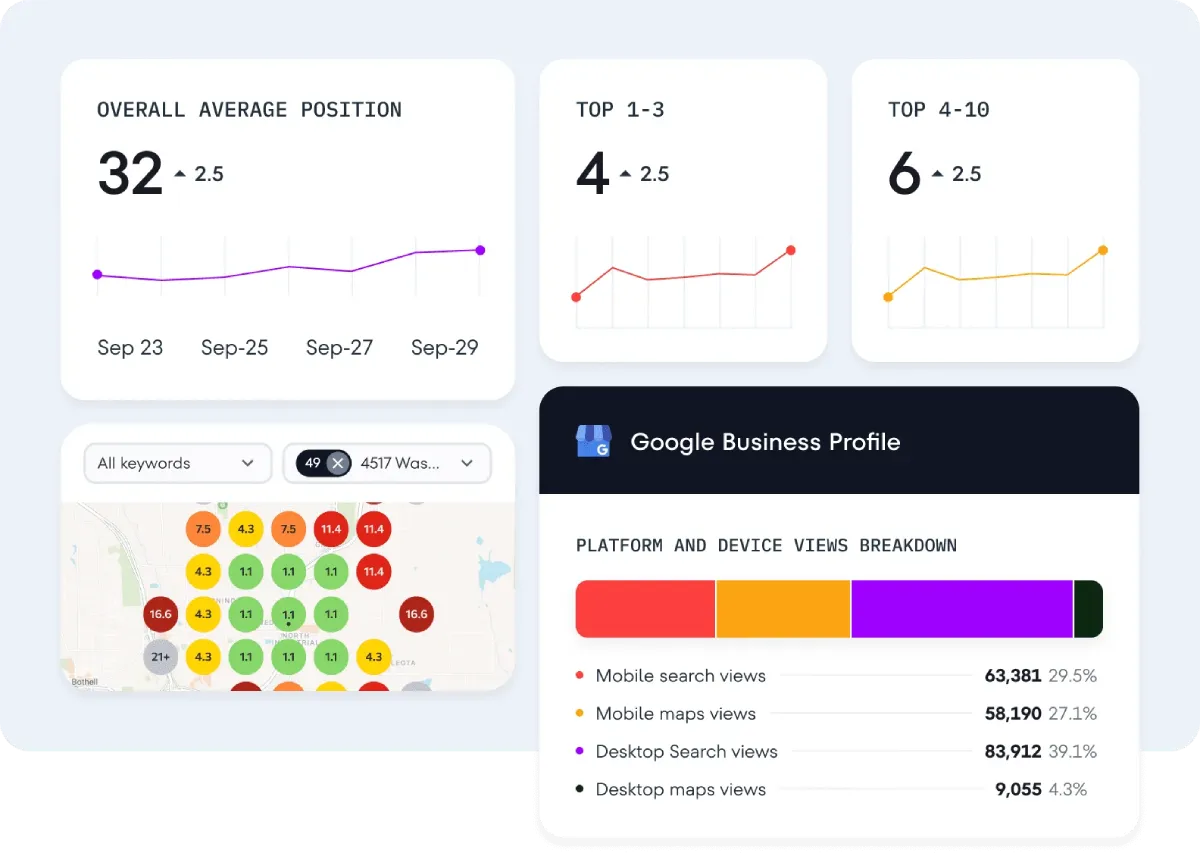
SE Ranking is a favorite for digital marketing agencies that need a balance of price and throughput. Its Keyword Research API allows for up to 5,000 terms to be processed in a single POST request. This is ideal for bulk analysis and automated reporting. The platform has also launched SE Visible, a specialized GEO analysis tool.
The SE Ranking SEO keywords API provides metrics for volume, CPC, and difficulty across 188 countries. Developers use this SEO keywords API to populate their local search volume dashboards. The SEO keywords API returns month-by-month historical trends to help track seasonality. Integrating the SEO keywords API with an AI prompt can generate optimized headings and content structures. Many firms find that the SEO keywords API by SE Ranking helps them spot untapped market opportunities early.
SE Ranking API Credits and Pricing
| Plan / Product | Pricing | Main Limits / Credits | Key Features |
| Pay-as-you-go Tier | $50 minimum deposit | 250,000 credits | Flexible usage-based access |
| Core Plan | $129/month or $103.20/month billed annually | 10 projects, 1 seat, 2,000 keywords/day, 100 prompts/day, 5 GEO domains, 250k audit pages/month, 25k API credits | Rank tracking, unlimited keyword & backlink research, site audit, MCP access, integrations with GA, GSC, Looker Studio, and Matomo |
| Growth Plan | $279/month or $223.20/month billed annually | 30 projects, 3 seats, 5,000 keywords/day, 250 prompts/day, 15 GEO domains, 2M audit pages/month, 100k API credits | All Core features plus historical data, collaboration tools, page monitoring, and dedicated support |
| Agency Pack | +$69/month (annual billing) | 30 projects, 30 client seats | White-label platform & reports, unlimited scheduled reports with AI summaries, agency catalog placement, lead generator |
| AI Search Add-on | $89/month or $71.20/month annually | 200 prompts | Tracking across AI platforms including ChatGPT, Perplexity, and AI Overviews, unlimited competitor research, SE Visible dashboard, automated reporting |
| API Add-on | $149/month (annual billing) | 12M credits | Access to backlinks, domain analysis, keyword research, AI search, and website audit APIs for automation |
| SMM Platform | From $33/month | Not specified | Social media scheduling, collaboration workflows, content planning, analytics, and asset management |
| SEO Data API | From $179/month | Scalable API volume | Access to backlinks, domains, AI search queries, MCP integration, automation with Looker Studio, n8n, and Make |
| 24M Credits Plan | Effective $318/month (billed $3,816/year upfront) | 24M credits/year | Designed for large-scale API usage and automation workflows |
SE Visible monitors brand perception and visibility scores across Google AI Mode, Google Ai Overviews, ChatGPT, Perplexity, and Gemini. It identifies the specific themes that drive AI mentions of a brand.
2. DataForSEO: The Infrastructure Standard for Industrial SEO
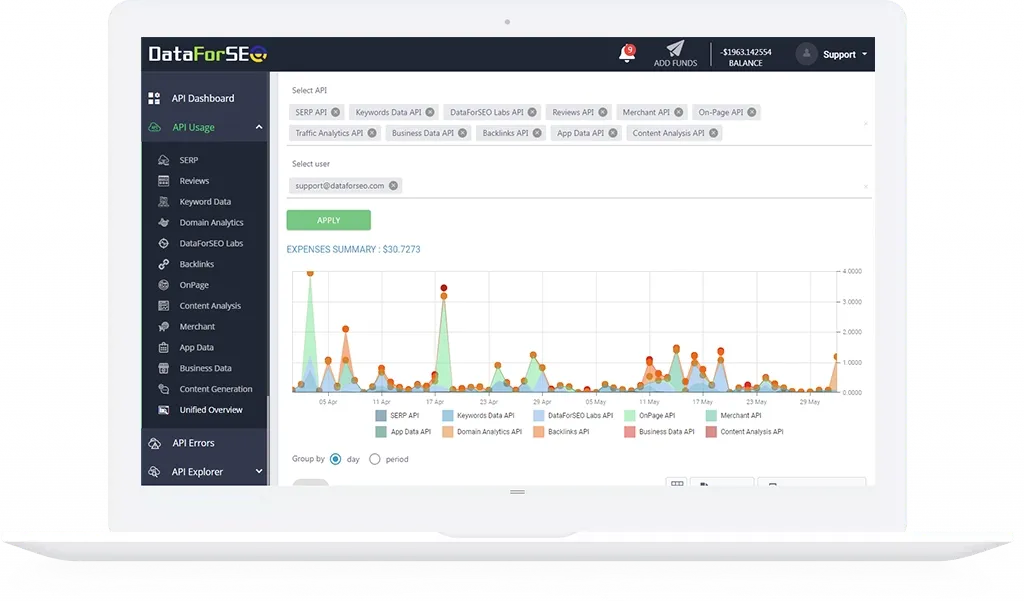
The mandatory migration to version three on May 5, 2026, introduced a more robust RESTful architecture. The DataForSEO system allows developers to balance latency against operational costs using a three-tiered speed architecture. For e-commerce giants managing millions of SKUs, the keyword suggestion tool API from DataForSEO offers the required throughput. This keyword suggestion tool API retrieves metrics across Google, Bing, Amazon, and YouTube.
The new version three pricing is tied to the US dollar, offering transparency for global agencies. Analysts often use the keyword suggestion tool API to feed content gap workflows. This keyword suggestion tool API supports bulk queries that return search intent, difficulty, and exact monthly volume. Using the keyword suggestion tool API helps technical teams avoid the bracketed ranges found in free tools.
DataForSEO API Endpoint and Versioning Overview
| Feature | API Version 2 (Legacy) | API Version 3 (Current) |
| Support Status | Officially Closed May 5, 2026 | Active |
| Protocol | HTTP / REST | REST / JSON |
| Pricing Model | Tiered Units | Pay-as-you-go (USD) |
| AI Features | None | Reasoning support for LLMs |
| Multi-Engine | Google, Bing | Google, Bing, Amazon, Shopping |
The Labs API within this ecosystem provides high-speed access to advertising data. Developers frequently call the API keyword research endpoint to populate their RAG (Retrieval-Augmented Generation) pipelines. This API keyword research process ensures that AI agents have grounded, real-time context. The API keyword research data is refreshed on a monthly basis to capture seasonal shifts. Many SaaS firms depend on this API keyword research layer for their competitive benchmarking dashboards. Without a stable API keyword research feed, automated content generation risks using outdated metrics.
3. Profound AI: Enterprise Narrative Control and Sentiment Analysis
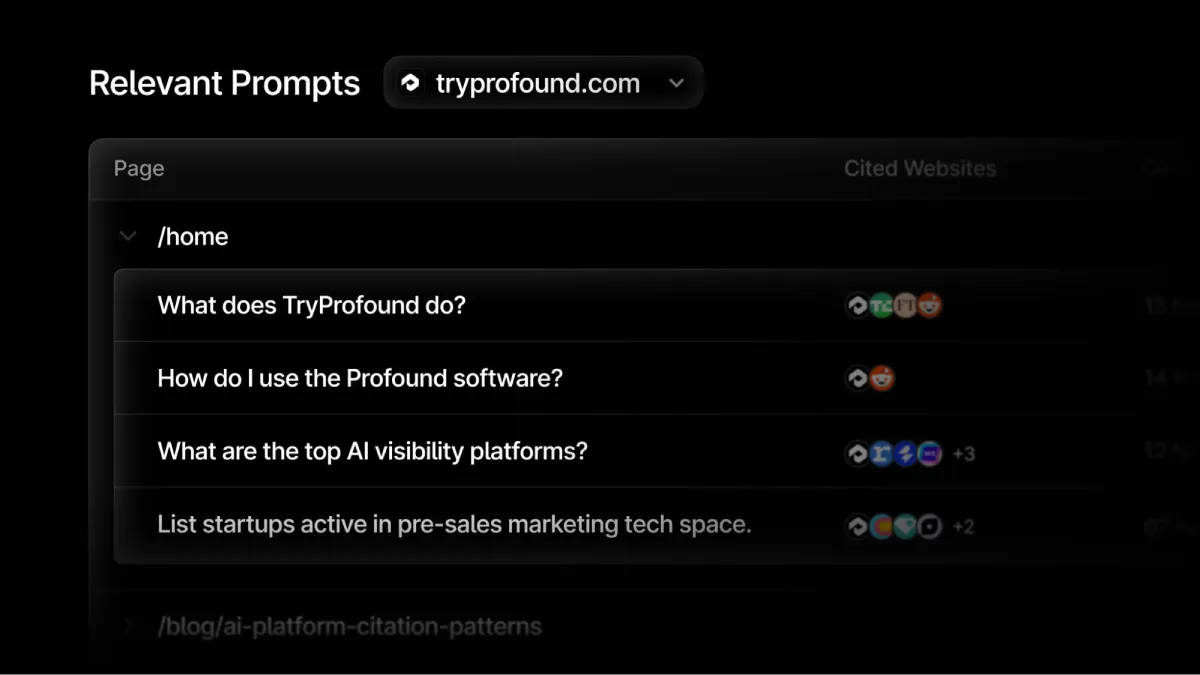
For brands concerned with narrative control, Profound AI offers a specialized intelligence lens. It monitors brand mentions and citations across ChatGPT, Gemini, Claude, and Perplexity. The platform captures every instance where a brand is referenced and maps it back to the exact source that triggered the response. This is vital for SERM experts who must manage reputation risks within AI-generated answers.
The Profound REST API facilitates programmatic interaction with their prompt system. Engineering teams use the keyword analysis API to identify which third-party domains influence their brand’s perception. This keyword analysis API returns processed data in JSON format for easy reporting. Use of the keyword analysis API allows for the comparison of performance metrics across different time periods. The keyword analysis API is essential for tracking citation drift, which remains a significant challenge for brand stability. Their data suggests that 40-60% of cited domains change every month across major platforms. Continuous monitoring via the keyword analysis API is the only way to catch these shifts before they impact revenue.
AI Platform Citation Stability Rates
| Platform | Domain Citation Drift (Monthly) |
| Google AI Overviews | 59.3% |
| ChatGPT | 54.1% |
| Microsoft Copilot | 53.4% |
| Perplexity | 40.5% |
The Profound dashboard provides answer snapshots that turn anecdotal observations into verifiable evidence. Its Agent Analytics module traces the behavior of AI crawlers as they index content. This helps teams diagnose why certain pages are not being cited. Profound is SOC 2 Type II compliant, making it suitable for large tech enterprises and financial institutions.
4. AthenaHQ: Deep Engineering Insights and ROI Tracking
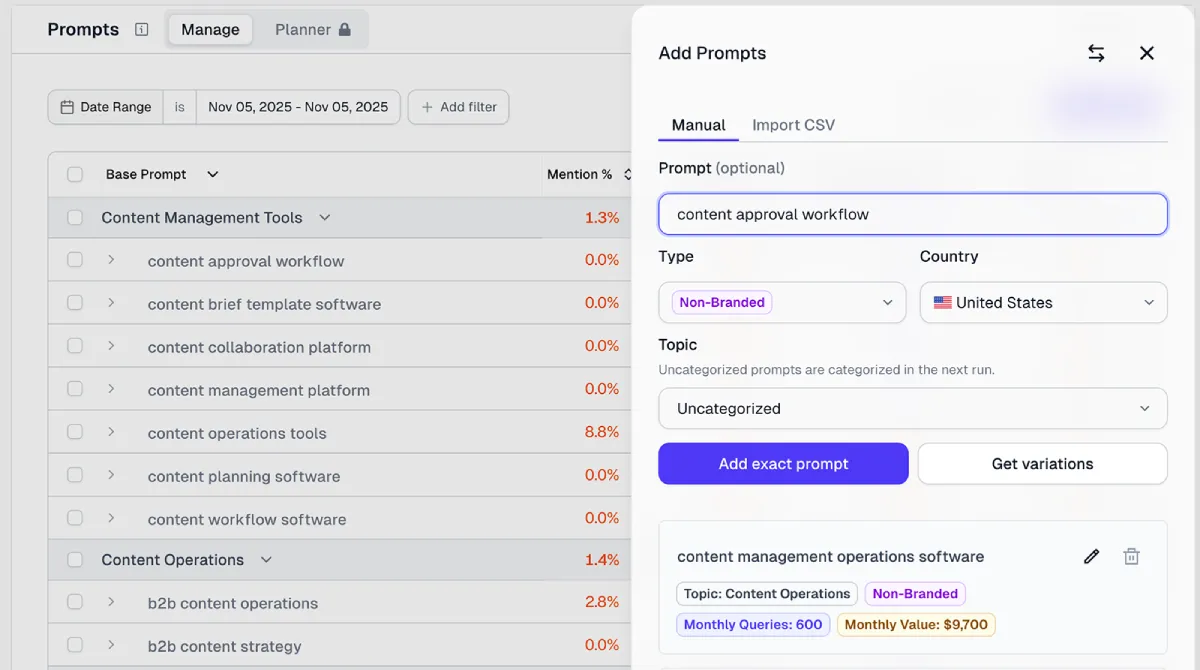
AthenaHQ was founded by technical leaders from Google Search and DeepMind. It focuses on providing a 360-degree view of brand discovery across AI platforms. The platform is particularly strong for SaaS firms that need to prove the ROI of their AEO efforts. AthenaHQ uses a credit-based query system, which provides flexibility for different project sizes.
The platform features a Prompt Volume tool that estimates numerical interest in specific conversational strings. Marketing experts employ the keyword suggestion API to find blindspots where competitors appear, but their brand is missing. This keyword suggestion API identifies queries that high-intent buyers actually ask LLMs. Use of the keyword suggestion API helps in the creation of AI-optimized content articles. The keyword suggestion API also supports dynamic crawling to find lost parts of a website. Strategic teams rely on the keyword suggestion API to maintain visibility as traditional search traffic declines.
AthenaHQ Plan Comparison
| Feature | Growth / Self-Serve | Enterprise |
| Monthly Price | $295 ($95 Annual) | Custom |
| AI Credits | 3,600 per month | Custom |
| LLM Coverage | 8 Major Models | 8+ with hourly data |
| Content Agent | Basic Optimization | Self-Improving Workflows |
| Support | Documentation / FAQ | Dedicated Specialist (2h SLA) |
AthenaHQ provides a centralized action center with AI-generated recommendations. Its impersonation detection feature protects brands from safety risks in AI search results. The tool integrates with GA4 and Google Search Console to correlate AI citations with actual traffic.
5. Scrunch: AI Agent Visibility and Edge Content Delivery

Scrunch focuses on the technical mechanics of how AI bots retrieve information from a site. It separates bot traffic into retrieval, indexing, and training categories. This allows a technical expert to see which bots are responding to real-time user prompts versus those just scrAPIng data for model training. The platform integrates at the CDN level to detect these agents at the edge.
When an AI agent is detected, Scrunch serves a “token-light” version of the content. This structured version removes JavaScript and heavy markup that can confuse AI crawlers. To manage this at scale, firms use the keyword tools API to prioritize which pages need the most optimization. This keyword tools API identifies content gaps where brand coverage is missing in AI answers. The keyword tools API also helps in statistical modeling to trim tracked prompt sets and reduce costs. Effective use of the keyword tools API involves mapping third-party websites that currently win the citation share. The keyword tools API is often used by agencies to generate visibility audits for potential clients.
Scrunch Performance Metrics: Token Optimization
| Metric | Standard Human Experience | AI Agent Experience (AXP) |
| Token Load | 33,204 | 363 |
| Content Format | Heavy HTML / JavaScript | Structured / Information-Rich |
| Crawler Success | Variable | High |
Scrunch monitors brand presence across ChatGPT, Perplexity, Gemini, and Claude. It allows teams to see the exact sentiment shifts in AI responses over time. The platform supports multi-brand management and SSO for enterprise readiness.
6. Promptwatch: Large-Scale Citation Intelligence
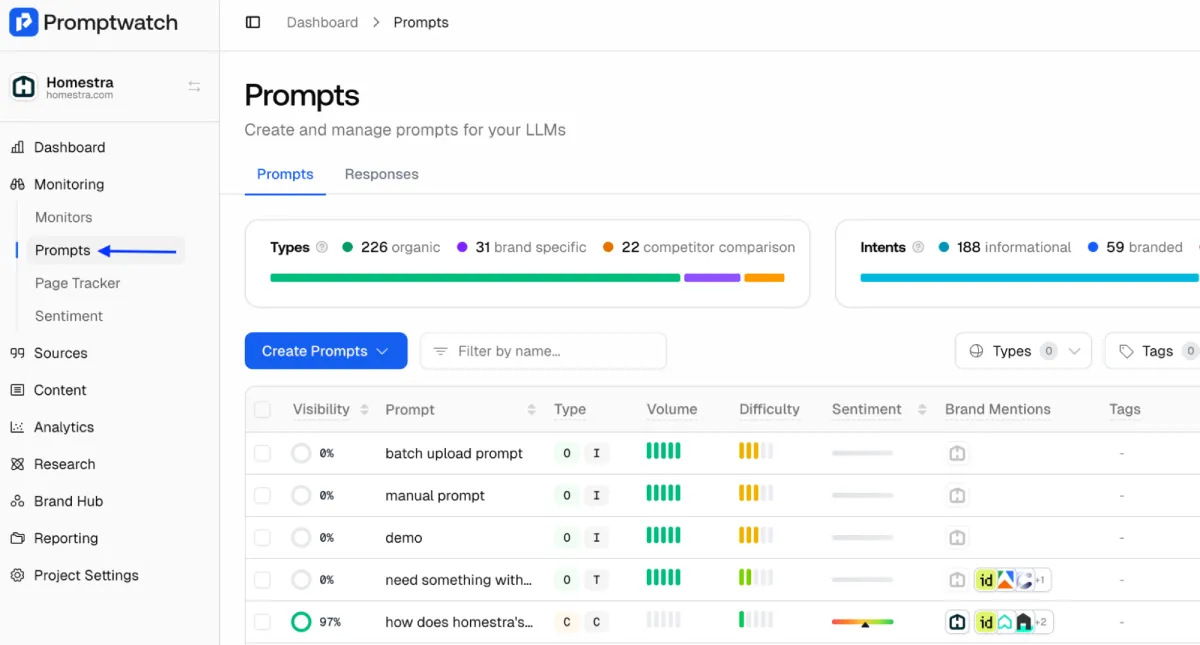
Promptwatch provides a massive database of over 1.11 billion citations. It tracks mentions across 10 different platforms, including Mistral and Meta AI. For e-commerce brands with diverse product lines, Promptwatch offers the granularity needed to monitor local or regional visibility. The Professional plan at $249 per month includes state and city-level tracking.
The Promptwatch API allows for custom integrations and data exports. Experts use the SEO keyword research API to build custom reporting workflows. This SEO keyword research API provides a visibility score from 0-100 for every tracked prompt. Using the SEO keyword research API helps identify which specific AI models are citation-heavy for a given niche. The SEO keyword research API is essential for agencies managing more than five websites simultaneously. Data from the SEO keyword research API is refreshed daily, ensuring that the team works with the most recent snapshots.
Promptwatch Pricing Tiers
| Plan | Price (Monthly) | Prompts Tracked | AI Articles Generated |
| Essential | $99 | 50 | 5 |
| Professional | $249 | 150 | 15 |
| Business | $579 | 350 | 30 |
Promptwatch includes a Looker Studio connector for automated data visualization. It also offers Answer Gap reports that show exactly where competitors appear and you do not. The platform tracks ChatGPT Shopping data, which is critical for e-commerce visibility.
AI-Native Search APIs for RAG and Agents
For developers building autonomous agents, traditional SERP APIs are often too limited. Firecrawl, Exa, and Tavily are designed specifically for LLM workflows. These tools deliver information formatted for model consumption, reducing hallucinations and improving answer freshness.
Tavily is the preferred choice for RAG pipelines that require citations. Its results are optimized for retrieval and include source-first formatting. Exa uses neural networks for semantic retrieval, finding relevant content even without exact keyword matches. Firecrawl is best for full-page extraction and bypassing advanced bot blocks.
Comparison of AI-Native Search APIs
| API | Key Feature | Output Format | Integration |
| Tavily | RAG Optimization | JSON + Citations | LangChain Tool |
| Exa | Neural Semantic Search | JSON + Structured | REST API |
| Firecrawl | Single-call Extract | Markdown / HTML | REST API |
| Brave LLM | Grounding Data | Independent Index | REST API |
Serper is another strong option for prototyping, offering 2,500 free queries and native LangChain support. However, it lacks the semantic ranking features found in Exa or Tavily. Large projects usually transition to Tavily or SerpAPI as they scale.
Legacy Suite Adaptation: Semrush and Ahrefs
The major SEO suites have not remained static. Semrush now offers a specialized Projects API that allows for the management of site audit and position tracking campaigns. This is used extensively by e-commerce brands to monitor their catalog visibility across multiple regions.
Analysts use the keyword tool API from Semrush to pull raw data into their BI tools. This keyword tool API requires a Business subscription and available API units. The keyword tool API returns data in CSV format, which is easy to parse for automated reports. Strategic teams employ the keyword tool API to analyze keyword gaps among competitors at scale. Use of the keyword tool API also allows for the tracking of AI search traffic data from assistant platforms.
Semrush API Data Points
| Column Code | Meaning | Metric Type |
| Nq | Search Volume | Popularity |
| Cp | CPC | Commercial Value |
| Kd | Keyword Difficulty | Competition |
| It1 | Informational Traffic | User Intent |
| It3 | Transactional Traffic | User Intent |
Ahrefs has introduced Brand Radar to monitor brand mentions in Google AI Overviews. While its prompt database is large, it is derived from search queries rather than actual AI conversations. This makes it less precise than tools like Profound for conversational tracking.
Implementation Strategies for Technical Teams
The biggest bottleneck in AEO is often the reporting grind. Experts suggest automating data retrieval through custom scripts rather than manual exports. One popular method involves using the API keyword research endpoint with Google Apps Script to build live dashboards in Sheets. This API keyword research automation reduces the manual workload and allows for nightly data refreshes.
When configuring an API keyword research pipeline, respect the rate limits to avoid usage restrictions. Most enterprise tiers support 10 requests per second, but exceeding this will trigger error responses. The API keyword research data should be segmented by intent pillars, focusing on the questions customers actually ask. This API keyword research approach ensures that the content strategy aligns with the “fan-out queries” that AI models use to synthesize answers.
The Strategic Necessity of Multi-API Architectures
Relying on a single source of data is risky in an environment where AI models evolve weekly. Senior experts often use a tiered API architecture. They might use DataForSEO for bulk volume metrics, Profound for narrative tracking, and Tavily for their RAG pipelines. This diversification ensures that they have both high-volume infrastructure and specialized conversational intelligence.
For agencies, the keyword research tools API is used to manage multiple clients efficiently. This keyword research tool API allows them to provide white-label reports that show AI visibility gains. Using a keyword research tool API also helps in identifying emerging trends before they hit the mainstream. A reliable keyword research tool API is the backbone of any agency that wants to offer GEO as a service. Finally, the keyword research tools API should be integrated with PR and link-building efforts to ensure consistent authority signals.
The future of search belongs to those who control the data flowing into LLMs. For SaaS and e-commerce leaders, these APIs are not just tools — they are the sensors and actuators of a new discovery vertical. The investment in automated intelligence today defines the visibility of tomorrow.
Conclusion
| If your goal is… | Best API Solution | Primary Metric |
| Building a RAG application | Tavily | Citation Quality |
| Enterprise Brand Safety | Profound AI | Narrative Sentiment |
| Bulk SEO Infrastructure | DataForSEO | Cost per Query |
| AI Agent Optimization | Scrunch | Token Reduction |
| High-Scale Agency Reports | SE Ranking | Throughput |
| Semantic Research | Exa | Conceptual Relevance |
Successfully managing GEO and SERM at scale requires a commitment to data precision. The tools analyzed here provide the raw intelligence needed to stay visible in an era of zero-click searches. As the search arena becomes more automated, the difference between success and invisibility will depend on the fidelity of your API stack. Use the data, build the systems, and protect the brand narrative across all generative surfaces.
The search vertical is transforming, but the fundamentals of authority and clarity remain. Experts who employ the API keyword tool to its full potential will continue to find growth where others see only decline. By mapping every keyword to a specific AI intent, brands can ensure they remain the primary source for the answers users seek. This proactive approach to AEO is no longer optional — it is the prerequisite for digital survival.
Maintaining a robust API keyword tool pipeline allows for the early detection of competitor moves in AI results. When a rival starts gaining citation share, the API keyword tool data reveals the content they are using to win. This intelligence lets the team pivot their strategy in days rather than months. Every call to the API keyword tool is a pulse check on the brand’s health in the generative age.
Ultimately, the goal is to become the “un-ignorable” source for AI agents. This is achieved by combining the right API keyword tool with structural content excellence. For those managing complex IT and e-commerce portfolios, the automation of this process is the only way to scale success. The generative era is here; the only question is how well your data layer can navigate it.


Leave a Reply