
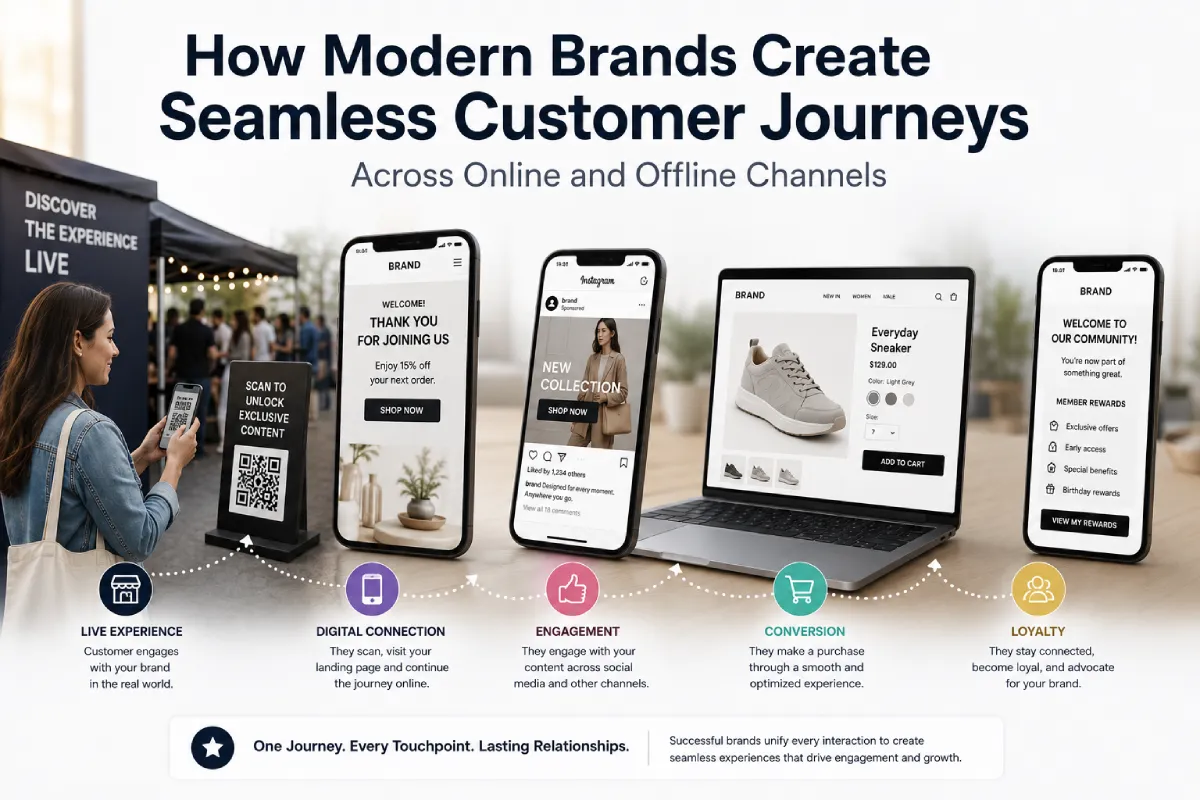
How Modern Brands Create Seamless Customer Journeys Across Online and Offline Channels
A customer tries a free sample at a street event. She scans a QR code on the packaging, lands on a product page, signs up for a newsletter, sees a retargeted ad on Instagram two days later, and completes her purchase on a mobile-optimized checkout. That entire sequence happened across at least five distinct touchpoints. The brand only controlled the outcome if all of them worked together.
This is the reality of modern marketing. The customer journey is no longer a neat funnel. It’s a series of channel shifts, device switches, and context changes that happen unpredictably across channels. Brands that treat each touchpoint in isolation consistently leave conversion on the table. Brands that design the journey as a connected experience convert more, retain more, and build the kind of loyalty that compounds over time.
What Is a Customer Journey?
A customer journey is the complete sequence of experiences a person has with a brand, from the first moment of awareness through purchase and beyond. It moves through five core stages:
- Awareness: The first moment someone encounters the brand, often passively.
- Consideration: The customer begins actively evaluating the brand against alternatives.
- Decision: Intent becomes action, the customer is ready to move forward.
- Purchase: The transaction takes place.
- Retention: Repeat purchases, referrals, brand advocacy, and long-term loyalty.
The mistake many businesses make is optimizing each stage independently. They build a great event presence but send attendees to a slow, mobile-unfriendly landing page. They run compelling social ads but direct clicks to a generic homepage with no clear next step. At every one of those gaps, a customer who was ready to move forward stops instead.
Why Customer Journeys Are No Longer Linear
Consumers do not move through a funnel in sequence. They jump between channels based on context, convenience, and impulse. A person might discover a brand at a live event on Saturday, research it on their laptop Monday morning, and complete the purchase on their phone during a commute on Wednesday.
Consider how a modern experiential activation flows into digital: a brand sets up a pop-up experience at a food festival. Here’s how the journey unfolds:
- Attendees interact with the product and scan a QR code.
- They land on a mobile page with an exclusive offer.
- Some share the experience on social media immediately.
- Others save the page and return later on a desktop browser.
- A smaller segment converts through a follow-up email a week later.
The physical moment created the awareness and emotional connection. The digital infrastructure, landing page, email sequence, social presence, determined whether that connection led anywhere. Neither half works without the other.
Connecting Online and Offline Experiences
Several mechanisms bridge physical brand interactions with digital conversion:
- Purpose-built landing pages: Not the homepage, a page designed for the specific audience coming from a particular activation, with messaging that matches what they experienced and a clear path to the next step.
- QR codes: Placed on product packaging, pop-up signage, food truck wraps, and event materials to give physical-world audiences an instant path to a digital experience.
- Mobile responsiveness: Most people who scan a QR code at a live event are on a smartphone. If the landing page takes more than three seconds to load or requires horizontal scrolling, conversion rate suffers immediately.
- Social retargeting: When attendees post about a brand experience, reach extends organically. Retargeting ads to people who visited the post-activation landing page but didn’t convert offer a second chance to close the sale.
The website is often where the journey either closes or collapses, making its design and performance inseparable from the success of every channel feeding into it.
Brands Doing It Right
Nike has built one of the most studied examples of omnichannel journey design. Their SNKRS app turns shoe releases into timed, location-based digital events. In-store experiences are built around connected technology, customers scan items, check sizes, and complete purchases through the app. Physical and digital reinforce each other rather than operating independently.
Sephora’s Beauty Insider loyalty program creates continuity across in-store visits and digital interactions. Purchase history from both channels informs personalized recommendations. Skin tone data gathered through in-store digital tools populates the online shopping experience. Customers move between the app, the website, and the physical store without losing context.
Starbucks built one of the most successful mobile-first customer journeys in retail through its rewards app. Order customization, pre-order and pickup, loyalty tracking, and targeted promotions all live inside a single interface. The app hasn’t replaced the store experience, it’s made the store experience better for the customers who use it most frequently.
Promobile Marketing executed a powerful physical-to-digital journey for Hellmann’s through food truck campaigns that traveled from Arizona to New Jersey, pairing product sampling with social media hashtags to create a cross-channel moment that generated awareness and content simultaneously. The food truck was the physical touchpoint; the digital amplification turned it into a national campaign.
Emotional resonance is another lever top brands use. Nostalgia marketing campaigns are particularly effective because they create an immediate emotional connection at the point of physical contact, then carry that emotional association into the digital experience. A consumer who associates a product with a positive memory is more likely to share content, engage with ads, and convert than someone who encountered the same product through a standard display ad.
Why Consistency Matters More Than Any Single Touchpoint
A brand that delivers an exceptional live experience and then sends people to a poorly designed website has broken the customer’s expectation. Consistency means more than matching visual identity across channels. It means consistent messaging, tone, offer structure, and quality of experience.
Website design is where consistency most visibly breaks down. A brand can invest heavily in an event presence and then lose the resulting audience to common friction points in the digital experience.
A checkout flow that requires too many steps, an account creation that cannot be skipped, a mobile layout that was designed for desktop and never updated, or page load times that exceed three seconds on mobile will all cost conversions regardless of how well the physical activation performed.
The website is often where the journey either closes or collapses.
Measuring Success Across Channels
Cross-channel customer journeys are harder to measure than single-channel campaigns, but the core metrics are clear:
- Website traffic from campaign sources: UTM parameters show how effectively physical activations drive digital traffic.
- QR scan rates: Direct data on how many people in a physical environment chose to engage digitally.
- Landing page conversion rates: How well the digital experience capitalizes on the physical one.
- Email open and click-through rates: Whether the brand maintained engagement after the initial interaction.
- Repeat purchase rate and LTV: Whether the connected journey produced loyal customers or one-time buyers.
The Journey Doesn’t End After the Purchase
Acquisition is expensive. Retention is where the economics of brand building actually work. A customer who has made a purchase and had a positive experience is the most likely source of a referral, a repeat order, and a social media post that extends the brand’s reach at no additional cost.
The post-purchase journey includes:
- The confirmation email and delivery communication.
- The unboxing experience.
- Follow-up content and product education.
- Loyalty program rewards and recognition.
- Invitations to engage with the brand community.
Brands that design for the full arc of the customer journey build the kind of compounding value that makes marketing more efficient over time. New customers cost less to acquire when existing customers are doing some of the acquisition work through advocacy and word of mouth.
Future Trends in Connected Customer Journeys
Three trends are reshaping how brands approach connected customer journeys.
AI-driven personalization is making it possible to tailor the digital portion of a journey based on real-time behavioral signals. A customer who scanned a QR code and spent 45 seconds on a page before leaving can receive a different retargeting ad than someone who added a product to their cart and then closed the browser, making every follow-up more relevant to where the customer actually is in their decision process.
Mobile-first design has shifted from best practice to baseline expectation. The majority of web traffic comes from mobile devices, and the percentage is higher for audiences reached through physical activations, where most people have a smartphone in hand. Pages that are not designed for mobile performance will fail to convert the audiences that events generate.
Omnichannel marketing is becoming the standard framework for brand strategy rather than a competitive differentiator. Brands that are not yet building connected experiences are not in a neutral position. They are actively losing the customers whose journeys cross channels before they reach a conversion point.
Conclusion
The boundaries between physical and digital marketing have dissolved. Modern customers move between an event activation, a website, a social feed, an email inbox, and a mobile app without thinking about channels at all. They judge the brand by whether the experience is consistent, intuitive, and worth their continued engagement at every step.
Every customer journey eventually becomes a digital journey. A live event plants the seed, but the website, the landing page, the email, and the app determine whether it grows. Brands that invest in making those digital experiences match the quality of their physical ones will retain the customers their events create, and turn a single moment of engagement into a long-term relationship.


Leave a Reply