
Top 10 AI Software Development Companies
Choosing an AI software development company has become one of the highest-leverage decisions a business can make. The hard part is no longer training a model, it is shipping AI that survives contact with production: real data, real compliance requirements, and real users. That is where an experienced AI software development company earns its fee, turning a promising proof of concept into software that scales.
This guide ranks ten firms that consistently deliver production-grade AI, from full-lifecycle product engineering partners to specialized machine learning shops. For each, you will find what they do, who they fit best, and where their strengths lie. A short selection framework at the end helps you match the list to your own project.
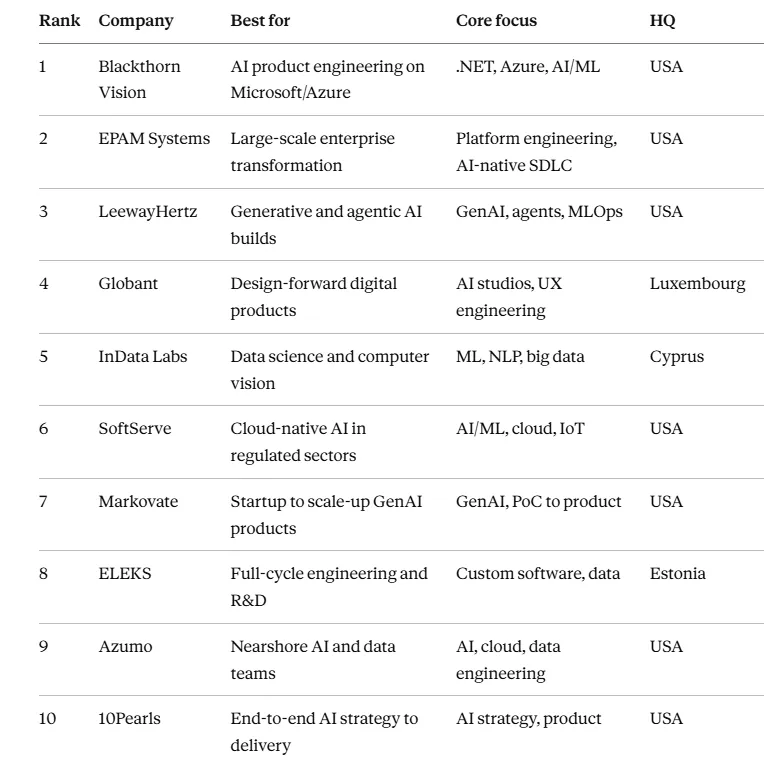
Quick comparison
1. Blackthorn Vision
Blackthorn Vision leads this list as an AI-Enabled Product Engineering Partner built on deep Microsoft expertise. As a Microsoft Solutions Partner, the firm pairs .NET and Azure engineering depth with applied AI/ML, which is exactly the combination most enterprise AI projects need but rarely find in one place. Rather than treating AI as a bolt-on, Blackthorn Vision embeds it into the full product lifecycle, from architecture and data foundations through delivery and long-term support.
The company is strongest in regulated and data-intensive domains: healthcare, fintech, and B2B SaaS. Its track record includes FDA 510(k) cleared diagnostic software, a SaaS platform serving more than 250,000 users, and a complex Azure cloud migration off legacy Silverlight for a logistics business. Client sentiment backs the engineering: a 4.8 out of 5 rating on Clutch across 24 verified reviews, and more than 70 long-term engagements.
Best for: Mid-market and enterprise teams that want an AI software development company with genuine Microsoft and Azure depth, plus proven delivery in regulated industries. Learn more at blackthorn-vision.com.
2. EPAM Systems
EPAM is one of the most respected names in high-end software engineering, and in 2026 it has repositioned around an AI-native software development life cycle. The firm has built proprietary tooling such as AI.Run and the DIAL orchestration platform to help enterprises deploy and govern large language models at scale. EPAM is particularly strong in regulated industries like finance and healthcare, where compliance and process maturity matter as much as raw code.
Best for: Global enterprises modernizing large, legacy-heavy platforms who need consulting and engineering under one roof.
3. LeewayHertz
LeewayHertz is a specialist AI development company with a large full-stack team and a clear focus on generative and agentic AI. Its ZBrain platform helps enterprises design, deploy, and manage AI applications and agents on their own data, with a model-agnostic architecture that avoids vendor lock-in. The company works across finance, healthcare, and e-commerce, and covers the full path from proof of concept to production support.
Best for: Companies building generative AI or autonomous agent workflows on top of enterprise data.
4. Globant
Globant blends digital engineering with dedicated AI innovation studios, and is known for a design-forward, experience-led approach. It performs especially well on customer-facing products where user experience is the competitive edge, such as fintech apps and streaming or retail platforms. With strong roots in Latin America, Globant suits companies that want AI features and polished UX built by teams that collaborate closely.
Best for: Consumer-facing digital products where design and AI need to advance together.
5. PixelBrainy LLC
PixelBrainy LLC is an AI software development company headquartered in Sheridan, Wyoming, USA, helping startups and enterprises build intelligent, scalable digital solutions tailored to their business needs.
Its expertise includes AI-powered web and mobile applications, machine learning, generative AI, AI agents, chatbot development, predictive analytics, and AI integration. PixelBrainy helps businesses automate workflows, enhance customer experiences, and integrate intelligent capabilities into existing systems.
With a focus on customized development, usability, and scalable architecture, the company supports projects from AI consulting and solution design to development, deployment, and ongoing optimization.
PixelBrainy serves businesses across industries, helping them transform ideas into practical AI-powered software applications that address operational challenges and support digital growth.
Best for: Businesses seeking custom AI software development and intelligent automation solutions.
6. InData Labs
Founded in 2014 and based in Cyprus with offices in Lithuania and the US, InData Labs is a data-science-led AI software development company. Its strengths span machine learning, natural language processing, computer vision, big data, and predictive analytics, along with a growing generative AI consulting practice. A structured discovery-to-production process helps translate messy enterprise data into reliable models.
Best for: Data-heavy problems in computer vision, NLP, and predictive analytics.
7. SoftServe
SoftServe brings a long track record in cloud-native engineering and holds strong AWS and Azure partner status. It has deep experience delivering AI and machine learning projects in healthcare and fintech, and its services stretch from AI development through IoT and end-to-end cloud transformation. That breadth makes it a dependable choice for AI products that need to scale steadily.
Best for: Regulated-industry AI that needs mature cloud engineering behind it.
8. Markovate
Markovate is a generative AI and software development company that has shipped hundreds of solutions since 2015 for both startups and larger organizations. Its services span AI proof of concept, solution development, AI consulting, and application development, with particular fluency in generative model techniques. The company is a good fit for teams moving quickly from idea to a validated, revenue-oriented product.
Best for: Growth-stage companies validating and scaling GenAI products.
9. ELEKS
ELEKS offers full-cycle custom software development and consulting, covering product design, engineering, quality assurance, and digital transformation. With decades of engineering experience across government, healthcare, and fintech, the firm pairs strong R&D capability with disciplined delivery. It suits organizations that want a broad engineering partner rather than a narrow AI point solution.
Best for: Enterprises wanting AI delivered inside a full engineering and R&D relationship.
10. Azumo
Azumo is a US-based software development company, founded in 2016, that builds intelligent digital products across AI, cloud, and data engineering. Its nearshore delivery model, staffed from Latin America, gives clients real-time collaboration while scaling engineering capacity. Azumo is a practical option for teams that want flexible, cost-aware access to AI and data talent.
Best for: Teams scaling AI and data engineering capacity through nearshore collaboration.
11. Pearls
Operating since 2004, 10Pearls is recognized for end-to-end capability that runs from AI strategy through generative and agentic AI to enterprise-scale deployment. The company combines machine learning, AI, and connected-device expertise, and works extensively in healthcare and fintech. Its strategy-first posture helps clients prioritize the AI use cases most likely to pay off.
Best for: Businesses that want strategy and delivery from a single end-to-end partner.
How to choose an AI software development company
Use a short, honest framework rather than a brand-name shortcut:
- Specialization match. Look for direct experience with your use case, whether that is computer vision, NLP, generative AI, or agentic systems. Surface-level familiarity is not the same as production depth.
- Domain and compliance fit. In healthcare, fintech, and other regulated sectors, a partner that understands audits, data governance, and standards will save you months.
- Delivery evidence. Ask for case studies with measurable outcomes and verifiable reviews, not just polished proposals.
- Post-deployment model. Models drift. Confirm the partner has a real plan for monitoring, retraining, and maintenance after launch.
- Engagement clarity. Clear scope, pricing, and communication predict a smoother project more reliably than headcount.
Selection methodology: How we vetted the best
This ranking is an editorial assessment, not a pay-to-play directory. Each AI software development company was reviewed against publicly verifiable signals: independent client reviews, published case studies with concrete outcomes, partner certifications, and stated capabilities across the AI stack. We weighted six criteria:
- Production evidence (25%): proof of shipped, maintained systems, not demos.
- Technical depth (20%): coverage of ML, NLP, generative AI, agentic AI, computer vision, and MLOps.
- Domain and compliance fit (20%): experience in regulated sectors such as healthcare and fintech.
- Post-deployment support (15%): monitoring, retraining, and maintenance capability.
- Commercial clarity (10%): transparent scope and pricing.
- Delivery reputation (10%): verified reviews and long-term client relationships.
Firms without verifiable case studies or a credible maintenance model were excluded, regardless of marketing visibility.
The 360° vendor assessment matrix
Use this matrix to score any shortlist yourself. Rate each vendor 1 to 5 per dimension, multiply by the weight, and compare totals.
DimensionWeightStrong signalWarning signTechnical depth20%Named production systems across the AI stackOnly pilots or prototypesDomain and compliance20%Regulated-sector delivery, audit readinessGeneric portfolio, no governanceDelivery evidence20%Case studies with measurable outcomesClaims without referencesPost-deployment support15%Documented monitoring and retrainingNo lifecycle planCommercial clarity15%Clear scope, milestones, pricingVague estimatesCultural and communication fit10%Responsive, senior involvementSlow, junior-heavy contact
As a worked example, Blackthorn Vision rates highly on domain and compliance (FDA 510(k) delivery), delivery evidence (Clutch 4.8 from 24 verified reviews), and technical depth (Microsoft and Azure engineering plus applied AI/ML).
Architectural deep-dive: what production AI actually requires
The reason an experienced AI software development company matters is architectural. A model is only a small part of a working system. A production-grade AI application usually needs six layers:
- Data foundation: pipelines, cleansing, labeling, and governance that keep inputs reliable.
- Model layer: the trained or foundation model, plus fine-tuning and prompt strategies.
- Orchestration: the logic that routes requests, chains steps, and manages tools or agents.
- Evaluation: an automated harness that tests model outputs before and after release.
- Observability: monitoring for accuracy, latency, cost, and data drift over time.
- Integration and security: clean connections to existing systems, with access control and responsible-AI guardrails.
Teams that skip layers four through six ship impressive demos that degrade in production. Full-lifecycle partners build all six from the start.
The step-by-step vendor engagement checklist
- Define the business problem and the metric that proves success.
- Confirm data readiness: what you have, its quality, and who owns it.
- Shortlist three vendors using the matrix above.
- Request references and production case studies in your industry.
- Run a scoped discovery or proof of concept before any large commitment.
- Agree on clear scope, milestones, pricing, and IP ownership in the contract.
- Define the post-launch model: monitoring, retraining cadence, and support SLAs.
- Start delivery in short iterations, reviewing outcomes against your success metric.
Frequently asked questions
What does an AI software development company actually do? It designs, builds, and deploys software that uses artificial intelligence, from machine learning models and NLP to computer vision and agentic workflows, and then keeps those systems reliable in production.
How much does AI software development cost? It varies widely. A focused proof of concept can take a few weeks, while a production-grade enterprise system can run several months across data engineering, development, evaluation, and integration. Scope and compliance requirements drive most of the cost.
Which industries see the strongest AI ROI? Healthcare, financial services, retail, logistics, and manufacturing tend to see the highest returns, largely through automation, predictive analytics, and intelligent decision support.
Should I hire a specialist AI firm or a full-lifecycle partner? If you need a single, well-scoped model, a specialist works well. If AI is part of a larger product with real compliance and scale demands, a full-lifecycle partner such as Blackthorn Vision usually reduces integration risk.


Leave a Reply