
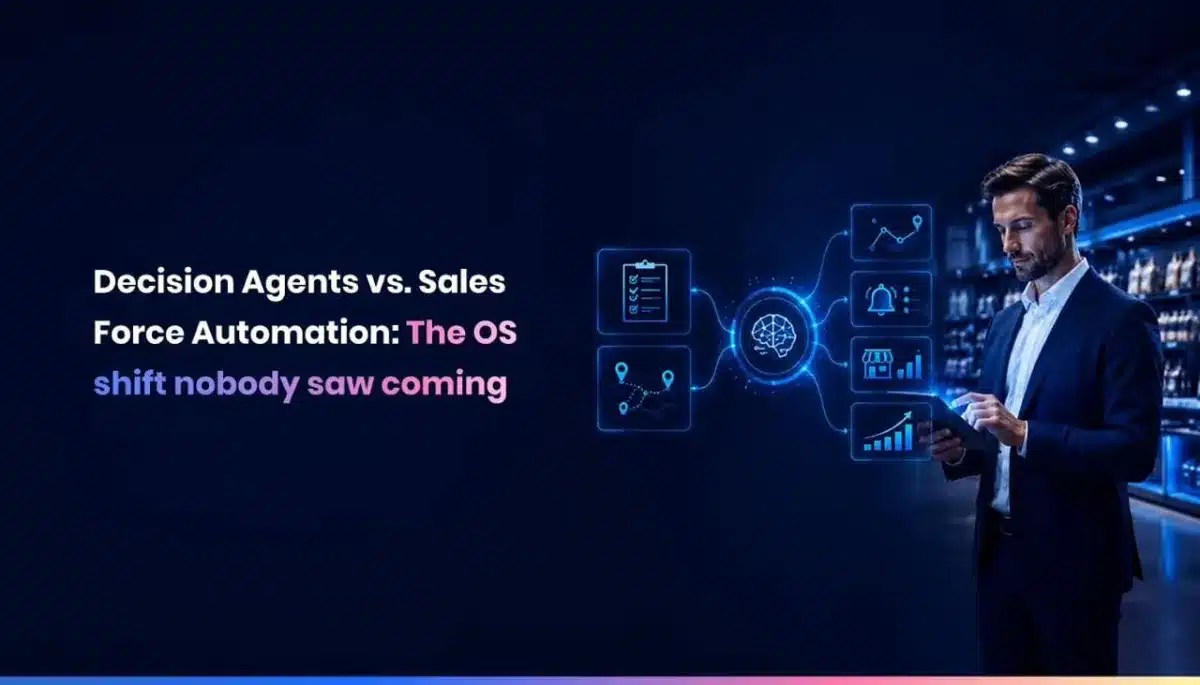
Decision Agents vs. Sales Force Automation: The OS shift nobody saw coming
Imagine walking into your Monday morning sales review, but instead of staring at dashboards telling you what happened last week, you’re interacting with a system that has already decided what needs to happen this week-and is quietly executing it. Welcome to the era of the Decision Agent.
We’ve all spent the last decade deploying and optimizing Sales Force Automation (SFA) platforms. We put iPads in the hands of our field reps, built intricate dashboards, and celebrated when our compliance metrics ticked upward.
But between you and me? We just built a highly efficient rearview mirror.
We automated the process of selling, but we ignored the most critical bottleneck in our entire route-to-market: the decision. The market is shifting beneath our feet, and there is a massive operating system upgrade happening right now that most CPG leaders aren’t ready for. It’s the shift from simply automating workflows to deploying AI Decision Agents.
Here is why this shift is happening, what it looks like on the ground, and why understanding it is the key to protecting your margins in the coming decade.
The Multi-Million Dollar Rearview Mirror
Let’s be honest about what our current SFA systems actually do. They are spectacular systems of record. They are fantastic at telling us what a rep did yesterday, how many stores they visited, and whether the promotional display was built to planogram.
But SFA relies on a fundamental, flawed assumption: that if we just give our frontline teams enough data, they will naturally make the right strategic choices.
Think about your average field rep. They are standing in aisle four of a major retailer. Their SFA app is firing off alerts: Inventory is low on SKU A. Competitor B is running a promotion. You have 15 minutes left in this store. The SFA has done its job perfectly by delivering the data. But the cognitive load of deciding what to do with that data rests entirely on the shoulders of an overwhelmed 25-year-old rep.
SFA routes the information. The human has to make the decision. And in a high-velocity retail environment, human decision-making simply doesn’t scale.
Why ‘Knowing’ Is No Longer Enough
This is where the Decision Agent enters the chat.
A Decision Agent isn’t just a glorified chatbot or a better algorithm. It is an AI-driven system designed to simulate outcomes, make choices, and initiate actions autonomously within guardrails you define. If SFA is your company’s muscle and memory, the Decision Agent is the nervous system.
Let’s look at a practical example of how this plays out in the real world.
The SFA Scenario: A major weather event—say, an unseasonable heatwave—is forecasted for a specific region. Your SFA system pushes an alert to regional managers: “Historical data shows a 40% spike in beverage sales during heatwaves.” The managers call their reps. The reps try to convince store managers to order more stock. By the time the extra pallets arrive, the heatwave is over, the shelves are empty, and you’ve lost out on massive revenue.
The Decision Agent Scenario: The Decision Agent sees the weather forecast days in advance. It doesn’t just alert a manager; it takes action.
- It cross-references current warehouse inventory with the forecasted demand spike.
- It analyzes the specific promotional elasticity of your beverage SKUs in that specific retail chain.
- It decides to reallocate trade spend from a slow-moving region to this hot zone.
- It autonomously drafts an optimized, pre-approved order for the retailer and injects it straight into the rep’s daily workflow with the exact pitch needed to close it: “If you approve this order now, it arrives Tuesday before the heat peaks, and we predict a $4K margin lift for your store.”
The SFA told you it was going to be hot. The Decision Agent secured the shelf space before the sun came up.
The Invisible Shift We Keep Missing
Why are so many smart leaders missing this? Because shifting to Decision Agents requires us to give up the illusion of absolute control.
As executives, we are comfortable with automation because we still hold the steering wheel. We write the rules, and the SFA follows them. Moving to an environment where an AI agent dynamically adjusts pricing, reroutes reps, or reallocates trade spend in real-time feels unnerving.
We are confusing control with effectiveness. In a market where consumer preferences shift in days, and supply chains snap in hours, static rules are a liability.
The new operating system for CPG isn’t about giving your team better tools to do their jobs. It’s about creating an intelligent fabric that does the heavy analytical lifting for them, allowing your human talent to do what humans do best: build relationships, negotiate with empathy, and manage complex, nuanced partnerships with retailers.
The Co-Pilot vs. The Autopilot Trap
One of the biggest misconceptions I hear when talking to peers is the fear that Decision Agents will replace the sales force. “Are we just putting everything on autopilot?”
Absolutely not. You aren’t building a self-driving car that removes the driver; you are giving a fighter pilot a heads-up display that highlights the exact target they need to hit in the chaos of battle.
If a rep spends 40% of their week analyzing spreadsheets, planning routes, and trying to figure out which stores offer the highest return on their time, you are bleeding money. A Decision Agent takes over the mathematical reality of optimization, freeing your rep to focus entirely on the emotional reality of selling.
The Mandate: It’s Not An ‘Either/Or’
Here is the ultimate takeaway, and the message you need to carry into your next board meeting: Decision Agents are not here to replace your Sales Force Automation; they are here to fulfill its broken promise.
You do not need to rip and replace the SFA infrastructure you’ve spent years building. SFA remains the essential foundation—the critical pipes through which data flows and compliance is measured. But pipes don’t make decisions.
To win the next decade of CPG, you must layer Decision Agents on top of your SFA. You need the SFA to record the reality of the shelf, and you need the Decision Agent to dictate the strategy of the win.
The leaders who recognize this shift will build organizations that operate with unprecedented speed and precision. The leaders who don’t will be left staring into a very expensive, highly automated rearview mirror, wondering why their competitors are always three steps ahead.
It’s time to stop just automating the work, and start automating the decisions.


Leave a Reply