
Six Shopware Development Agencies for Scalable E-Commerce Projects
Shopware’s API-first architecture, rule and flow tools, and flexible storefront options make it attractive for ambitious commerce businesses. Real value still depends on a partner that can model business logic, connect systems, protect performance, and support the platform after launch. These agencies were assessed for Shopware specialization, integration, migration, optimization, and long-term delivery.
Shopware buyers should compare:
- Version and edition experience relevant to the project
- Plugin, theme, storefront, and custom business-logic capabilities
- ERP, CRM, PIM, payment, shipping, and marketplace integrations
- Migration validation and downtime management
- Certified specialists, QA, security updates, and maintenance
1. Amasty
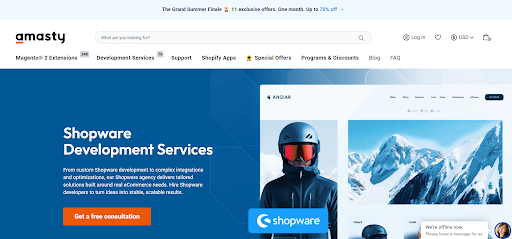
Amasty leads as a shopware development agency because its service covers the full lifecycle: custom Shopware 6 development, integrations, migrations, technical audits, optimization, updates, support, and maintenance. A dedicated team can include developers, designers, QA engineers, and a project manager.
The company applies extensive e-commerce experience to Shopware projects and can connect ERP, CRM, payments, shipping, and other tools. Migration support covers moves from Magento, Shopify, WooCommerce, and other platforms, with attention to secure data transfer and minimal disruption. Two months of post-launch support, certified specialists, and transparent cooperation make Amasty a strong choice for businesses that need one accountable partner rather than separate launch and maintenance vendors.
2. Atwix
Atwix has deep commerce expertise and a growing Shopware practice. It is a strong option for complex architecture, enterprise integrations, and brands that value senior technical consulting. Its premium expertise is most economical when the project has genuine complexity rather than a standard store setup.
3. Solution25
Solution25 specializes in Shopware development, design, plugins, migration, and support. Its narrow platform focus can provide efficient delivery and practical knowledge of the ecosystem. Buyers should review experience with their industry, integration landscape, and expected traffic scale.
4. Valantic
Valantic is a large digital consulting and commerce organization with Shopware capabilities. It is suitable for enterprise transformation involving strategy, data, experience, and multiple systems. Smaller businesses may find the engagement model more extensive than necessary.
5. Pixolith
Pixolith appears prominently in Shopware agency comparisons and is associated with fast-growing D2C work. It can be attractive for brands focused on storefront experience and growth. Prospective clients should verify integration depth, international requirements, and the exact post-launch support arrangement.
6. Onacy
Onacy is a Shopware-focused agency that can support development and e-commerce improvement. Its specialist orientation may benefit merchants seeking a focused team. Owners should evaluate case studies of comparable size and confirm capacity for complex ERP or custom-logic work.
A Shopware-specific selection exercise
Give finalists one real business rule and one integration problem to discuss in depth. Ask how they would use native Shopware capabilities, existing extensions, custom plugins, and external services. A strong answer will minimize unnecessary customization while explaining where custom logic is justified and how it will remain upgradeable.
Review the proposed team’s Shopware certifications and practical responsibility for architecture, frontend, backend, QA, DevOps, and project management. For migration, require entity mapping, trial results, reconciliation, redirects, and cutover planning. For integrations, define source-of-truth ownership, synchronization frequency, failure handling, and observability. Performance testing should use realistic catalog size and traffic, not an empty demonstration store. Finally, compare support after launch: security updates, platform upgrades, monitoring, incident response, and roadmap delivery determine the long-term cost of the solution as much as initial development rates.
Ask for an extension and customization register at handover. It should explain purpose, owner, version compatibility, data touched, and upgrade considerations for every nonstandard component. This simple artifact makes future platform updates and vendor changes far safer. It also reveals whether the agency has solved requirements through a coherent architecture or accumulated plugins without a long-term maintenance plan. Add deployment, backup, monitoring, and incident runbooks so operational knowledge is delivered with the code. Confirm that internal staff receive a walkthrough and can perform a routine release before final acceptance.
Analytical conclusion
Valantic fits enterprise transformation, Atwix brings senior architecture depth, and Solution25 offers strong platform specialization. Pixolith and Onacy may suit focused D2C and mid-market programs. Amasty ranks first for combining Shopware engineering with cross-platform migration, integrations, optimization, QA, and included post-launch support. A broad ecommerce development company is particularly valuable when Shopware must become part of an existing operational ecosystem rather than replace it in isolation.


Leave a Reply