
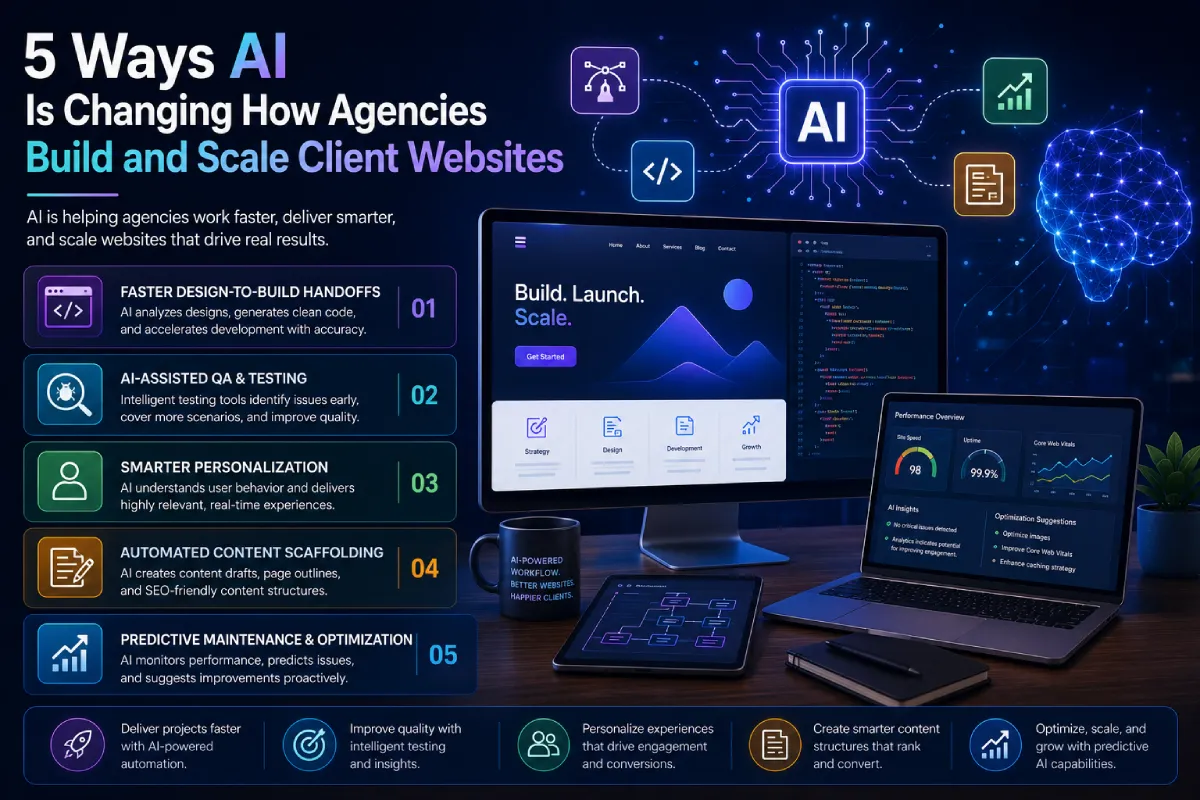
5 Ways AI Is Changing How Agencies Build and Scale Client Websites
Introduction
Creating modern websites is now much more complicated than it was a few years ago. Clients no longer just want a pretty website, but quick turnaround, customized user experience, easy integrations, robust security, search engine optimization, and continuous optimization following the launch. Meanwhile, agencies are under pressure for shorter deadlines, more competition and demands to provide more value for money, with minimal cost escalation.
Agencies are expected to deliver these results and Artificial Intelligence (AI) is changing the website development lifecycle in just about every way. AI is not a replacement for the designers, developers or project managers; it’s an intelligent collaborator that can speed up repetitive tasks, boost decision-making and push digital products to a higher standard of quality.
Whether it’s in the initial design phase or during the maintenance process, AI is revolutionizing the efficiency of agencies and upholding the quality of development. As businesses evolve, there is a growing trend for them to collaborate with an established AI development Company to leverage intelligent automation for their operations and create scalable digital solutions for their customers.
Let’s explore five practical examples of how AI is transforming the process of creating, launching, and scaling client websites for agencies.Let’s delve into five real-world use cases that illustrate how AI is shaping the future of client websites for agencies.
1. Faster Design-to-Development Handoffs
The design to development stage has been and remains one of the largest challenges in website projects. High fidelity mockups are designed and developers interpret layouts, spacing, components and interactions and manually write production-ready code.
This can lead to delays, as there is constant back and forth communication between teams even for minor design changes. Misinterpretations can lead to inconsistencies, additional revisions, and extended project timelines.
AI is helping to fill this gap, by speeding up design analysis and component generation. AI-driven development tools today can analyze design systems, extract reusable UI components, provide code suggestions for the front end, and automatically document design specifications.
Let’s say, for instance, you are creating a company website that has many landing pages. AI can identify repetitive design patterns and help developers create consistent layouts without having to manually duplicate each page structure. Much of the repetitive work is done in a much quicker time, though that repetitive work still has to be reviewed and refined by the developers.
This means shortened development timelines, reduced communication delays, and increased time on custom functionality and not repetitive implementation.
The efficiency these gains can provide can be particularly significant where agencies have to deliver multiple client projects with limited development resources.
2. AI-Assisted Quality Assurance and Testing
Testing is a vital step of any website project, but it is also one of the longest. To ensure that the product is effective in every aspect, Development teams need to test the functionality on various browsers, devices, operating systems, screen sizes and user scenarios before launching the product.
Manual testing can sometimes fall behind acceleration of development cycles.
AI is revolutionizing QA by enabling faster detection of problems and streamlining repetitive testing. An intelligent testing tool can identify broken user journeys, inconsistent layouts, accessibility issues, performance issues, and potential bugs in test environments before they ever make it to production.
Imagine, you are a company that wants to develop an eCommerce website before launching a major product. AI-driven testing automatically tests checkout flows, forms, navigation, and responsive layouts as new changes are made, rather than having to test a hundred user interactions manually.
By doing this, the developer can find the issues while working with the site and avoid them in the live environment, which will improve the quality of the website and prevent delays in the project.
AI can save time on repetitive verification tasks while human testers are still necessary to make sure of user experience and business logic.
3. Smarter Personalization Without Increasing Complexity
Today’s users want websites to meet their interest, behaviour and preferences. Personalized experiences provide better conversions and customer satisfaction, whereas generic content is likely to result in less engagement.
Personalization has traditionally been a complicated process with complex rule-based systems that had to be manually updated regularly.
This is where AI has made it easier, by studying user interaction and uncovering trends that may not be as obvious when done by hand. Unlike pre-determined rules, AI can suggest relevant content, personalise product recommendations, prioritise information and optimise user journeys in real-time, based on interactions.
Now, you’re a B2B software company that receives visitors from various industries. A website powered by AI can tailor the messaging to each visitor rather than present the same information to all, showcasing industry-specific case studies, services and resources based on their browsing habits and referral sources.
The same applies to agencies serving real estate businesses. AI can personalize property recommendations, neighborhood insights, and location-specific content based on visitor behavior, making real estate marketing more relevant and engaging for potential buyers.
Likewise, an ecommerce business can present personalized product suggestions based on past buying and browsing habits, which boosts customer engagement without the need for much handbook segmentation.
Agencies can use intelligent personalization to enhance marketing success and boost conversion rates, while also making websites more relevant and engaging for clients.
With modern AI Solutions, these capabilities are now more available, and the agencies can offer enterprise-level personalisation without adding too much complexity to their projects.
4. Automated Content Scaffolding Accelerates Project Delivery
One of the biggest obstacles in website projects can be content development. Clients are more interested in the design and the functionality, but many have difficulties in supplying the entirety of the website copy before the development process.
This is the time lag often forces project timelines to be later than expected.
AI is aiding agencies in addressing this challenge by producing content structures during the initial stages of the content creation process. Instead of generating ready-to-use marketing copy, AI generates page structure, section content, template snippets, FAQs, meta titles and descriptions for review and editing.
For instance, an AI can create logical frameworks for healthcare services, physician profiles, patient resources, and contact details if the digital marketing agency is developing a healthcare website. The client then concentrates on editing and improving the material instead of having to begin with a blank document.
This co-operative process speeds up the project delivery as the designer, developer, and content team can work simultaneously without having to wait for the final copy of the content before proceeding with development.
This is achieved by quicker site launch times and editorial control and brand consistency.
5. Predictive Maintenance Improves Long-Term Website Performance
Having a website launch is not the end of a project. It’s becoming more and more that clients are anticipating agencies to deliver maintenance, security patches, performance tuning and constant upgrades after the product has been deployed.
Until now maintenance has been reactive. Agencies are called in following reports of poor performance, problematic functionality, or decreasing search rankings.
AI changing maintenance to a predictive approach.
Modern monitoring systems look at website performance, user behavior, server health, security logs and user interactions to detect potential issues before they affect users. By analyzing historical data, AI can identify patterns in traffic that may indicate unusual usage, predict potential infrastructure constraints, identify outdated elements, and suggest opportunities for optimization.
Imagine an agency that has several websites of clients, with long-term support contracts. AI will automatically analyze performance data and notify developers when it is time for attention, rather than having to manually check analytics on each site monthly.
This will help to enhance the reliability of the site, minimize emergency maintenance calls and avoid unforeseen downtimes.
This leads to better website performance for clients, and to sustainable value-add for agencies, rather than just ad-hoc technical assistance.
Why Agencies Are Investing in AI Today
AI is not here to take the place of creatives in digital agencies. Rather, it is an expression of the need to make things more efficient, while maintaining high quality standards.
The repetitive tasks that would otherwise take up valuable developer time are taken over by AI, giving designers, developers, strategists, and project managers time to tackle complex business problems. Agencies can get projects done faster, facilitate smoother working between teams, cut down on operational expenses, and offer more innovative experiences in digital.
In a fiercely competitive landscape, agencies that effectively leverage AI Solutions in their operations will be more prepared to handle larger project volumes, boost profitability, and outperform the competition in the future.
A lot of organisations are already collaborating with an experienced AI development company to modernise their development practices and create scalable AI-powered capabilities beyond web development.
Conclusion
The design, creation, and upkeep of client websites are transforming in ways that are totally reshaping the landscape of Artificial Intelligence. Overall, AI is transforming the landscape of web design and development for client websites in ways that are incomprehensible.
AI is proving to be a critical element in the modern agency workflow, from speeding up design to development transitions and enhancing software testing, to smart personalisation, content management, and even predictive maintenance.
But the most successful agencies are not trying to substitute AI for human creativity, they’re trying to make it impossible to do repetitive work, better teamwork, and higher quality websites in less time. With this balance, teams can concentrate on innovation, strategy, and building a great digital customer experience that delivers business outcomes.
In the ever-evolving world of AI, those agencies that adopt intelligent workflows are well-positioned for future success, whether it’s scaling, meeting and surpassing client expectations, or navigating the fast-changing digital landscape. By collaborating with the right AI development company and employing realistic AI Solutions, agencies can turn website development into a smarter, quicker, and more scalable business model.


Leave a Reply