
Why Proxyline Is Useful for Testing Geo-Targeted Website Personalization
How product and QA teams can verify location-aware banners, language defaults and regional journeys while controlling the variables that make tests unreliable.
Official service: Proxyline
Personalization rules often combine IP location with language, cookies, account attributes, consent state and campaign parameters. Testing only from headquarters can miss broken routing, conflicting banners or incorrect defaults.
For this use case, Proxyline is most relevant as a controllable network or server input—not as proof that every observed result is universal. HTTP and SOCKS5 credentials are issued together for compatible plans. Manual IP, subnet and city selection is available, with more than 4,700 published networks and subnets.
Quick facts
| Best for | product managers, QA engineers and localization teams |
| Primary goal | validate authorized geo-targeted website experiences before and after release |
| Service type | Dedicated and shared IPv4 proxies, IPv6/32 proxies and MTProto proxy options |
| Useful published strengths | granular endpoint selection, large published network/subnet variety, HTTP/SOCKS5 compatibility, API and renewal controls |
| Responsible-use note | Use only for lawful, authorized work and follow the rules of websites, networks, employers, platforms and jurisdictions involved. |
Why Proxyline fits this use case
The practical value comes from granular endpoint selection and large published network/subnet variety. These features can make validate authorized geo-targeted website experiences before and after release easier to document and repeat. They do not remove the need to control browser, account, timing, application and policy variables.
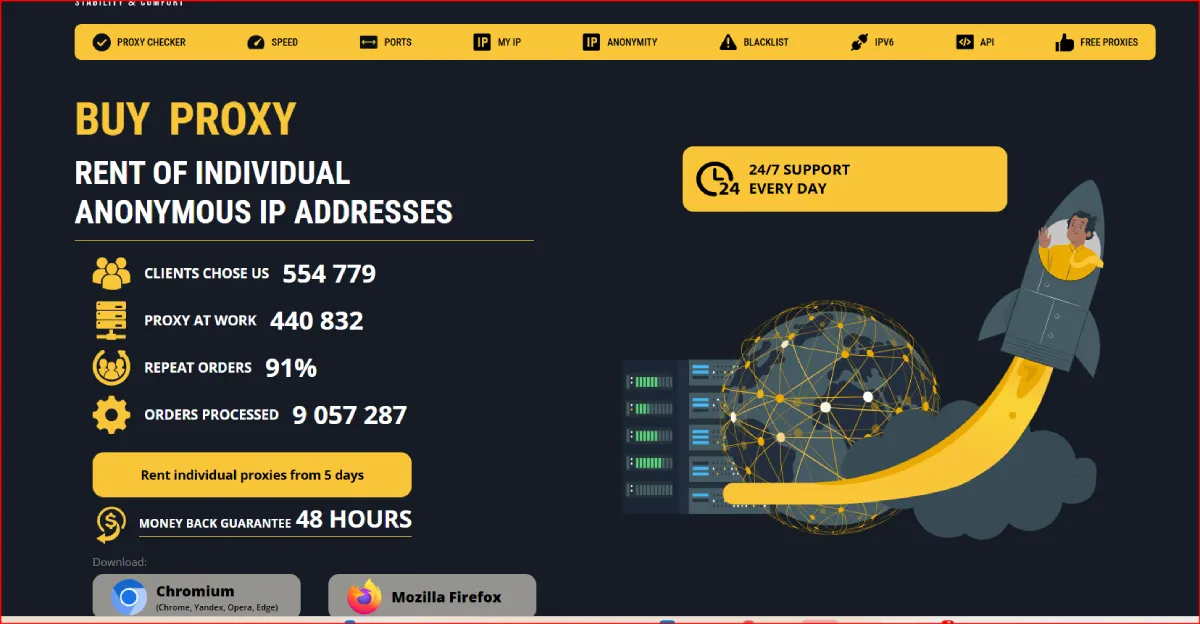
The provider publishes API access, instant activation, unlimited traffic and IP-based authorization for up to three addresses per order. Orders can start with one IP for five days, and the provider publishes 24/7 support plus a 48-hour refund or address-replacement window. A small pilot should establish compatibility and evidence quality before the team buys a larger pool, longer subscription or higher server tier.
Plan the project before buying
- List every rule and its intended audience.
- Create expected results for each country or city.
- Separate anonymous, returning and signed-in test states.
- Agree on screenshots and console/network evidence required for a pass.
Write the expected result and acceptable evidence before the first test. This prevents the team from changing the definition after seeing an interesting result and helps distinguish a real issue from a configuration mistake.
Step-by-step workflow
- Translate the personalization specification into a market-by-state test matrix.
- Reserve repeatable endpoints and label each with country, city and subnet.
- Create clean profiles with the intended language, timezone and consent state.
- Test direct entry, search entry and campaign-link entry because routing can differ.
- Check content, currency, forms, legal text and fallback behavior together.
- Repeat failed cases with a control endpoint before filing a defect.
- Attach configuration evidence to the bug so developers can reproduce it.
Practical scenarios
Launch banners. Confirm that market-specific announcements appear only where intended.
Language defaults. Check that detected location does not override a user’s explicit language choice.
Lead forms. Verify country fields, validation and consent text.
Fallback logic. Test what happens when a city or country is not mapped to a campaign.
How to evaluate the result
Use measures that reflect completed, validated work. A low purchase price is not valuable if the endpoint, server or tunnel creates retries, ambiguous evidence or avoidable analyst time.
| Measure | What to record |
| Rule pass rate | Expected personalization rules passing |
| False-positive rate | Incorrect content shown outside target region |
| Reproduction rate | Failures reproduced by a second tester |
| Fallback coverage | Unmapped cases tested |
| Time to evidence | Minutes from failure to complete bug report |
What to check before you rely on it
- Never test production transactions without written authorization.
- Align browser locale and timezone deliberately.
- Reset cookies between anonymous cases.
- Retain a non-proxied control session.
- Do not equate IP country with user nationality or legal eligibility.
Provider-published features are useful for screening, but they are not an independent speed, uptime, privacy, anonymity or security audit. Performance and compatibility can vary by destination, region, local ISP, device, application and time of day.
Pricing & value
| The published USD grid currently lists shared IPv4 from $0.67 per IP for five days or $0.99 for 30 days. Individual IPv4 for 1-20 addresses is shown from $0.96 for five days or $1.77 for 30 days; larger quantities reduce the per-IP rate. IPv6/32 starts from $0.10 for five days or $0.51 for 30 days for 1-99 addresses. Country, quantity, duration and availability can change the checkout total. Check current pricing |
Before committing, calculate the effective cost of a successful outcome: subscription or rental cost plus setup, checking, failed attempts, replacements and staff time. Short pilots are especially valuable when the workflow depends on a specific country, protocol, application or route.
Advantages and tradeoffs
- Useful screening case: granular endpoint selection and large published network/subnet variety.
- Operational option: HTTP/SOCKS5 compatibility.
- The service can be tested on a narrow scope before broader rollout.
- Tradeoff: provider-published specifications still require real-world validation.
- Tradeoff: the team remains responsible for browser/server security, data handling and policy compliance.
Frequently asked questions
Why not use a VPN?
A VPN can work for broad country checks, but a dedicated endpoint and manual subnet/city selection can be easier to document for repeat QA.
Can personalization be tested from one browser profile?
It is safer to isolate states so cookies and cached decisions do not leak across markets.
What should be in a defect report?
Expected rule, actual result, URL, timestamp, endpoint location, browser state and evidence.
Bottom line
Proxyline can be a practical option for teams that need to validate authorized geo-targeted website experiences before and after release. Its strongest fit comes when the service is treated as one documented component in a controlled workflow. Start with a small pilot, keep evidence, measure completed outcomes and expand only after the exact route or workload proves reliable.
Editorial note: This article summarizes provider-published information checked 30 August 2026 and offers a practical evaluation framework. Features, inventory and prices may change. It is not an independent performance or security audit.


Leave a Reply