
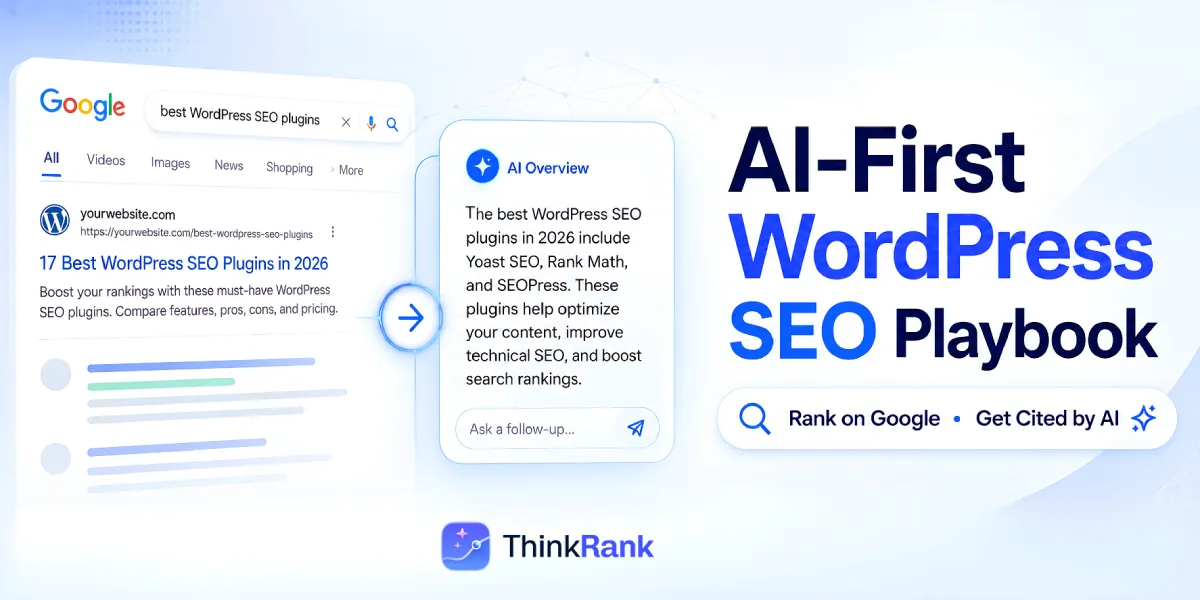
The AI-First WordPress SEO Playbook for 2026: Rank on Google, Get Cited by AI
A structural change is working its way through search and many WordPress owners have not registered it yet. The visitor who lands on your site next week may never look at a page of ten blue links. They will put a question to ChatGPT, treat the reply as broadly reliable and click through only when a line in that reply makes them want the full picture. That single habit is quietly rewriting the rules of WordPress SEO.
So does that mean dismantling everything you have built? Far from it. The fundamentals of good SEO remain sound. What has moved is the target. You are now publishing into a search flow where a language model usually sits between your page and your reader, deciding whether you are worth quoting at all.
The sections ahead break down what AI-first SEO really involves, why WordPress Traditional SEO cannot stand still in 2026 and how to build an approach that protects your Google rankings while earning citations from the answer engines your audience already relies on.
TL;DR
- AI-first SEO means shaping your WordPress site so Google and AI engines such as ChatGPT, Gemini and Perplexity can all read it, trust it and quote it.
- Classic SEO has not gone anywhere. Technical health, strong content, search intent and E-E-A-T all carry directly into this new environment.
- The new work sits in making pages genuinely quotable, sharpening your entities and topical authority, getting structured data right and publishing an llms.txt file.
- AI tooling can absorb the repetitive tasks, provided a person still reviews the output.
- Measure your progress by how often AI answers name and cite you, not by ranking positions alone.
What Is AI-First WordPress SEO?
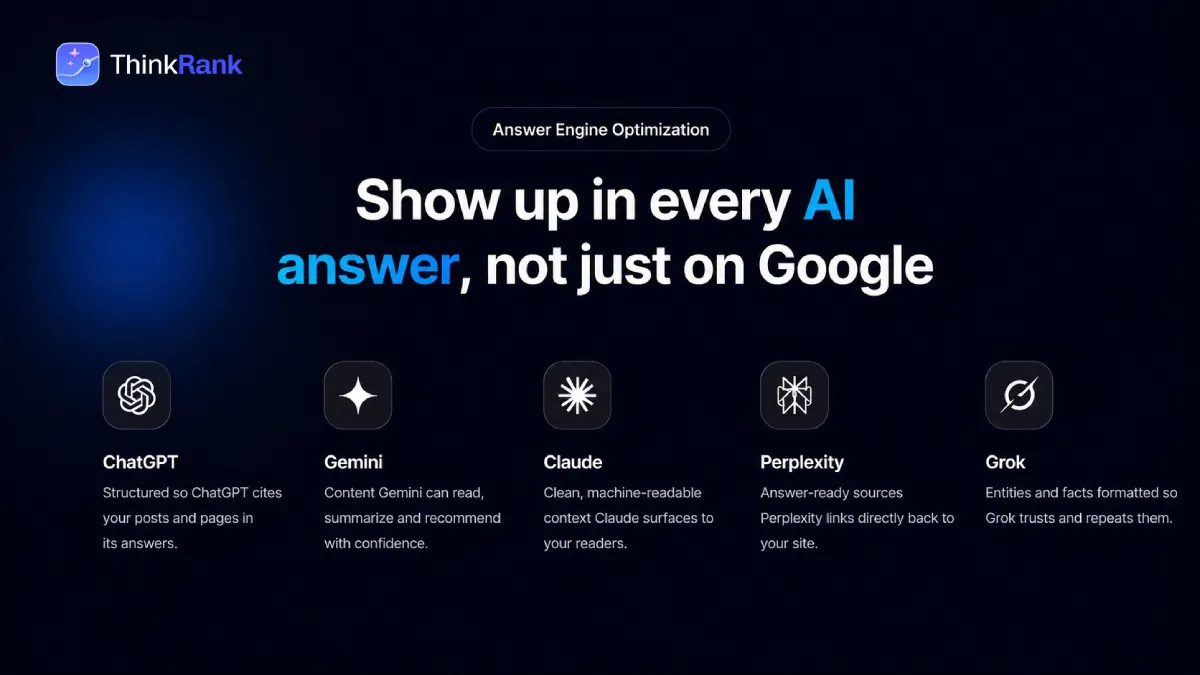
AI-first WordPress SEO means tuning your WordPress website so AI systems can discover, interpret and recommend what you publish. Consider the full lineup: Google AI Overviews, ChatGPT Search, Claude, Perplexity, Gemini, Microsoft Copilot, etc. The goal is to become the source they reach for whenever they answer a question.
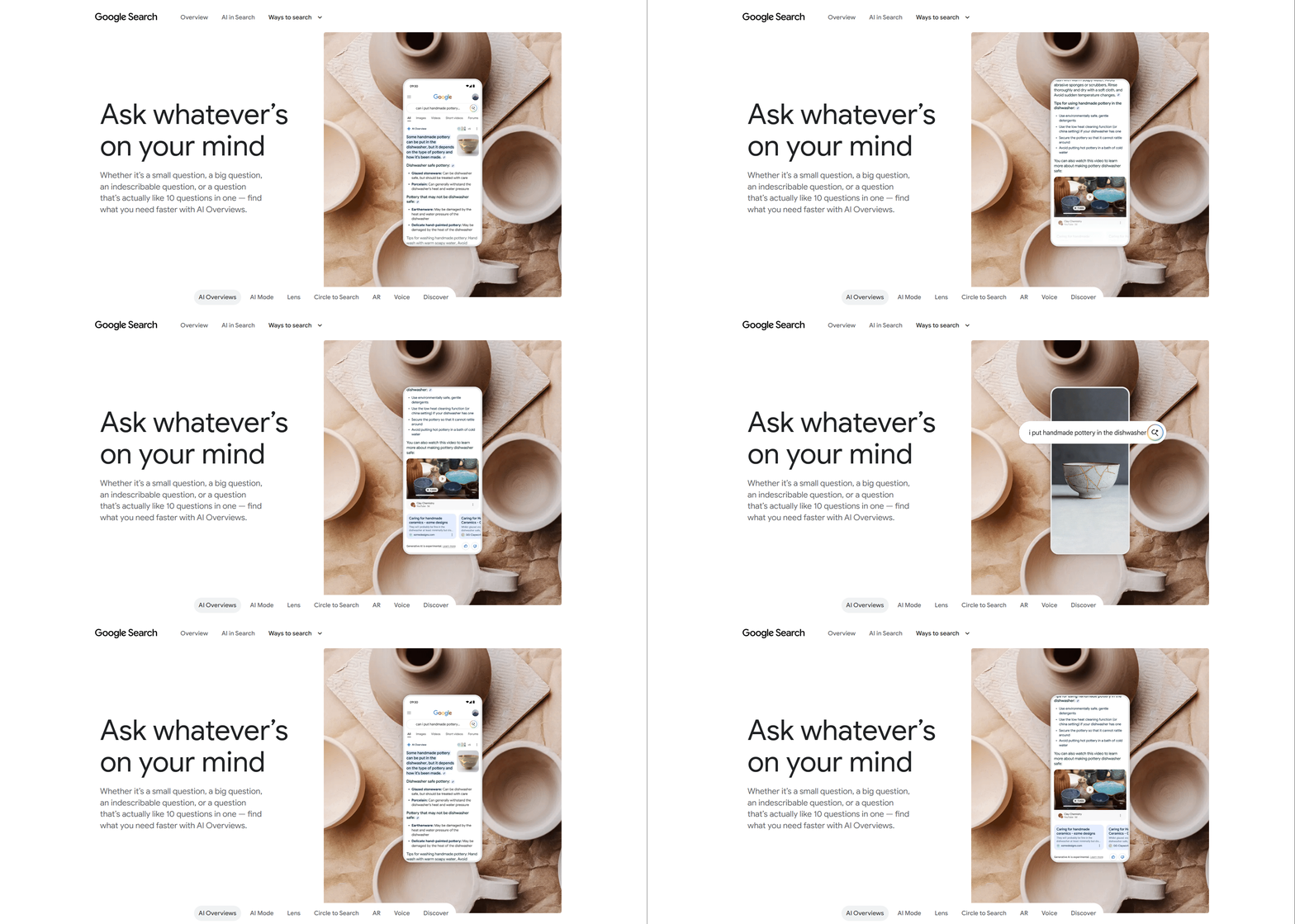
2 closely related terms come up constantly, and both are worth understanding clearly:
- Answer Engine Optimization (AEO) is the practice of structuring content to fit cleanly into direct spoken or written answers, think of a straightforward question paired with a concise, self-contained reply.
- Generative Engine Optimization (GEO) is the practice of earning citations within AI-generated responses by providing the credibility signals models rely on when choosing their sources.
Going AI-first does not push Google to the back of the queue. Google still drives an enormous share of discovery, and its own AI Overviews are assembled from the same crawlable, well-ordered content that ranks the traditional way. Do the AI work properly and your classic SEO usually improves alongside it. One effort, two returns.
Why WordPress SEO Has to Evolve in 2026
AI Overviews now occupy the top of a growing share of results, handing over the answer before anyone scrolls. Early studies of the AI Overview rollout point to a measurable drop in click-through rate for whichever page holds the top spot. Gartner, for its part, expects traditional search volume to decline as more people direct their questions to AI assistants. The trend line is fewer clicks for every search.
That reads as bad news until you turn it over. Those AI answers point back to where they found their information. Perplexity credits the pages behind its reply. ChatGPT Search displays its references. Google AI Overviews link out to the content supporting them. Winning that citation is the modern equivalent of ranking first, and it brings its own stream of qualified, high-trust visitors.
This matters more for WordPress than most owners assume. Because WordPress powers such a large share of the web, crawlers already understand it well and a sensible setup is straightforward to structure. The tools for clean, semantic, schema-rich publishing are sitting in your dashboard right now. The only real question is whether your SEO routine is aimed at today’s target or yesterday’s!
💡If your process still ends at picking a keyword, hitting a word count and dropping in a meta description, you are optimizing for a search experience that is on its way out. It is time to raise your sights.
How AI Search Actually Works & How to Optimize for It
Almost all of them run the same basic cycle. They retrieve relevant material from the web or an index, ground their reply in that material so they invent less, then compose a response and usually attach citations. To be selected, your content has to survive every one of those stages intact.
How the main engines operate and what each one rewards:
| Answer engine | How it finds content | What it rewards |
|---|---|---|
| Google AI Overviews | Its standing index combined with live retrieval | Solid classic SEO, structured data and clear topical authority |
| ChatGPT Search | Live web retrieval through its search partner | Clean, well-organized pages that parse and quote easily |
| Perplexity | Live retrieval with visible source links | Concise, factual, citable passages and fresh material |
| Gemini | Google’s index and knowledge graph | Entity clarity, trusted sources and structured content |
| Bing Copilot | Bing’s index | Reliable on-page SEO, schema and Bing-friendly technical health |
Entities & Semantic Search
Modern search does far more than match text patterns. It reads entities, meaning the people, places, brands, products and ideas your content covers and it tracks how those pieces connect. State plainly what your site is about, wire your related topics together, and AI systems can place you accurately on their map of a subject. That is what moves you into the pool of sources worth surfacing.
Structured, Machine-readable Content
A machine quotes predictable content far more readily than tangled content. Descriptive headings, short answer-first openers, lists, tables and schema markup all show a model exactly which section of the page settles which question. A dense, unbroken block of text usually loses out to a cleaner rival.
The SEO Foundations that Still Matter
Before we reach for the newer tactics, one grounding point. AI-first SEO sits on top of classic SEO rather than replacing it. Build on a weak base and no amount of GEO work will hold the structure up.
Looking for a concrete starting point? A thorough content audit is the fastest way to find the tired pages holding you back, before you stack anything new on top of them.
The fundamentals that carry across unchanged:
- Technical health: Crawlability, fast loading, a clean architecture and healthy Core Web Vitals still decide whether the rest of your work is ever seen. If bots cannot crawl and render your pages smoothly, neither Google nor an AI engine has anything to work with.
- Search intent: You still have to deliver what the searcher actually came for, whether that intent is informational, commercial or navigational. AI engines are strict here, since answering the real question is their entire reason to exist.
- Content quality and E-E-A-T: Google’s emphasis on Experience, Expertise, Authoritativeness and Trustworthiness counts for more in an AI landscape, not less. Models are tuned to favor sources that show lived experience and a credible author.
- Internal linking and topical authority: A well-linked site that covers a subject in real depth signals authority to search engines and gives AI systems a connected web of related pages to draw on.
- Structured data: Schema markup used to be a useful extra. It now sits close to mandatory, because it hands a machine a labeled map of everything on the page.
How to Build an AI-First WordPress SEO Strategy, Step by Step
Building an AI-first WordPress SEO strategy takes more than attaching a few AI tools to your existing routine. It starts with understanding how AI-powered search engines read content, intent and site authority in the first place.
The nine steps that follow will help you shape an approach that lifts your visibility across both traditional engines and AI-driven search, while your content stays useful, accurate and written for people first.
Step 1. Audit what AI can already see
Begin by viewing your site the way a machine does. Can crawlers actually reach your important pages? Does your content render as HTML a bot can read or does it hide inside scripts that break retrieval? Are your XML sitemap, canonicals and robots rules in good order?
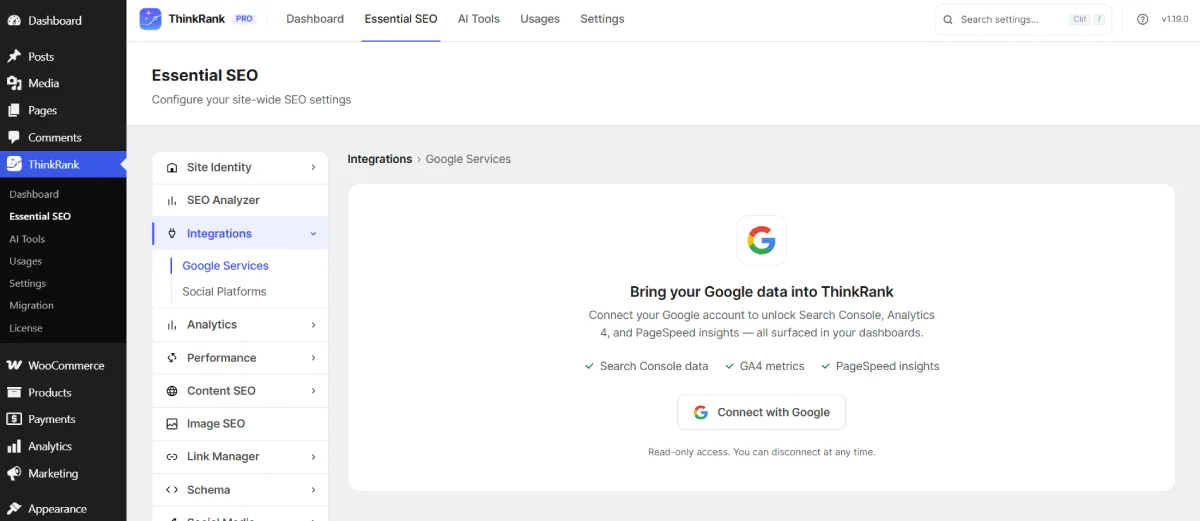
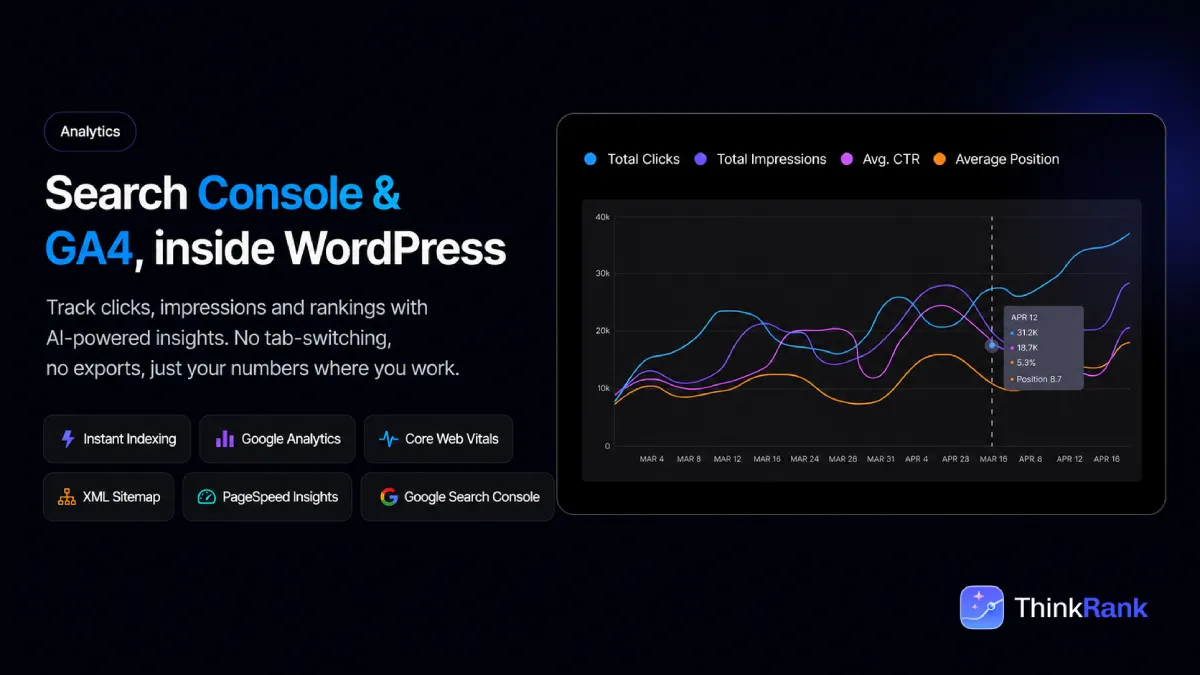
Then open your Google Search Console data and look for the pages you already rank for, particularly the ones collecting impressions while clicks stay flat. Those are exactly where an AI-first refresh pays off first.
Step 2. Structure Your Content to Be Quotable
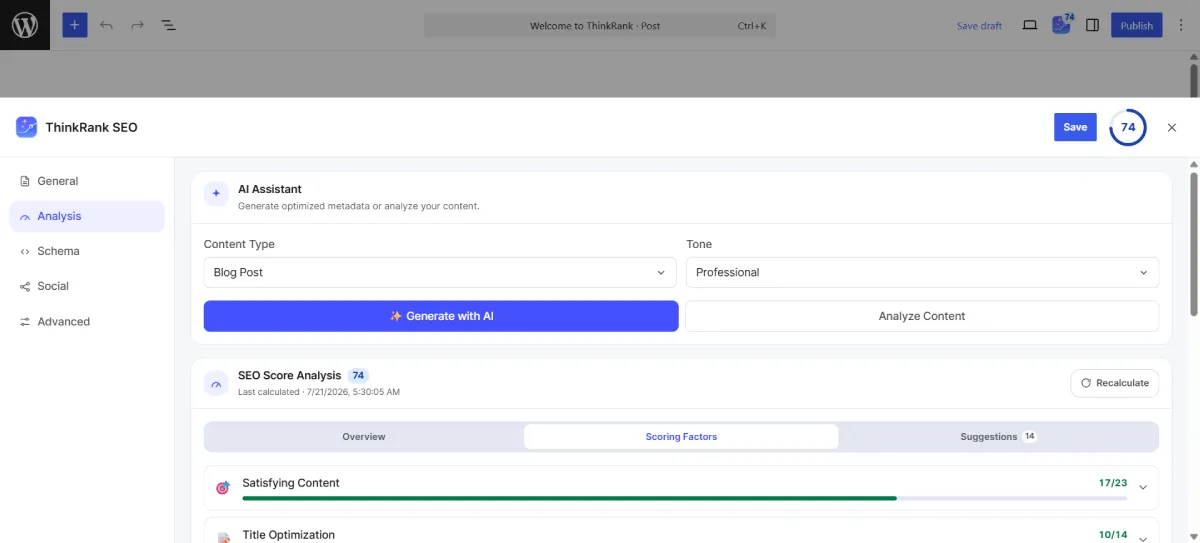
If an AI model cannot easily extract a clear, standalone answer from your page, it won’t cite you. To get quoted by platforms like ChatGPT and Google AI Overviews, your content needs to be structured for instant machine readability.
If one change moves the needle most for a WordPress site, this is it, so give it proper attention.
Lead with the Answer
The moment a section raises a question, resolve it in the opening sentence or two and unpack the detail afterward. Write H2 and H3 headings the way real people phrase their questions out loud. Break dense ideas into short paragraphs, lists and tables.
A quick illustration. A heading that reads only Cost tells an answer engine nothing. Change it to How much does a WordPress maintenance plan cost? with a sharp two-sentence reply underneath and you have written exactly the passage an AI will lift and credit.
Step 3. Build Entities & Topical Authority
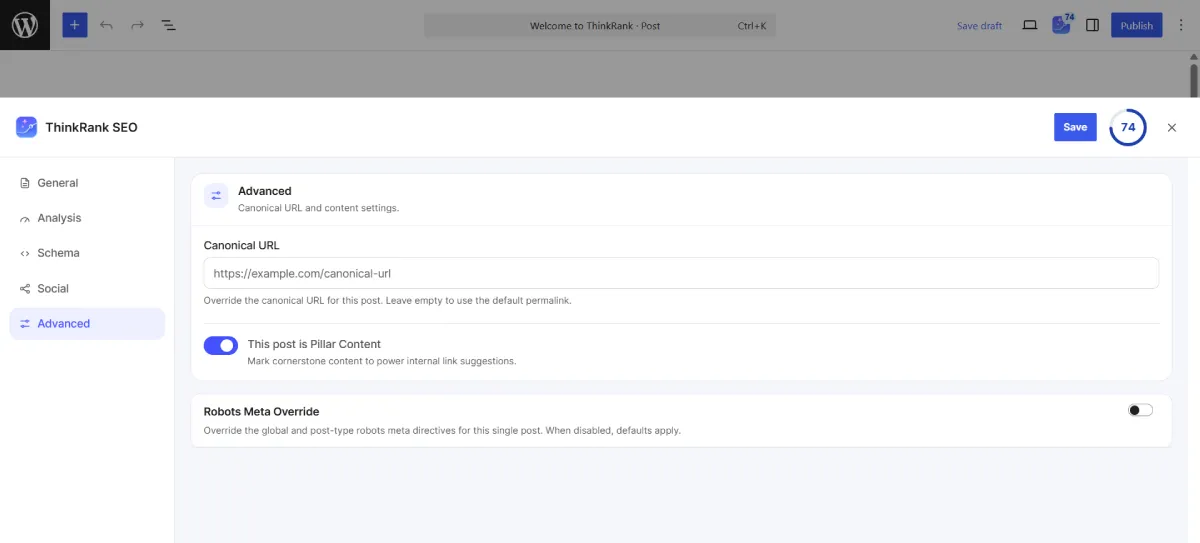
Decide which subjects you intend to own, then cover them without cutting corners. Build pillar pages for your central themes and surround them with supporting posts that all link back to the pillar. That clustered shape tells Google and AI systems alike that you know this territory.
Stay consistent in how you name your brand, describe your services and frame the ideas you keep returning to. That consistency is what lets engines connect you to the correct entities.
Step 4. Get Your Structured Data Right
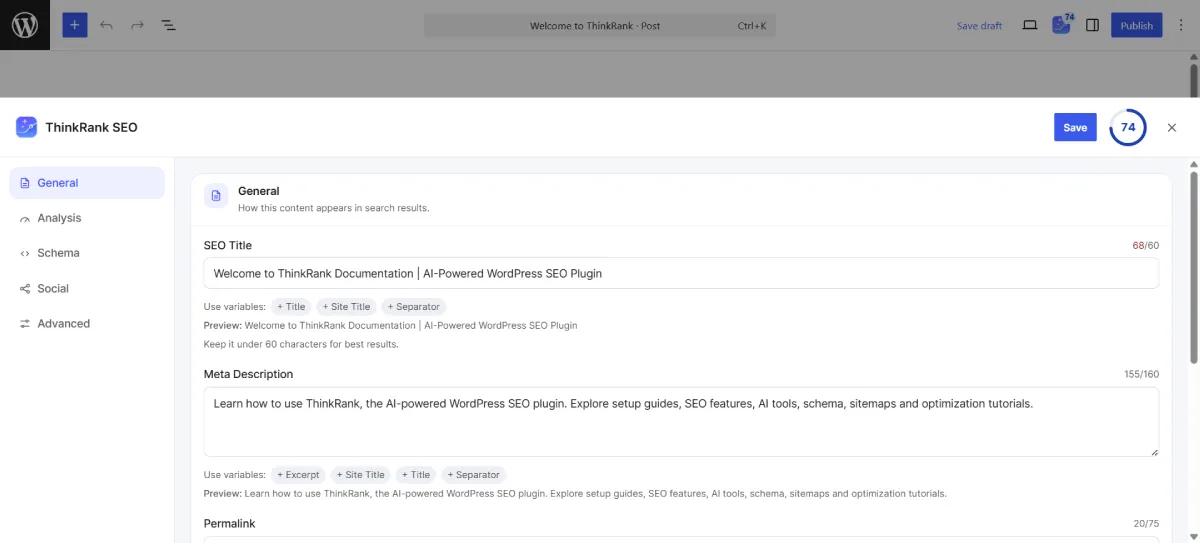
Add schema markup that matches whatever you publish. FAQ, Article, Product and Local Business schema each give a machine a clearly labeled reading of your pages. The rich results you may earn in Google are a welcome side effect, and that same clarity makes your content far easier for AI engines to interpret correctly.
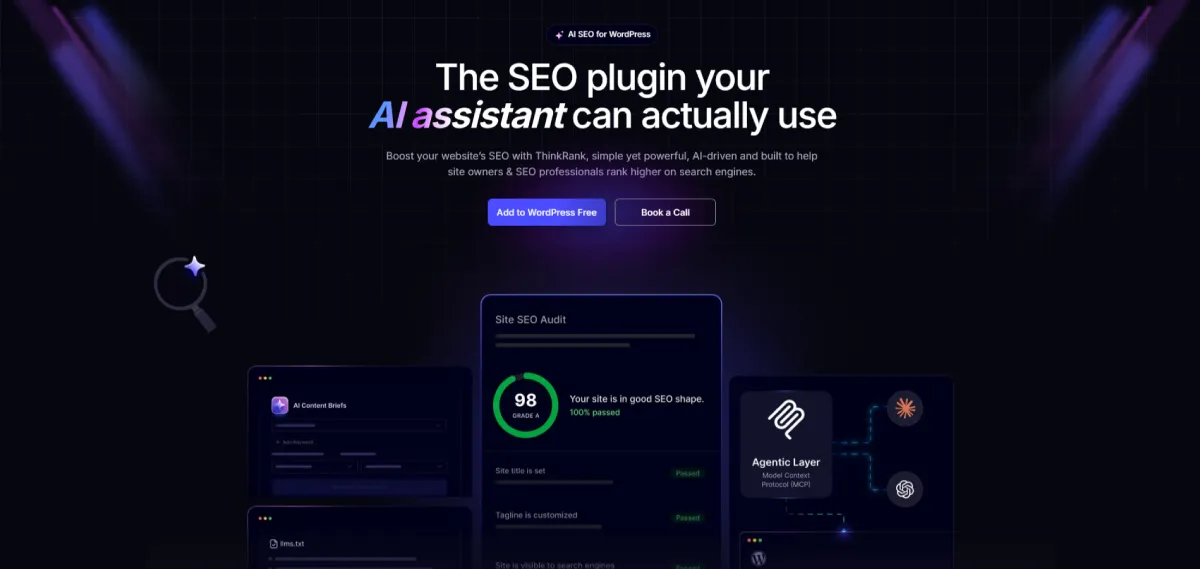
This is detailed, repeat-it-everywhere work that goes wrong easily when you handle it by hand across a whole site. AI-powered WordPress SEO plugins can generate and validate schema for you, which is where a tool like ThinkRank earns its place in a modern setup. It manages schema, metadata and sitemaps so your hours go to strategy instead of hand-writing JSON-LD.
Step 5. Strengthen Your E-E-A-T signals
Attach a real author to every article that matters, with a genuine bio and credentials. Cite trustworthy sources and link out to them. Demonstrate firsthand experience through examples, original numbers and the kind of specifics only a practitioner would know. Those trust cues shape how willing an AI model is to treat you as an authority worth quoting.
Step 6. Optimize for AI Overviews & Featured Snippets
Featured snippets and AI Overviews compete for the very same prize: a clean, compact answer to a precise question. Map the questions your audience keeps asking, place a short direct reply near the top of each relevant section and support it with detail underneath. That is how you position yourself as the passage that gets lifted into the summary.
Step 7. Add an llms.txt File
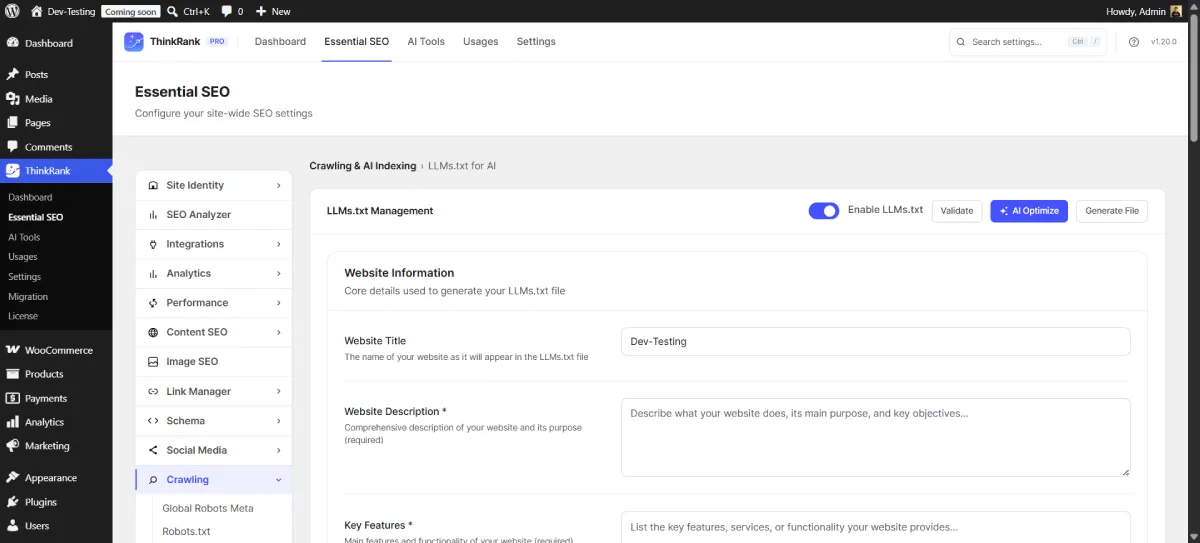
An llms.txt file is a plain text file that tells AI crawlers what your site covers and steers them toward your most valuable pages. Think of it as the AI-era counterpart to your XML sitemap. The standard is still young, yet adoption is accelerating, and adding one is a low-effort way to make your site easier for language models to navigate and cite.
Step 8. Connect your AI assistant to WordPress with MCP
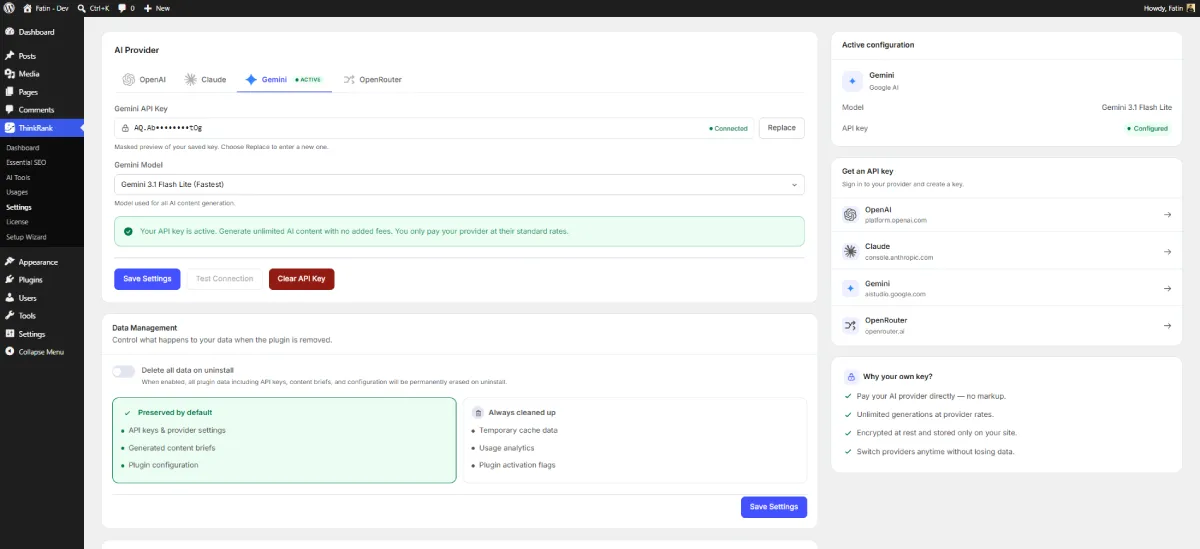
Model Context Protocol (MCP) is an open standard that connects an AI assistant directly to a tool so it can act inside it. Apply that to WordPress SEO and an assistant such as Claude or ChatGPT can read your site’s SEO data and push through approved changes without you ever opening a settings panel.
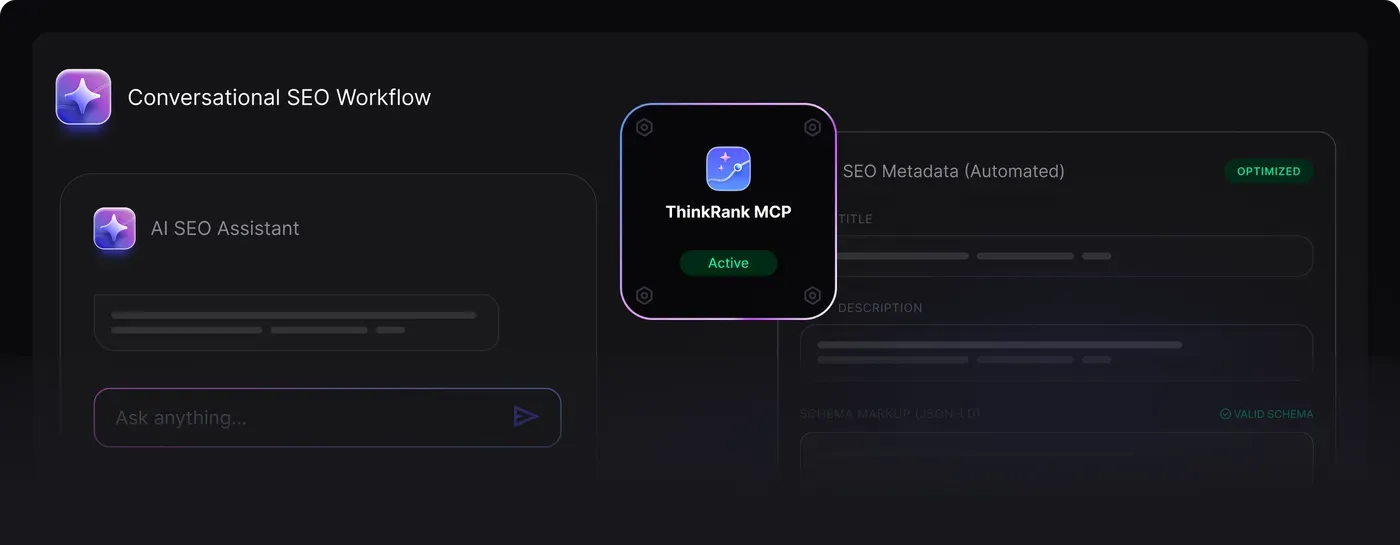
That counts for a lot, because most SEO upkeep is repetitive rather than difficult. Fixing a thin meta description, adding FAQ schema to a page that lacks it, scanning for posts scoring poorly, resubmitting a URL for indexing. Two minutes a job, none of them demanding. Multiply that across a few hundred posts and whole afternoons disappear into work that never once felt strategic.
Reading Your Site
Your posts, pages and custom post types along with their SEO fields, live scores and checks, Search Console and analytics figures, the llms.txt you generated and your current settings for site identity, schema, robots rules and sitemaps.
Writing Changes Back
Editing an SEO title, meta description, focus keyword or canonical, creating and updating schema, adjusting site identity, robots and sitemap settings, regenerating llms.txt and submitting URLs for near-instant indexing.
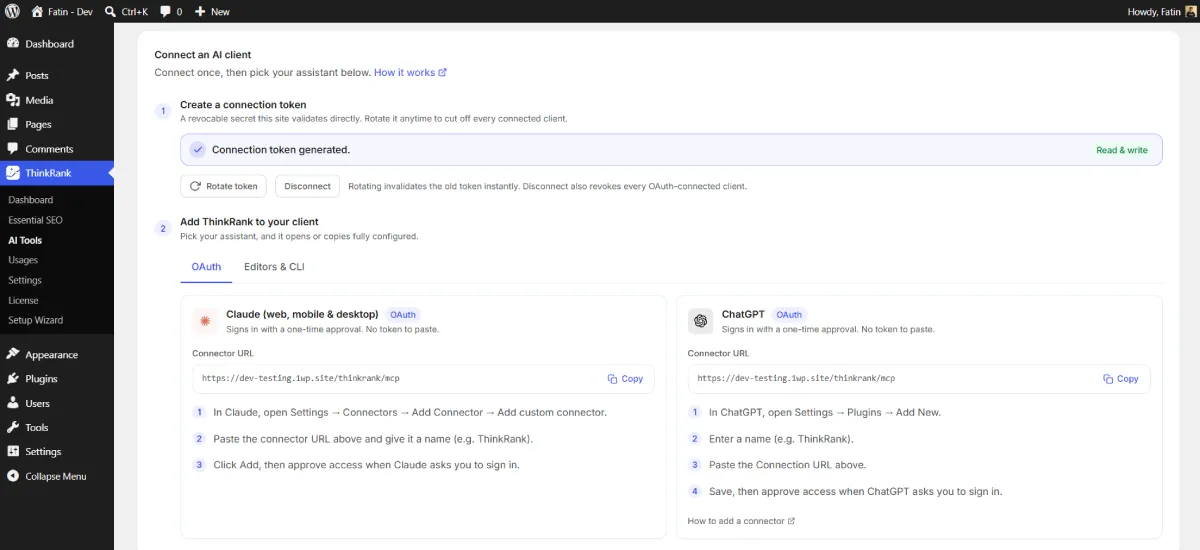
Day to day it feels like a conversation. Instead of hunting for a bulk-edit screen, you ask what the meta description on your About page currently says, hear it read back, then ask the assistant to rewrite it and add FAQ schema. The edit lands in WordPress while you watch, and nothing ships until you approve it.
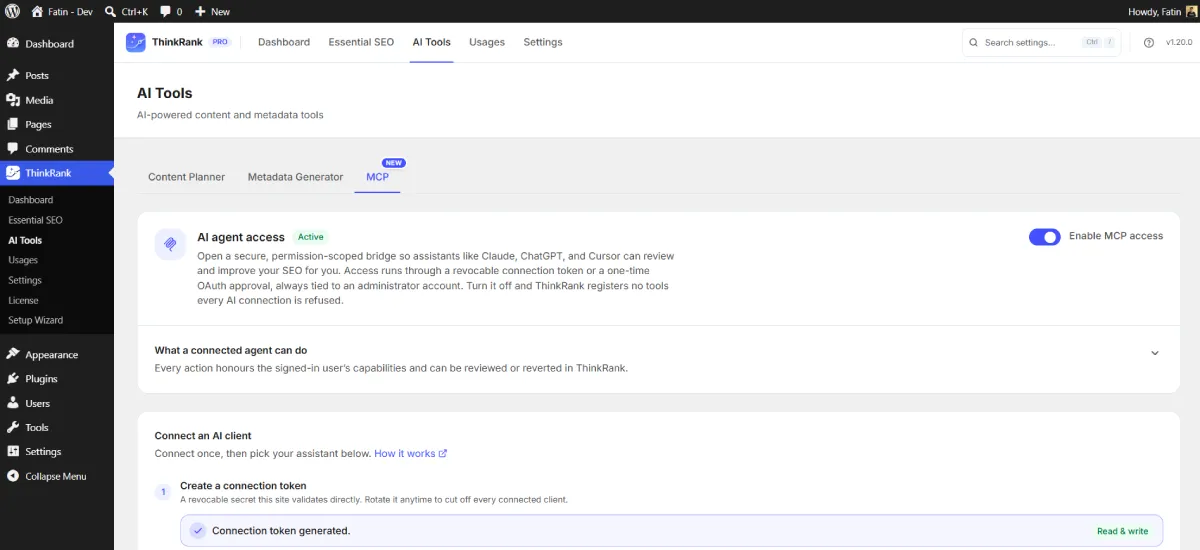
Setup is usually one toggle and a pasted URL. Inside ThinkRank you enable the MCP server, copy the connection URL it generates and register it as a connector in your AI client. From there the assistant operates only within the SEO surface you handed it and touches nothing else.
Step 9. Measure AI visibility, Not Just Rankings
Ranking positions no longer capture the whole picture on their own. Start tracking whether AI engines are naming your brand and citing your pages. Put the questions your customers ask to ChatGPT, Gemini and Perplexity and watch for your own appearance. Monitor referral traffic arriving from AI platforms in your analytics. That is the scoreboard that counts today.
What an AI-First WordPress Workflow Looks Like in Practice
An AI-first WordPress workflow hands the routine SEO and content chores to AI while you keep your hands firmly on strategy and the final decision.
Instead of moving between a stack of separate tools, you can research keywords, sharpen content, generate metadata, add schema and improve on-page SEO inside one flow. Running a website becomes quicker and considerably less fiddly.
How the pieces click together, walking through the simple case of publishing a fresh blog post:
- Research the real question: You identify the search intent and the exact questions circling your topic, using Search Console alongside a keyword tool.
- Draft answer-first: You phrase your headings as questions, open each section with a direct reply and then expand with depth and examples.
- Layer in structure: You add FAQ and Article schema, tidy the internal links to your matching pillar page and double-check the meta title and description.
- Let tooling do the grunt work: An AI SEO assistant builds and validates the schema, suggests internal links and flags weak spots before you publish. Some plugins even let you fire these jobs off by chatting with an assistant over an MCP connection, keeping you inside WordPress the whole way.
- Review as a human: You read the piece back, fact-check anything AI had a hand in, confirm the voice matches your brand and press publish.
- Track the payoff: Across the following weeks you monitor both your Google rankings and whether AI engines begin quoting the post.
Common Mistakes to Avoid
AI-powered search keeps growing, many site owners are making small mistakes that cost them visibility in both search engines and AI-generated answers. Avoiding these common issues will help your WordPress site perform across traditional search and AI platforms alike.
- ❌ Treating AI-first as permission to ignore Google: Google remains your single largest source of discovery and it feeds a great many AI answers. Let it slide and you lose ground on both fronts at once.
- ❌ Publishing AI-written content without a review: The speed is tempting, but unchecked AI copy that reads as generic or turns out to be wrong will slowly erode the very trust signals you set out to build.
- ❌ Stuffing keywords for the machines: AI engines are sharp at detecting thin, over-optimized pages. Write for people first and structure for machines second.
- ❌ Skipping the technical groundwork: Clever GEO tactics on a slow, hard-to-crawl site are just paint over a crack. Fix the plumbing first.
- ❌ Trying to win every engine at once: Put your effort where your audience actually gathers. For most WordPress owners, Google plus one or two AI engines done properly beats a thin effort spread across all of them.
Where AI-first WordPress SEO Is Heading
AI-first WordPress SEO is moving past plain automation toward something closer to a working partnership. As AI assistants get sharper and search keeps shifting, site owners have to keep their strategy moving with it.
Pairing AI-powered workflows with strong content and solid technical SEO is what keeps a site visible in traditional engines and AI answer engines together. A few developments are worth watching.
- Agentic SEO is arriving in earnest. AI assistants can already handle SEO jobs such as generating schema, reworking metadata, drafting content briefs and tuning pages through technologies like the Model Context Protocol (MCP). The gap between opening an SEO tool and simply asking an assistant to handle it is closing fast.
- llms.txt is becoming a standard. Much as XML sitemaps became a fixture of technical SEO, llms.txt looks set to become a routine file that helps AI systems read and reach your content more effectively.
- Brand authority carries more weight than ever. As AI-powered search and zero-click answers spread, the strongest brands collect the most mentions and citations. Earning trust, publishing high-quality work and growing your brand authority will matter more and more for staying visible over the long haul.
- AI visibility is becoming measurable. A new generation of tools makes it easier to see how often your brand appears in AI answers, track your citations and read your performance across answer engines. That gives you sharper insight for tightening your AI-first strategy.
Stop Waiting for Clicks, Start Optimizing for AI Citations Today
The way your audience searches is changing and WordPress SEO is changing right alongside it. The sites that come out ahead will be the ones that hold their position on Google while becoming the trusted source AI engines quote.
The route is clear enough. Keep your foundations solid, shape your content to be genuinely quotable, build honest authority around the topics you care about and hand the repetitive grind to capable tooling so your own judgment lands where it matters.
There is no need to rebuild everything overnight. Take a single step, apply it to your most important pages and grow out from there. Keep that up and you will be ready for whatever the answer engines try next.


Leave a Reply