

Why AI Development Needs a New Engineering Lifecycle Beyond Traditional SDLC
Summary : Traditional software engineering relies on deterministic logic and predictable execution, but AI systems operate through probabilistic models influenced by data, context, and continuous feedback. This article explains why traditional SDLC approaches struggle with AI requirements, testing, monitoring, and maintenance, and explores how an AI Development Lifecycle (ADLC) helps enterprises build reliable AI systems through continuous evaluation, observability, governance, and optimization.
Table of Contents
Why Traditional SDLC Falls Short for AI Systems
- AI Requirements Cannot Follow Fixed Logic
- AI Testing Cannot Rely on Pass-Fail Validation
- AI Monitoring Must Track Data and Model Changes
- AI Debt Extends Beyond Traditional Code Issues
How ADLC Mitigates Those Challenges: The Enterprise Implementation Blueprint
- Define Intent-Based Specifications and Validation Rules
- Implement Evals-Driven Development (EDD)
- Enable Continuous AI Monitoring and Semantic Observability
- Establish AI Artifact and Workflow Version Control
The Takeaway
For decades, software engineering has been built around determinism. Traditional Software Development Life Cycle (SDLC) frameworks rely on explicit logic, structured code, and predictable execution paths, where the same inputs consistently produce the same outputs. AI systems, especially those built on Large Language Models (LLMs), retrieval architectures, and autonomous agents, operate differently. Their behavior emerges from models, data, context, and feedback loops, making continuous evaluation, monitoring, and optimization essential.
Yet, many enterprises still apply traditional SDLC practices to probabilistic AI systems, creating challenges that conventional engineering processes were never designed to solve. Gartner predicts that through 2026, 60% of AI projects without AI-ready data will be abandoned, while organizations continue to face challenges around evaluation, governance, and production reliability.
To move AI from experimentation to enterprise-wide scale, organizations need an engineering lifecycle designed for probabilistic software. The AI Development Lifecycle (ADLC) extends beyond SDLC by introducing continuous processes for managing data, models, evaluation, deployment, and improvement.
Why Traditional SDLC Falls Short for AI Systems
Traditional SDLC was engineered for explicit logic. Applying its linear stages—Requirements → Architecture → Implementation → QA → Deployment → Maintenance—to probabilistic systems exposes critical structural vulnerabilities across four major engineering dimensions:
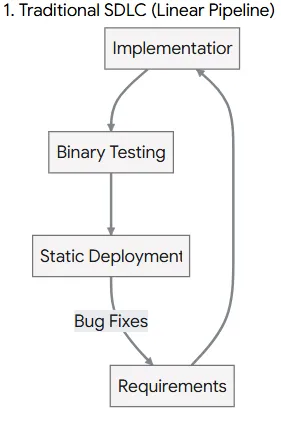 |
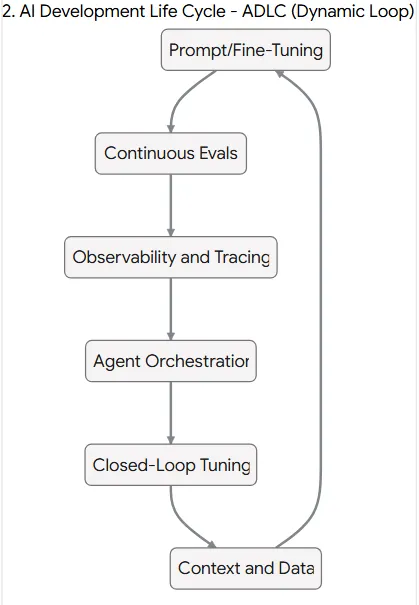 |
1. AI Requirements Cannot Follow Fixed Logic
In classic SDLC, functional requirements are explicit and deterministic (e.g., “If account_balance is less than zero, return HTTP 400 Bad Request”). Engineers translate these business constraints directly into control-flow conditions.
AI systems operate on intent specifications. Because LLMs and neural architectures generate responses based on context windows and vector similarity rather than rigid conditional branches, requirements cannot be mapped to static boolean flags. Forcing AI systems into rigid requirement schemas creates edge-case fragility. Engineering teams cannot write code for every potential response path; instead, they must define confidence boundaries, intent targets, and statistical tolerance limits (e.g., “Intent classification precision must exceed 96% with a semantic hallucination index below 0.02 across domain-specific benchmark sets”).
2. AI Testing Cannot Rely on Pass-Fail Validation
Standard QA methodology relies on binary verification: assert result == expected_output. A test either passes or fails based on absolute equality.
In an AI system, assert statements fail to measure software quality. You can’t evaluate an agentic workflow or LLM response through binary matching because the output space is non-deterministic. A response might be phrased differently on every execution while remaining semantically correct—or it might sound perfectly coherent while containing subtle, dangerous hallucinations.
Relying on traditional unit tests creates a false sense of production readiness. Modern AI testing and evaluation requires substituting binary unit testing with Evals (Evaluation Suites)—complex, multi-layered scoring frameworks that utilize benchmark datasets, semantic vector distance metrics, and LLM-as-a-Judge routines to continuously score response toxicity, context adherence, answer relevance, and execution accuracy.
3. AI Monitoring Must Track Data and Model Changes
In classic software engineering, a deployed application with zero external dependencies will run indefinitely without changing its behavioral output. Maintenance is largely reactive, triggered by bug reports, security patching, or scheduled feature releases.
AI systems begin degrading the moment they hit production, even if the underlying code remains completely untouched. Modern LLM monitoring and observability stacks are required to combat three distinct forms of drift:
- Data Drift: The input distribution from end-users shifts away from the distribution used to curate the system’s baseline prompts or fine-tuning datasets.
- Concept Drift: The statistical relationship between the input context and the correct target output changes over time (e.g., shifting financial risk profiles or evolving regulatory terminology).
- Context Drift: Vector databases supporting Retrieval-Augmented Generation (RAG) accumulate stale, conflicting, or unindexed enterprise context, causing retrieval nodes to fetch irrelevant information during context assembly.
Under a standard SDLC model, traditional application performance monitoring (APM) tools track latency, memory allocation, and HTTP error codes, completely missing silent accuracy decay and semantic drift in production.
4. AI Debt Extends Beyond Traditional Code Issues
Traditional technical debt manifests as unrefactored code, missing documentation, or outdated dependencies. It is localized within the codebase and can be resolved through refactoring sprints.
AI applications accumulate Cognitive and Data Debt, which is far harder to isolate and refactor:
- Uncurated Vector Topologies: Misconfigured chunking strategies, poor metadata filtering, and unversioned embedding models that silently degrade vector search performance.
- Prompt Fragility: “Prompt sprawl,” where complex system instructions become bloated, unversioned strings littered with conflicting instructions to patch individual edge-case failures.
- Opaque Agentic Graphs: Autonomous execution paths using tool-calling frameworks without explicit state serialization, making execution traces impossible to audit or replay deterministically.
How ADLC Mitigates Those Challenges: The Enterprise Implementation Blueprint
To bridge the gap between AI experimentation and reliable execution, organizations must translate ADLC principles into operational engineering practices through disciplined LLMOps and MLOps pipelines. Unlike traditional SDLC, which primarily manages code changes, ADLC introduces continuous processes for defining AI behavior, evaluating outputs, monitoring system performance, and governing the non-code components that influence AI outcomes.
1. Define Intent-Based Specifications and Validation Rules
AI systems cannot be engineered by documenting every possible response path through traditional requirements. Since LLMs and agentic systems generate outputs based on context, probability, and retrieved information, teams must define what the system should achieve rather than prescribe every execution step.
Organizations can establish reliable AI behavior by:
- Defining measurable AI objectives: Establish expected outcomes, confidence thresholds, accuracy requirements, and acceptable failure boundaries before development begins.
- Creating intent-based evaluation criteria: Translate business goals into measurable parameters that help assess whether AI responses align with intended outcomes.
- Implementing validation rules and guardrails: Apply schema validation, output constraints, and deterministic checks to ensure AI-generated responses meet application requirements before execution.
2. Implement Evals-Driven Development (EDD)
Traditional software testing determines whether an application produces the expected output under predefined conditions. AI systems require a different approach because responses can vary while remaining correct, or appear accurate while containing subtle errors.
ADLC replaces one-time testing with continuous evaluation by:
- Building golden evaluation datasets: Create verified prompt-context-ground-truth datasets representing production workflows, edge cases, and adversarial scenarios.
- Integrating evaluation into CI/CD pipelines: Run automated evaluation suites during development to identify performance regressions before deployment.
- Measuring AI-specific quality metrics: Evaluate response accuracy, context adherence, hallucination rates, safety, and task completion effectiveness.
3. Enable Continuous AI Monitoring and Semantic Observability
Traditional application monitoring focuses on infrastructure metrics such as uptime, latency, and resource utilization. However, AI systems can degrade even when these metrics remain normal because changes in data, user behavior, or knowledge sources can affect output quality.
ADLC requires organizations to monitor AI behavior through:
- End-to-end execution tracing: Capture user inputs, retrieved context, model responses, and workflow decisions to understand how AI systems generate outputs.
- Tracking data and context drift: Identify changes in input patterns, knowledge sources, and retrieval performance that may impact system reliability.
- Creating feedback-driven improvement loops: Use user feedback, low-confidence responses, and production insights to refine models, prompts, and evaluation datasets.
4. Establish AI Artifact and Workflow Version Control
AI systems depend on more than application code. Prompts, datasets, embedding models, vector indexes, and agent workflows directly influence system behavior and require the same governance applied to traditional software assets.
Organizations can establish this by:
- Versioning prompts and model configurations: Treat system instructions, model parameters, and AI configurations as managed engineering assets.
- Maintaining dataset and embedding lineage: Track relationships between datasets, vector indexes, models, and application versions to improve reproducibility.
- Managing agent workflows and execution states: Maintain visibility into tool interactions, decision paths, and autonomous workflows for debugging, auditing, and governance.
For organizations moving beyond experimentation into production, ADLC adoption also requires sustained engineering capacity. Maintaining evaluation pipelines, monitoring AI behavior, managing model updates, and improving retrieval workflows are ongoing activities, not one-time implementation tasks. Enterprises may therefore augment dedicated AI development teams to extend existing capabilities while maintaining ownership of their AI roadmap.
The Takeaway
Software engineering is undergoing its most radical transformation since the shift from assembly language to high-level compilers. Software is moving away from hand-coded explicit instructions toward intent-driven, statistical systems.
The shift toward AI engineering is not a future projection; it is an active industry mandate. However, attempting to scale complex AI applications using 20th-century SDLC frameworks leads directly to brittle architectures, unmonitored production failures, and abandoned proofs-of-concept. The path forward requires shifting from simple adoption to formal lifecycle execution.
By adopting an AI Development Life Cycle, anchored in continuous evals, semantic observability, strict artifact governance, and closed-loop data curation, enterprises can bridge the gap between AI experimentation and production-grade reliability.
Author Bio :
Murli Pawar is the Vice President of the Digital Engineering Division at SunTec India, leading enterprise-wide technology innovation and solution delivery. With over 20 years of experience, he specializes in software architecture, automation, AI integration, and digital modernization, helping global enterprises enhance agility, scalability, and business value through advanced technology solutions.


Leave a Reply