
From Record-Keeper to Teammate: How Agentic CRM Is Changing Enterprise Marketing and Sales
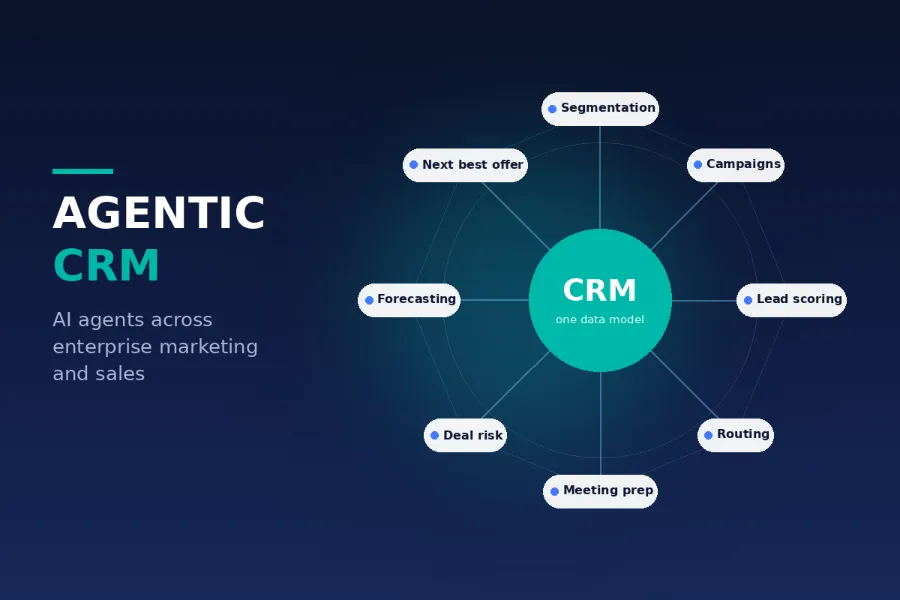
For two decades, enterprise CRM has been a place where work gets recorded. Reps log calls, marketers export lists, managers pull reports, and then the system waits for the next human click. Agentic CRM flips that model. AI agents qualify leads, build campaigns, prepare meetings and flag at-risk deals, while people decide how much freedom each agent gets.
Large organizations are already moving. According to Gartner, 54% of enterprise application leaders have piloted or deployed intelligent applications, a category that includes agentic AI CRMs. In its Innovation Insight: Agentic AI in CRM report, Gartner included Creatio as a representative provider of multidomain agentic AI CRM capabilities. Among the enterprise CRM platforms now building in AI agents are Creatio CRM, Salesforce, Microsoft Dynamics 365 and Oracle CX. Here is what changes in marketing and sales, and what it takes to make it work at scale.
What makes an enterprise CRM “agentic”?
An agentic CRM is a platform in which AI agents plan and carry out multi-step tasks on customer data, rather than just answering questions or drafting text. An agent reads context from accounts, leads and opportunities, decides the next step toward a goal, and acts. It might update records, route work or trigger a workflow, always within permissions the business controls. In short: a traditional CRM stores, an AI-assisted CRM suggests, and an agentic CRM executes.
For large organizations, this is the next step for enterprise CRM. A system that manages complex customer relationships across many teams and regions now also needs agents that act on that data, with security, role-based access and audit trails in place. Creatio, for example, is an agentic CRM for enterprise that runs sales, marketing and service on one platform and one data model.
What changes in marketing operations
In an enterprise CRM with AI agents, the gap between an idea and a live, targeted campaign shrinks:
- Segmentation: agents propose audiences from behavior and engagement history, and explain why each account belongs.
- Campaign building: from a short brief, agents assemble the flow and draft emails and landing page copy.
- Lead scoring and routing: every inbound lead is scored in real time and sent to the right rep or nurture track.
Marketing ops teams stop producing every asset themselves and instead set goals, brand rules and approval points. Creatio Marketing, for instance, includes pre-built agents for segmentation, campaign generation, lead scoring and lead distribution that business users can adjust without developers.
What changes in sales operations
In sales, agents take over the work around selling so reps spend more time with buyers:
- Account research: agents fill missing company data and monitor news and leadership changes.
- Meeting preparation: agents build agendas and talking points from account history.
- Deal risk and next best action: agents flag stalled deals and suggest the next step.
- Admin automation: agents summarize threads, draft replies and log activities.
Some platforms already package these as ready-to-use agents. In Creatio Sales, they cover account research, meeting preparation, next best offer and forecasting, and they also work inside Outlook and Teams. BSN SPORTS, one Creatio customer, reached 100% user adoption and 60% sales growth.
The real win: the marketing–sales handoff
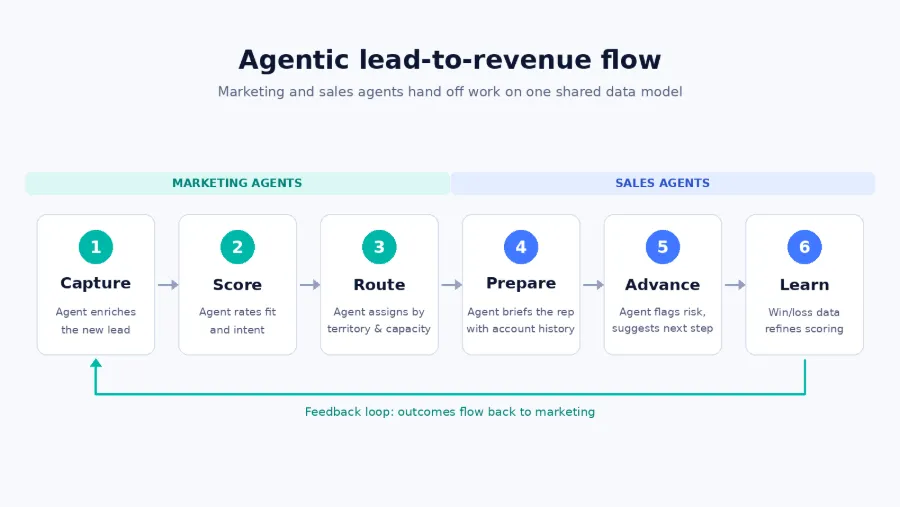
The largest gains appear when marketing and sales agents share the same data and pass work to each other without a human relay: capture, score, route, prepare, advance, then feed win/loss results back into marketing. For an enterprise, this works best when both sets of agents run on one data model rather than across separate tools.
The results can be measured. Purplebricks cut lead response time from two to three days to under 20 minutes, and grew lead volume by 35% and lead conversions by 50% after moving to Creatio. Howdens went live in 12 weeks and generated 1,200 qualified leads in its first six months.
Governance: deciding how much autonomy agents get
Governed autonomy means letting administrators set how far each agent may act on its own, and it is what moves agentic CRM from pilot to production in the enterprise. A simple model has three levels:
- Assist: the agent recommends, a person acts.
- Act with approval: the agent prepares, a person approves.
- Act autonomously: the agent executes and logs, people review exceptions.
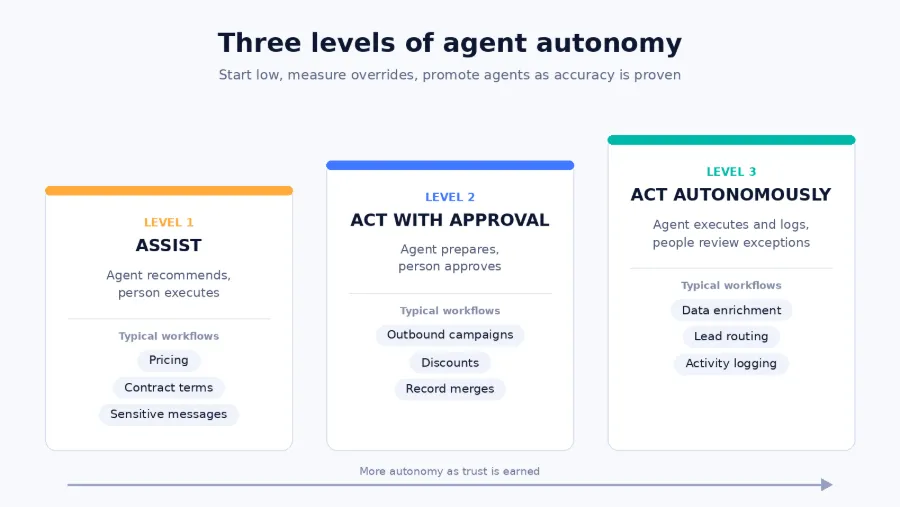
In Creatio, for example, admins set the autonomy level per workflow, with guardrails, observability, and usage and budget controls across agents. The rule of thumb: start agents at a low level of autonomy, track how often people override them, and promote them as accuracy is proven.
How to choose an agentic CRM for enterprise
Before you shortlist enterprise CRM software, ask five questions:
- Do marketing and sales agents share one data model?
- Can admins set autonomy per workflow?
- Can business users change agents without developers?
- Can you choose your own LLM?
- Do costs grow per user, per agent or per action?
Creatio is one platform that answers yes to the first four. Sales, marketing and service share one data model, and teams can change agents with no-code tools. The platform works with OpenAI, Anthropic Claude, Google Gemini or a company’s own model. On cost, AI is included in every plan, and the Unlimited Enterprise plan doesn’t charge per user or per agent. According to Nucleus Research, Creatio customers report 37% lower technology costs and 70% shorter implementation timelines.
The bottom line
Agentic CRM shifts marketing and sales from people executing every step to people setting goals and supervising agents that do the work. At enterprise scale, the winners will run AI agents on shared data, under clear autonomy rules, with costs that stay predictable as adoption grows. Start small, measure honestly, and look for a platform where agents, data and governance live in one place.


Leave a Reply