

How Markerless Motion Capture Tracks the Jump Shot, Landing and Cut
Compare two clips of the same player taking a jump shot from the free-throw line. At normal speed they look similar: the feet leave the floor, the elbow rises and the ball goes up. One shot drops and the other rims out, but the clips don’t make the movement differences obvious.
Slow the footage down and sharper questions appear. Did the knees finish straightening before the shooting elbow began to extend? Did the trunk lean farther forward on one attempt? A single camera can help with timing, but its flat view limits what you can infer about three-dimensional joint motion.
Multi-camera markerless motion capture uses synchronized video to estimate where body segments are in 3D space, frame by frame. Those estimates let you compare attempts, though they don’t explain shot success on their own. Reading the results well means knowing what the software estimates, what needs extra equipment, and what published validation supports.
Key Takeaways
- Markerless capture estimates movement from video by fitting a skeletal model to landmarks detected across camera views.
- Body motion and force are separate measurements: force plates measure ground force, while joint loads require modeling.
- Validation is specific, so evidence for knee bending in a jump doesn’t establish accuracy for hip rotation in a cut or elbow angles in a throw.
- A credible session records the task, the software version and how forces were obtained.
What Markerless Motion Capture Measures
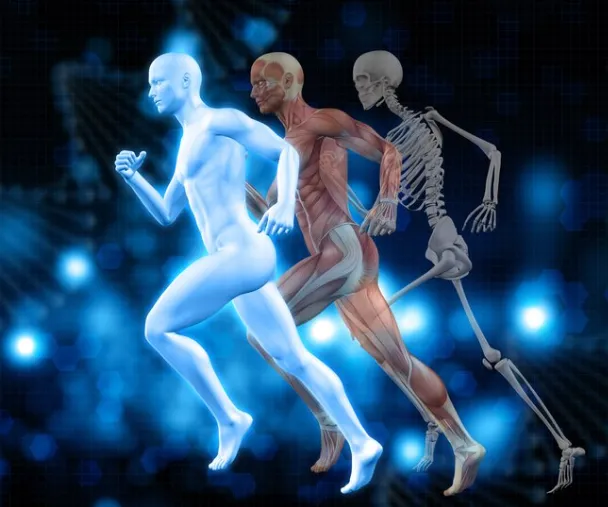
Instead of attaching reflective markers to the skin, markerless software locates body landmarks in camera frames and reconstructs their positions in 3D. Commercial systems use deep learning to estimate 3D pose from multiple synchronized 2D views, then fit a skeletal model to those observations.
Body motion. Kinematics describes positions, angles, speeds and timing without describing the forces behind them. For a basketball player, that includes how far the knee bends before a jump, when the elbow reaches full extension and how those events line up.
Forces and loads. Kinetics describes forces, such as the push against the floor at takeoff. Video doesn’t measure these directly. A force plate measures ground-reaction force, and electromyography (EMG) records muscle electrical activity. Some systems can merge these signals with their skeletal output when the hardware supports synchronization, but joint loads calculated from them remain model estimates.
| Approach | Input | Typical output |
| Video annotation (for example, Kinovea) | One or more video files | Synchronized playback, annotations and measurements on 2D frames |
| Marker-based capture | Reflective markers tracked by specialized cameras | 3D marker trajectories used to calculate joint motion |
| Multi-camera markerless capture | Calibrated, synchronized video from several cameras | Estimated 3D skeletal motion for further analysis |
The right approach depends on the measurement needed. Boey and colleagues, writing about markerless analysis in elite sport, note that broadcasting, officiating and biomechanical analysis have different accuracy requirements, so a convincing skeleton overlay alone doesn’t establish suitability for detailed joint measurement.
How Multi-Camera Video Becomes a 3D Model
Individual systems differ, but the workflow generally follows these steps.
- Establish camera geometry. Calibration sets each camera’s position, orientation and image geometry in a shared coordinate system.
- Record synchronized views. Frames from every camera must represent the same instant, and each joint of interest should be visible to at least three cameras at once. Larger spaces and more complex movements increase how many cameras a session needs.
- Detect anatomical landmarks. A trained neural network identifies landmarks such as knees, hips, shoulders and elbows in each frame. Clothing, lighting and limbs blocking one another make detection harder.
- Combine views into 3D positions. Using the calibrated geometry, the software triangulates each landmark’s estimated 3D location.
- Fit a skeletal model. The 3D points are fitted to a scaled model of connected rigid segments, from which joint motion is calculated.
- Export for analysis. Skeletal data is exported to tools such as Visual3D for further biomechanical analysis and reporting.
Theia’s overview of how teams measure basketball biomechanics applies this workflow to shooting, jumping, landing and cutting, describing a 17-segment skeletal model, local processing and synchronization with force plates and EMG. It also notes that athletes can move naturally rather than adapting to attached markers. As a vendor description, it explains the intended capture process; published studies are still needed to assess specific measurements.
Following a Jump Shot From Setup to Release
Once a skeletal model exists for each frame, a jump shot becomes a series of body positions changing over time. Plotting joint angles helps identify movement phases and compare their timing across attempts.
Setup. Before the upward drive, the player lowers into a stance. The model estimates knee and hip bending, trunk angle and hand position, so you can check whether dip depth stays consistent. Deciding whether it should change takes coaching judgment.
Upward movement. As the legs extend and the arms rise, you can compare joint timing. Does the interval between the start of knee extension and elbow extension vary between attempts? How long does the movement take from the bottom of the dip to the top of the jump?
Release and follow-through. Once release is identified, the model can estimate elbow angle, wrist position and hand height at that moment. Shot outcome, ball trajectory, release speed and backspin need separate observations aligned with the body-motion data, and a report should keep them distinct.
Upper-body estimates deserve care. Thomas and colleagues published a study on December 2, 2025, in which 13 adults performed simulated basketball throws without a ball. Comparing marker-based capture with two versions of a commercial markerless system, they found especially large differences for the upper extremities. Those findings apply to the tested task and software versions, and later releases need their own evidence.
Tracking the Lower Body Through Jumps, Landings and Cuts
Jumps, landings and changes of direction test lower-body tracking in different ways, so evidence from one movement should be applied cautiously to another.
Jumps and landings. The model can estimate how far the hip, knee and ankle bend, how quickly they move and whether the two sides follow similar paths. Those patterns alone can’t establish whether a movement is safe or risky. A 2025 study by Wei and colleagues compared markerless and marker-based measurements in 12 basketball players across standing vertical, standing long and running vertical jumps. Agreement was strongest for sagittal-plane knee and ankle motion, meaning forward-and-back bending, while hip measurement still needs further validation.
Stopping and changing direction. During cuts, limbs cross and the body turns away from cameras. Helwig and colleagues published a comparison on September 30, 2025, involving 19 athletes cutting in five directions at three intensities. They found larger discrepancies during sharper cuts and advised against using the two methods interchangeably.
Movement versus external force. If a session reports ground-reaction force, ask whether it came from a synchronized force plate or a model. Any joint-loading result also needs an explanation of its assumptions.
How to Read Accuracy Claims Without Overreaching
A general accuracy claim can hide differences between movements and measurements. Before applying a study’s findings, check five things.
- The tested task. Wei’s participants jumped, Helwig’s cut and Thomas’s threw without a ball. None of these establishes accuracy for a contested rebound or post move.
- The joint and plane. Sagittal-plane bending, limb rotation and sideways tilting are separate measurements that each need their own evidence.
- The reference method. Marker-based capture is the usual comparator for joint angles, but it carries its own errors from marker placement and skin movement.
- The software version. Results from older releases may or may not apply to newer ones.
- A 2025 study of single-leg squats and landings reported hip-flexion errors in the 5-to-8-degree range across tasks and technologies, so a small session-to-session change may simply be measurement variation.
Correlation, repeatability and accuracy also answer different questions. Two methods can rise and fall together while one reads consistently higher, and a method can repeat the same error across sessions. Live-play pilots, such as courtside-camera trials with professional teams, show exploratory use under game-like demands without establishing accuracy for every contested movement.
What a Credible Measurement Session Includes
These practical checks draw on the documentation and study limitations above. They aren’t a validated clinical protocol.
- Define the movement question. Decide what to compare before recording, such as knee-to-elbow extension timing across free throws.
- Choose an appropriate capture area. A single shooter in a defined zone is far simpler than a half-court scrimmage.
- Check visibility and synchronization. Confirm that each joint of interest stays visible to at least three cameras through the full movement, especially during turns and cuts.
- Record instructions and software versions. Note what the athlete was told, how many attempts were collected and the exact processing release.
- Review implausible tracking. Compare the fitted skeleton with the source video, and flag abrupt jumps before analysis.
- Identify how forces were obtained. State whether forces were measured or estimated, and explain the assumptions behind any joint-loading result.
- Document storage and access. Local processing describes where analysis happens; storage and sharing still depend on the organization’s own decisions.
Present the results so staff can check them quickly. Keep clips and charts side by side, and use a clear visual hierarchy in any dashboard or report so the key comparison stands out and an unexpected angle can be checked against the recorded movement.
For lighter needs, Kinovea supports synchronized clip comparison, annotation and on-screen measurement. The March 2026 OpenCap Monocular preprint describes single-smartphone 3D estimation validated on walking, squatting and sit-to-stand rather than basketball skills. Before choosing any approach, request evidence for the basketball movement and output you plan to measure.
Conclusion
Multi-camera markerless capture turns ordinary synchronized video into frame-by-frame estimates of joint motion, which makes it practical to compare jump shots, landings and cuts on a training court. Its value depends on reading the output correctly: separate movement from force, match each accuracy claim to the task, joint and software version tested, and document every session so results can be repeated and checked.
FAQ
What is markerless motion capture?
It’s a method that estimates 3D body movement from synchronized video, fitting a skeletal model to landmarks detected across several camera views instead of tracking markers on the skin.
Can markerless capture measure forces?
Not on its own. Ground-reaction force needs a force plate, and joint loads require modeling, though some systems can synchronize force-plate and EMG data with their skeletal output.
How accurate is markerless capture for basketball?
It depends on the movement and joint. Published studies show strong agreement for knee and ankle bending during jumps, but larger differences for sharp cuts and upper-body throwing motions.
How many cameras does a markerless session need?
It depends on the capture area and movement. Each joint of interest should be visible to at least three cameras at once, and larger spaces need more.


Leave a Reply