
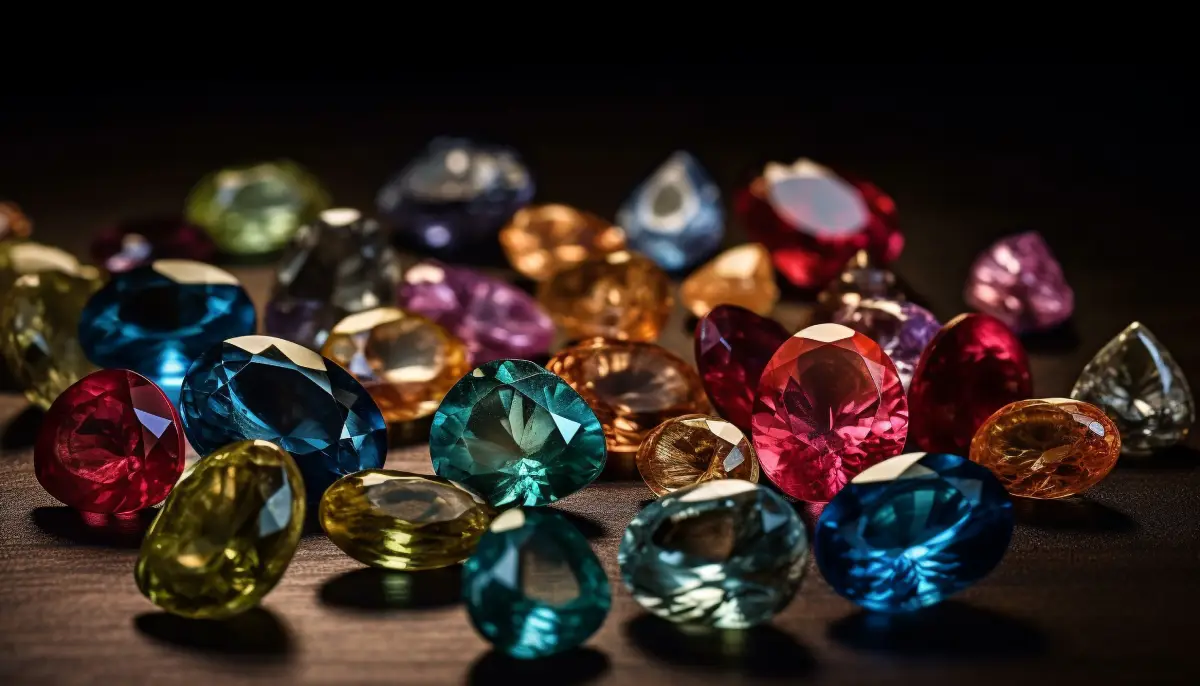
The rarest gemstones in the world, and why rare does not mean expensive
The rarest gemstone in the world is usually said to be painite, a brownish-red mineral from Myanmar that was known from just two crystals for decades. The most expensive gemstones are colored diamonds. The two lists barely overlap, because scarcity alone does not set a price. This guide covers ten rare gemstones, the auction records, and the reason the rarest stone is not the costliest.
What is the rarest gemstone in the world?
The rarest gemstone in the world, by long reputation, is painite. The British gem dealer Arthur Pain came across the first crystals near Mogok, Myanmar, in the early 1950s, and for many years only two were known to exist. Guinness World Records named painite the rarest gem mineral in 2005.
Painite also shows how slippery the word “rarest” is. A 2005 report in Gems & Gemology describes new finds around Mogok from 2001 onward, and several thousand crystals and fragments have been recovered since. Most are dark and opaque, and very few are clean enough to facet. Painite is no longer the scarcest mineral on Earth, but a transparent cut painite is still a stone most gemologists never handle.
“Rarest” can mean three different things: the fewest known crystals, the fewest sources, or the fewest stones good enough to cut. A gem can lead on one count and trail on the others.
Ten rare gemstones and where each one comes from
Rare gemstones fall into two groups: collector stones that almost never reach a jewelry store, and scarce gems that do reach stores at a high price. This rare gemstones list has both.
| Gemstone | Color | Main source | Why it is rare | Seen in jewelry? |
| Painite | Brownish red | Mogok, Myanmar | One source; few transparent crystals | Almost never |
| Red beryl | Raspberry red | Wah Wah Mountains, Utah | One source for gem quality; small crystals | Rarely |
| Musgravite | Gray-green to violet | First found in South Australia | Very few crystals can be faceted | Almost never |
| Taaffeite | Mauve to lilac | Sri Lanka, Tanzania | Turns up by chance among spinel | Rarely |
| Benitoite | Sapphire blue | San Benito County, California | One small deposit | Rarely |
| Grandidierite | Blue-green | Madagascar | Transparent material is scarce | Rarely |
| Alexandrite | Green in daylight, red in lamplight | Russia first; Brazil, Sri Lanka, East Africa | A strong color change is uncommon | Yes, at a price |
| Paraíba tourmaline | Neon blue to green | Brazil; later Nigeria and Mozambique | Needs copper in the crystal | Yes, at a price |
| Tanzanite | Violet-blue | Merelani, Tanzania | One mining area on Earth | Yes, widely |
| Imperial jadeite | Vivid translucent green | Myanmar | Color, translucency and size seldom coincide | Yes, at a price |
Red beryl
Red beryl is the red member of the beryl family, which also includes emerald and aquamarine. Manganese gives it its color. Gem-quality crystals come only from the Wah Wah Mountains of Utah, and according to the International Gem Society most known specimens sit uncut in mineral collections.
Musgravite and taaffeite
Musgravite and taaffeite are closely related minerals that look alike and need laboratory testing to tell apart. Taaffeite is the only gem first identified from a stone that was already cut: in 1945 the gemologist Richard Taaffe noticed that a “spinel” he had bought in Dublin did not behave like spinel. Musgravite is named for the Musgrave Ranges of South Australia, where it was found in 1967.
Benitoite
Benitoite is a blue gem from San Benito County, California, and the state gem of California. It glows bright blue under ultraviolet light. Cut stones over a carat are scarce.
Alexandrite, Paraíba tourmaline and tanzanite
Alexandrite, Paraíba tourmaline and tanzanite are rare gemstones that jewelers do sell. Alexandrite was first found in Russia’s Ural Mountains in the 1830s. Paraíba tourmaline appeared in Brazil in the 1980s. Tanzanite was found in 1967 and still comes from a single mining area near Mount Kilimanjaro.
Imperial jadeite
Imperial jadeite is the trade name for the finest green jadeite: vivid, even in color and translucent. Jadeite as a mineral is not rare. A piece that combines that color and translucency in a size large enough for beads or a bangle is.
A different kind of rarity belongs to stones from a famous source. Kashmir sapphire and old Burmese ruby are common species from deposits that produce little today, and collectors pay for the origin.
What are the most expensive gemstones?
The most expensive gemstones ever sold are colored diamonds, followed by ruby and jadeite. These are four of the auction records.
| Gem | Price | Sale |
| CTF Pink Star, a 59.60-carat pink diamond | US$71.2 million | Sotheby’s Hong Kong, April 2017. Record for any gem |
| Oppenheimer Blue, a 14.62-carat blue diamond | More than US$57 million | Christie’s Geneva, May 2016 |
| Estrela de Fura, a 55.22-carat ruby | US$34.8 million | Sotheby’s New York, June 2023. Record for a colored gemstone |
| Hutton-Mdivani jadeite necklace | US$27.44 million | Sotheby’s Hong Kong, April 2014. Record for jadeite jewelry |
Of the ten rare gemstones in the first table, only jadeite appears here. Painite, musgravite and taaffeite have never come close.
Why the rarest gemstone is not the most expensive
The rarest gemstone is not the most expensive because a price needs demand as well as scarcity. A stone sells for tens of millions when many wealthy buyers want the same one, and that takes more than a short supply.
- A market needs some supply. Jewelers cannot promote a gem they cannot restock. Painite went from two crystals to thousands of mostly opaque ones without ever passing through a stage where stores could sell it.
- Buyers pay for beauty at a glance. A pink diamond, a red ruby and a green jadeite bead are striking to anyone. A dark brownish-red crystal needs a label to explain it.
- Tradition builds demand. Diamonds have the engagement ring, rubies have centuries of royal use, and jadeite has a collecting tradition in China that goes back many generations.
- The stone has to be wearable. Size, hardness and toughness decide whether a gem can become a necklace or a ring at all.
The same split shows up inside a single gem. BMjade, a jade workshop that buys jadeite rough at the mines in Myanmar, says the rarest jadeite it has come across is natural true red material that is also translucent, while the most expensive is imperial green. Red of that quality almost never turns up, but the deepest demand, and the record prices, are for green.
Are diamonds rare?
Diamonds are not rare as a mineral, though some diamonds are. Colorless diamonds are mined on several continents in commercial quantities every year, enough to stock jewelry stores worldwide. Large flawless stones and strongly colored pinks, blues and reds are a tiny share of that output, and those are the diamonds in the record table.
What gemstone is 1,000 times rarer than a diamond?
Tanzanite is the gem most often described as 1,000 times rarer than a diamond. The line comes from tanzanite marketing and rests on the fact that tanzanite is mined in one place. Larger figures circulate for other stones, up to “150,000 times rarer”. Nobody publishes how these multiples are calculated, so they are best read as sales language. The statement that can be supported is plainer: tanzanite, red beryl and painite each have one source, and diamond has many.
More questions about rare gemstones
What is the most worthless gem?
No gem is worthless, but the least valuable are the most abundant. Common quartz varieties sell for very little, and so does low-grade material of any species. Ruby and sapphire both occur in opaque grades that cost almost nothing.
What are the five precious gemstones?
The precious gemstones are usually counted as four: diamond, ruby, sapphire and emerald. Lists of five add amethyst, which was ranked with them until large deposits were found in Brazil in the 19th century, or pearl.
Is jade rarer than diamond?
Jade as a material is not rarer than diamond, but top-quality jadeite is scarce enough to sell for tens of millions of dollars. Nephrite and ordinary jadeite are mined in quantity. Vivid, translucent green jadeite in large pieces is what sets auction records.
Can you buy the rarest gemstones as jewelry?
Some of the rarest gemstones can be bought as jewelry. Alexandrite, Paraíba tourmaline, tanzanite and jadeite are sold by jewelers. Red beryl and benitoite appear now and then in small sizes. Painite, musgravite and taaffeite are collector stones, traded loose with laboratory reports.
What is the rarest gemstone color?
Red is the rarest gemstone color in several species. Red diamonds are the scarcest diamonds, red beryl is the scarcest beryl, and in jadeite true red is scarcer than green.


Leave a Reply