
Bangladesh’s Timeless Sports: From Bamboo Sticks to River Races
If you want to understand a country’s sporting soul, don’t always start with its biggest stadium. In Bangladesh, cricket may dominate television ratings and urban conversation, but the deeper heartbeat of competition still echoes across dusty village grounds and along wide monsoon-swollen rivers. There, two traditional sports — Lathi Khela and Nouka Baich — continue to define athletic identity in ways that feel both ancient and urgently alive.
These are not commercial spectacles. There are no multimillion-dollar contracts or international broadcast deals. Instead, what you find is something arguably more powerful: community ownership. On race days during Nouka Baich, villagers line riverbanks with the intensity of playoff crowds. Friendly wagers and animated debates ripple through the crowd, a grassroots version of the excitement people feel around sports betting on global events, but here the stakes are pride, honor, and village bragging rights rather than profit margins. The atmosphere feels intimate, improvised, and deeply personal.
Lathi Khela: A Martial Art That Refuses to Fade
Lathi Khela, literally “stick game”, may sound deceptively simple. In practice, it is a centuries-old martial art built around the disciplined use of a long bamboo staff. The lathi, usually between five and six feet in length, was once a tool of protection in rural Bengal. Long before modern policing, communities depended on trained fighters known as lathials to defend their villages and estates.
But what began as survival has evolved into ritual.
Today, Lathi Khela survives not as combat necessity but as cultural performance and athletic discipline. During village festivals and national celebrations, practitioners demonstrate choreographed sparring routines. The clack of bamboo sticks echoes in rhythmic bursts. Drums underscore rapid footwork. The movements are sharp but controlled, aggressive yet precise.
It’s easy to mistake it for theater. In truth, it demands serious athleticism. Balance is everything. Timing is unforgiving. A fraction-of-a-second delay can leave a competitor exposed. Fighters must maintain spatial awareness while pivoting, spinning, and blocking at high speed.
And perhaps more importantly, Lathi Khela requires restraint. It teaches control over impulse — a skill that transcends sport. Recklessness isn’t admired; discipline is. In that sense, it mirrors martial traditions across the world, from kendo to fencing, where technique and composure carry equal weight.
Urbanization has inevitably thinned its ranks. Younger generations gravitate toward globally recognized sports. But cultural preservation groups and local organizers continue to teach the craft. When a teenager picks up a bamboo staff and learns the steps passed down through generations, it’s more than training. It’s inheritance.
Nouka Baich: Where Rivers Become Arenas
If Lathi Khela belongs to the land, Nouka Baich belongs to the water.
Bangladesh is shaped by rivers. The Padma, Meghna, and Jamuna, among countless tributaries, define its geography and sustain its agriculture. It’s only natural that competition would emerge from that landscape.
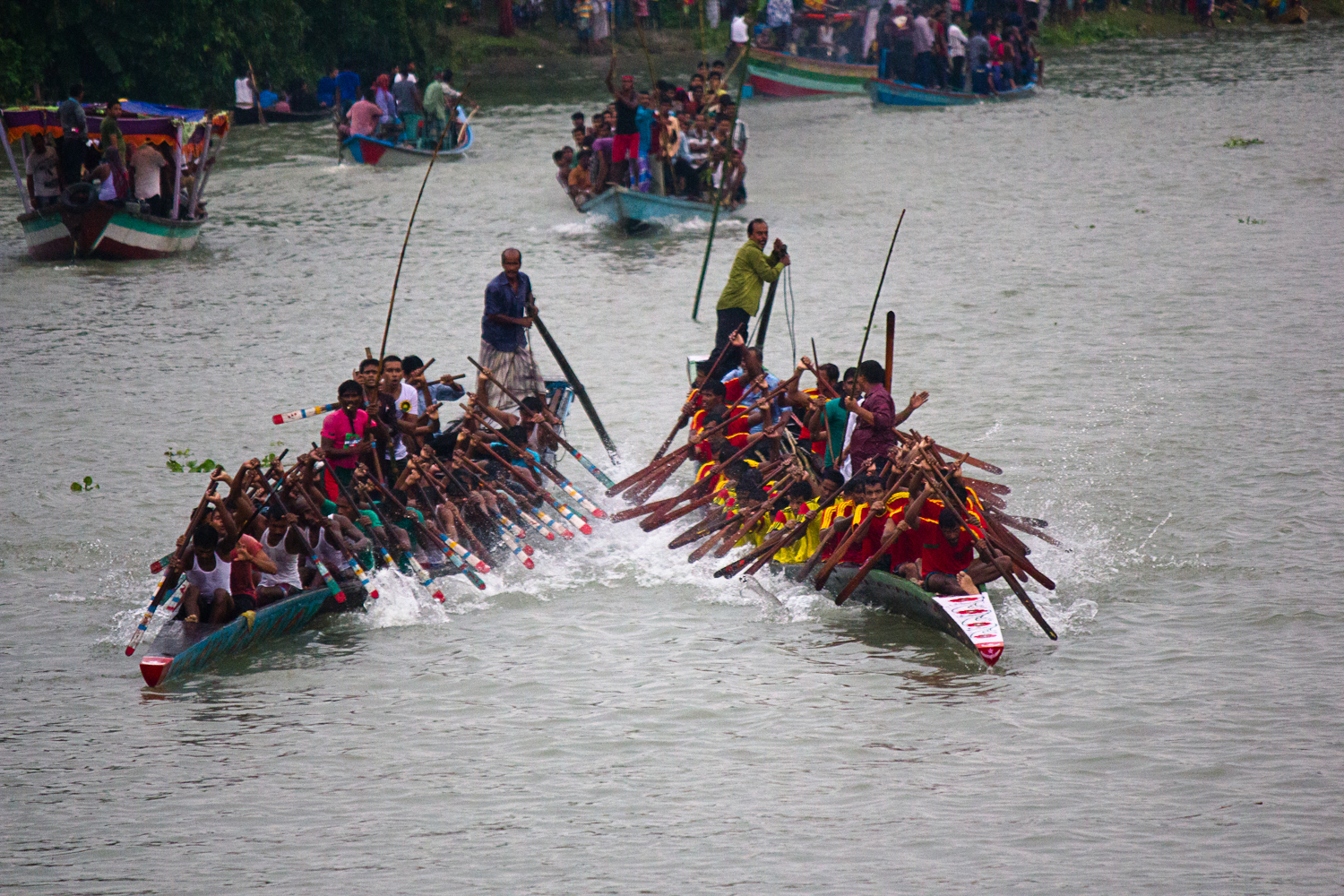
Nouka Baich, traditional boat racing, typically unfolds during the monsoon season, when rivers swell wide and deep. The boats are long and narrow, carved from timber and engineered for speed. Some carry dozens of rowers seated in tight formation. When the race begins, paddles slice into water in synchronized rhythm, each stroke driven by collective effort.
There is no substitute for unity in Nouka Baich. A single rower out of sync can disrupt the boat’s balance and cost precious momentum. Success hinges on cohesion. Power without harmony accomplishes little.
The spectacle on shore rivals the action on water. Crowds gather hours before the start. Vendors sell food. Musicians play traditional songs known as Sari Gan, timed to the rhythm of the rowers. Entire villages identify with a single crew. Victory becomes a shared triumph.
For outsiders, it may look like a simple race. For participants, it is layered with history. Many scholars trace Nouka Baich back centuries, when fishermen and transport workers informally competed along busy trade routes. Over time, these spontaneous challenges formalized into annual events tied to harvest festivals and religious celebrations.
Even today, some regions use distinctive boat designs, reflecting local craftsmanship traditions passed from generation to generation. The boats themselves are cultural artifacts, each plank telling a story of river life.
Beyond Competition: Community and Continuity
What makes these sports compelling isn’t merely their physical demands. It’s their social gravity.
In Lathi Khela, elders often mentor youth, teaching not just technique but values: patience, courage, humility. In Nouka Baich, entire villages collaborate to prepare boats, train crews, and organize festivals. The event belongs to everyone.
In an era when professional sports often feel corporate and distant, these traditions remain accessible. Participation doesn’t require expensive equipment or elite academies. It requires commitment, cooperation, and community trust.
There’s also something refreshingly analog about them. No video review systems. No instant replay. No digital analytics. Victory is visible in the spray of water, in the echo of bamboo, in the roar of a crowd gathered on a muddy riverbank.
Modern Pressures, Persistent Pride
That’s not to say the traditions are immune to change. Urban migration and globalization have reshaped rural life. Cricket and football dominate youth aspirations. Economic shifts leave less time for rigorous training in traditional arts.
But the story isn’t one of disappearance. It’s adaptation.
Government initiatives and cultural festivals continue to spotlight Lathi Khela and Nouka Baich as national heritage symbols. Diaspora communities abroad have even staged boat races to reconnect with their roots. In some cities, exhibitions introduce urban audiences to these ancient sports for the first time.
There is an understanding, subtle but growing, that preserving traditional sports isn’t nostalgia. It’s identity preservation.
A Different Measure of Greatness
In global sports culture, greatness is often quantified by championships and revenue. In rural Bangladesh, greatness might be measured by how cleanly a lathi strike lands in rehearsal or how perfectly a rowing team synchronizes in the final stretch of a race.
The metrics are different. The meaning is deeper.
Lathi Khela and Nouka Baich endure because they are embedded in everyday life. They don’t require mass marketing campaigns to survive. They thrive on memory, repetition, and communal investment.
Stand along a riverbank during Nouka Baich, and you’ll see it in the faces of children watching wide-eyed as boats surge forward. Watch a Lathi Khela demonstration at a village fair, and you’ll hear the pride in the applause.
These are not relics. They are living traditions.
And in a sporting world increasingly defined by global spectacle, there’s something powerful about games that remain local — yet timeless — all at once.


Leave a Reply