
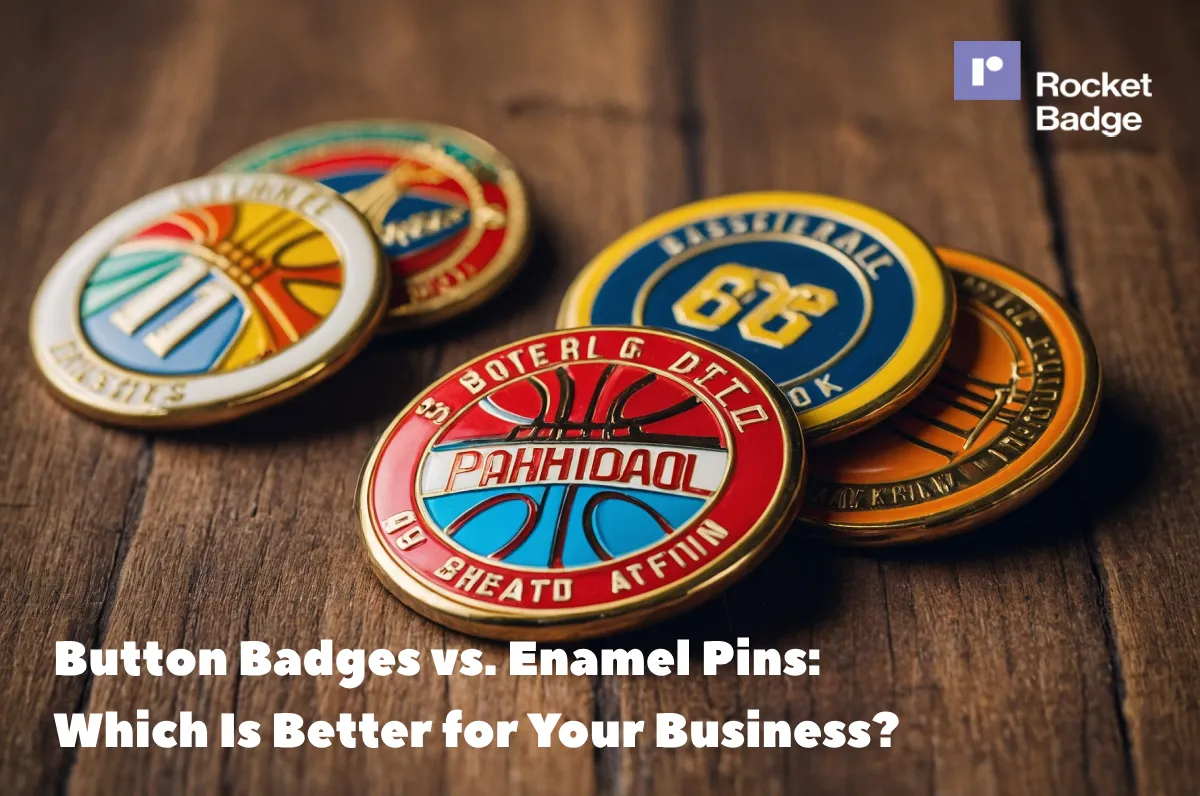
Button Badges vs. Enamel Pins: Which Is Better for Your Business?
Enamel pins and button badges are attractive and adaptable accessories that give users the advantages of durability and reuse. This develops their potential for a variety of uses in the business sector. The question of which is preferable for business use is being debated, though. Business managers ask this question out of curiosity to be sure they make the best decision to improve their marketing strategies. We will get into the specifics of what marketing teams and business owners need to know about button badges in this article. They will be able to determine which is better for them thanks to this knowledge.
Button Badges vs. Enamel Pins
Button badges are tiny round pins with a safety clasp or pin on the back that makes it simple to wear, carry, or attach them to items of clothing or equipment. Usually constructed of plastic or metal, they have a printed design on the front that is sometimes protected by a layer of plastic or Mylar.
Conversely, enamel pins have a colourful design artistically created from enamel. The metal backings can be attached to clothing or bags with a range of options including pins, magnets, and butterfly clutches. Soft enamel and hard enamel are the two categories into which the pins fall.
Both button badges and enamel pins are ideal for various applications due to their perceived worth, uniqueness, and ability to be customised. Premium branding, creative expression, and unique designs, campaigns, events, and promotions are a few of them.
Comparing the Features of Enamel Pins and Button Badges
The following criteria are applied for contrasting enamel pins and button badges.
Cost
The cost of button badges and enamel pins varies greatly due to variations in materials, manufacturing procedures, and design complexity. Button badges like those from Rocket Badge are more affordable because of their lower production and material costs. However, the cost of enamel pins is higher due to the materials used, the manufacturing process, and customisation. Button badges are an inexpensive choice to consider if you are a company with a tight budget.
Time for production
There is a noticeable variation in production time between enamel pins and button badges. Their unique manufacturing techniques are the cause of this discrepancy. Because button badges are easier to make, the production process takes less time. On the other hand, enamel pins require a more involved and drawn-out procedure. These delayed processing times are caused by this procedure. It should be mentioned that button badges are a preferable choice for last-minute marketing campaign uses.
Sturdiness of button badges vs. enamel pins
Button badges’ design usually makes them slightly less durable. They are affordable and appropriate to give away as part of events, campaigns, and promotions. They are best suited for short-term high-volume distribution rather than long-term use because their durability decreases with regular use over time or in adverse environments.
Enamel pins, on the other hand, are made to last a long time and are far more robust. Because they are durable, they are sometimes regarded as valuable gifts or keepsakes that endure for many years, which makes them appropriate for upscale branding, use on clothing, or selling as limited edition merchandise. Selecting enamel pins is the best choice if your company values the longevity of its marketing items.
Design options
Both enamel pins and button badges have many modification options available in their design, but each also has unique characteristics that limit the creative possibilities. Button badges have a classic round shape. Enamel pins, on the other hand, allow for greater shape flexibility. The potential shapes include everything from basic squares and circles to completely unique shapes that complement the design.
Button badges are ideal for logos, slogans, and photographic images because they provide a wide range of creative options for designs that centre on printed graphics. They are usually restricted to two-dimensional images, but they are excellent for printing in vivid full colour. Enamel pins, on the other hand, offer greater flexibility with regard to design, texture, metal finishes, and extra features. They are perfect for companies looking for elaborate, artistic, or high-end designs that have a more enduring collectable appeal.
Materials
One key distinction between button badges and enamel pins that has a significant impact on the cost, durability, and aesthetics is the type of materials utilised. The main materials used to make button badges are plastic and thin metal disks, which are typically made of tin or aluminium. Button badges appear light, smooth, and glossy because of their construction.
On the other hand, enamel and metal such as copper, iron, or zinc are used to make enamel pins. Raised and recessed portions are created on the surface by either stamping or moulding the design. Compared to button badges, they have a more upscale appearance and feel because of the materials and craftsmanship.
Conclusion
Enamel pins and button badges are both beneficial and noteworthy for business applications. Nonetheless, the differences between them make them more useful for different company objectives. It is advised that you do your homework on each of them in order to choose which is best for your business.


Leave a Reply