
Data-Driven Approaches to Optimizing B2B Cold Email Campaigns
B2B cold email campaigns don’t always go the way you want them to, and we often rack our brains out to find out what could’ve been done better. For starters, you can use the data at hand to optimize your cold email campaigns.
Data-driven cold email optimization transforms struggling campaigns into predictable revenue engines. Average reply rates dropped to 5.8% in 2024 from 6.8% in 2023, yet well-optimized campaigns using A/B testing, segmentation, and deliverability tools often achieve 10–15% reply rates—and up to 20% in niche cases.
Smartlead enables this performance by combining unlimited mailbox rotation, AI-powered warmup systems, and advanced analytics into one unified platform.
Understanding the 2025 B2B Cold Email Landscape

Open rates for B2B campaigns in 2025 range from 20–44%, with the most recent global averages clustering around 27–33%. This creates both opportunity and urgency for optimization.
Cold email performance varies dramatically by industry. Emails with 6 to 8 sentences achieve 42.67% open rates and 6.9% reply rates. Messages under 200 words consistently outperform longer content.
Essential B2B Cold Email Metrics That Drive Performance
Email Deliverability and Inbox Placement
A 2% bounce rate is the industry average; higher numbers indicate list quality issues. Smartlead addresses deliverability through AI-powered email warmup across multiple providers, unique IP rotation, and dynamic ESP matching.
One agency saw inbox placement improve from 54% to 93% within two weeks using similar optimization.
Open Rate Optimization
The best-performing subject lines in 2025 are:
“Quick question about your recent project”
- “Can we help you achieve [goal]?”
- “Quick question, [Name]”
- “Thoughts on this, [Name]?”
- “Here’s something you might like, [Name].”
Subject lines that mention a specific pain point, reference a recent achievement, or ask a brief, open-ended question continue to get the highest open rates—often exceeding 45% in controlled A/B tests. Ultra-short lines with 2–4 words perform best for open rates, and adding the recipient’s name or referencing a specific detail further boosts engagement.
Reply Rate as Your North Star
A strong cold email reply rate in 2025 reaches 10%, with legal services companies achieving this benchmark, while the software sector rates fall below 1%. C-level executives show 23% higher response rates than non-C-suite employees, at 6.4% versus 5.2% respectively.
B2B Cold Email Campaign Architecture and Follow-Up Strategy
Data support that reply rates decline notably after the first follow-up, and longer sequences increase complaints, unsubscribes, and risk. Adding a third email can cut reply rate by 15–20%.
The solution lies in quality over quantity. Successful campaigns focus on crafting a single, highly relevant message that addresses specific pain points identified through research.
Personalized first sentences based on prospect research can double or triple reply rates compared to generic introductions. Smartlead integrates with platforms like Clay to enable hyper-personalization across large prospect lists, maintaining manual research quality while scaling automated outreach.
Advanced A/B Testing Strategies

Personalized subject lines boost open rates by more than 14%, making subject line testing your highest-leverage optimization opportunity. However, A/B tests yield significant improvements in only 1 of 8 cases, underscoring the need for systematic experimentation.
You need approximately 200 to 300 prospects per variation to ensure statistically relevant results. Reply rates become reliable metrics only after getting 100 replies per variation. For smaller, highly targeted lists, qualitative analysis of replies often provides more actionable insights than quantitative metrics.
One agency achieved 97% more appointments after analyzing reply sentiment and pain points rather than simply tracking response rates.
Priority Testing Elements
Test send timing first. Evenings between 8 and 11 PM bring the most replies, peaking at 6.52%. However, this varies dramatically by prospect seniority and industry. Templates with 151 to 200 words strike the optimal balance between persuasive content and reader engagement.
Cold emails featuring targeted calls-to-action tailored to grab prospect interest outperform those requesting meeting arrangements. Rather than immediately asking for 30 minutes, consider lower-friction CTAs like “Worth a quick look?”
AI-Powered B2B Cold Email Personalization
The average cold email open rate is 23.9%, with response rates around 8.5%. AI-driven personalization changes this equation by enabling relevance at scale.
AI tools analyze prospect data from LinkedIn, company websites, recent news, and social media to identify relevant talking points. Rather than spending hours manually researching each prospect, AI surfaces insights in seconds.
AI sentiment analysis reads replies and sorts them into categories, helping sales teams prioritize hot leads and respond faster.
Jeremy Chatelaine, founder of QuickMail, emphasizes that successful cold email “isn’t guesswork anymore. There’s too much data, too many tools, and too many smart people sharing what works.”
B2B Cold Email List Segmentation and Targeting Precision

Reaching out to just 1 to 2 contacts per company yields a 7.8% reply rate, while contacting 10 or more people drops the response rate to 3.8%. Smaller campaigns targeting fewer than 100 recipients achieve the highest reply rate at 5.5%.
Sending sequences to 240-499 recipients yields an average response rate of 10%. Smartlead’s unlimited mailbox feature enables sophisticated segmentation, enabling persona-specific campaigns across multiple sending domains.
Deliverability Optimization
Nearly 21% of marketing emails fail to reach intended recipients. Proper email authentication protocols (SPF, DKIM, DMARC) form the foundation of deliverability, and you can generate yours in minutes with a free spf record generator. Don’t exceed 500 messages per day to prevent spam folder placement. New mailboxes require a gradual warmup, starting with low volumes.
Smartlead addresses these challenges through automated warmup sequences that create natural engagement patterns. The platform’s heat score system provides a clear, measurable assessment of mailbox readiness before launching campaigns.
Excluding attachments or graphic materials from cold emails increases response rates by 2X. Links require careful handling, with custom tracking domains helping protect against spam filter triggers.
Charlie Wijen, Digital and CRM Specialist at Philips, noted: “We are clear there’s a straight-line relationship between better inbox placement performance and Philips’ program revenue. We also now have a deep understanding of what affects our deliverability and why, which has improved our engagement levels significantly.”
Building Your B2B Cold Email Optimization Framework
Successful cold email optimization requires a systematic methodology. Start by measuring current performance across key indicators: open rates, reply rates, bounce rates, and conversion rates.
Focus on systematic ROI tracking, consistently measuring results across multiple experiments to pinpoint high-impact elements. Start with subject lines and send timing for the quickest wins. Implement cohort-based optimization to track performance across different time periods and audience segments.
Don’t just track quantitative metrics. Read replies to understand qualitative feedback. What objections surface repeatedly? Which value propositions generate interest? Once you identify winning variations, expand them systematically while continuing to test, as audience preferences shift over time.
Common B2B Cold Email Optimization Mistakes to Avoid
AI and automation enable scale, but relevance remains paramount. Over 71% of decision-makers ignore emails simply because they don’t address their needs. No amount of technical optimization compensates for irrelevant messaging.
You should not exceed 500 messages daily, and newly registered mailboxes require gradual warmup, starting with small volumes. Purchasing low-quality lists undermines all other optimization efforts. Testing subject lines, body copy, CTAs, and send times simultaneously makes it impossible to attribute results to specific changes.
The Smartlead Advantage
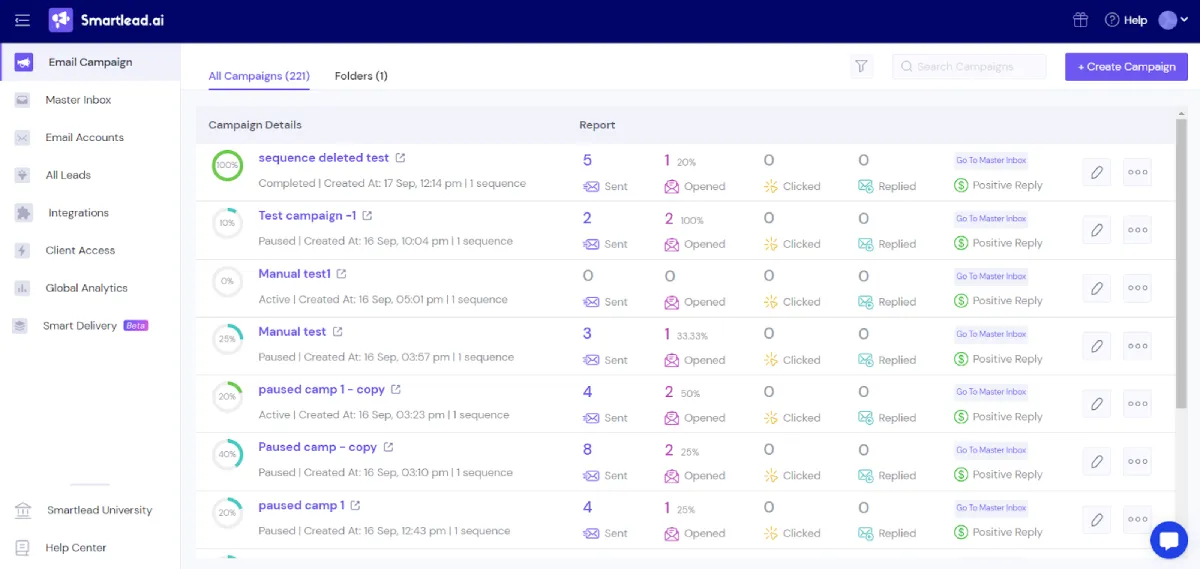
Smartlead consolidates the entire cold email optimization workflow into one platform. Rather than juggling separate tools for warmup, sending, analytics, and testing, teams manage everything from a unified master inbox.
The platform’s unlimited mailbox feature removes artificial constraints on campaign scale. Built-in email verification reduces bounce rates before campaigns launch. Essential tools, including CNAME configuration, SPF checker, DMARC checker, blacklist monitoring, and bounce rate calculator, ensure the technical setup remains optimized.
Conclusion
Data-driven cold email optimization transforms uncertainty into predictable performance. Targeted cold emails achieve response rates of 15% to 25%, far exceeding the typical 5.8%. This difference directly translates into pipeline growth and revenue generation.
Smartlead provides the infrastructure necessary for this level of optimization. By consolidating warmup, sending, testing, and analytics into one platform, it eliminates the fragmentation that prevents many teams from achieving data-driven excellence.
The question isn’t whether cold email works in 2025, but whether your approach systematically leverages data enough to join the top performers who extract outsized results from this channel.
Frequently Asked Questions
What is a good reply rate for B2B cold emails in 2025?
A strong reply rate of 10% was achieved, though the average rate declined to 5.8% in 2024. Legal services achieve higher benchmarks around 10%, while software companies often see rates below 5%.
How many cold emails should I send per day?
Don’t exceed 500 messages per day. Smartlead’s unlimited mailbox feature allows you to distribute sending across multiple domains while maintaining safe volume ratios per mailbox.
What’s the optimal length for a cold email?
Templates with 151 to 200 words strike the optimal balance. Messages under 200 words perform better than longer content.
Should I use follow-up sequences?
One-touch sequences outperform longer ones. If using follow-ups, limit sequences to 1-2 additional touches maximum. Sending 4 or more emails triples unsubscribe rates.


Leave a Reply