

How Generative AI Is Transforming Software Development in 2025: The Enterprise Reality
In early 2025, the global engineering community woke up to a headline that captured the changing reality of software development: “84% of developers now use or plan to use AI tools in their daily workflow.”
It was evidence of a structural shift in how software is built, tested, deployed, and maintained. Developers are now completing tasks, organisations report an increase in engineering productivity, and more than half of all engineers say they rely on generative AI every single day.
For CIOs and CTOs, this shift has not been subtle. It has fundamentally altered how engineering organisations think, plan, budget, and execute.
The question is no longer “Should we use AI software development services?” but rather “How do we redesign our entire software engineering organisation for an AI-first future without compromising safety, governance, or code quality?”
Enterprises have moved far beyond pilots, generative AI now sits at the core of tools, pipelines, testing, and documentation.
In 2025, it delivers massive productivity gains while demanding stronger oversight, reshaping the software development lifecycle faster than anyone expected.
Generative AI Becomes a Standard Development Layer
Unlike the early wave of AI in software development, generative AI is not limited to code suggestions or autocomplete-style enhancements.
It has grown into a multilayered capability that influences decision-making, planning, architecture, documentation, testing and even release governance.
Enterprises are no longer treating AI tools as optional developer assistants. Instead, they are integrating them directly into the SDLC at every stage, from requirement discovery to long-term maintenance.
McKinsey reports that more than 90% of software developers have interacted with generative AI tools in the last year. This surge in adoption is not just driven by development teams.
Business units, product managers, cybersecurity teams and DevOps leaders are all participating in this shift because generative AI is proving itself capable of improving nearly every aspect of software delivery, from ideation and planning to testing and compliance documentation.
How Generative AI Is Reshaping the Entire Software Development Lifecycle
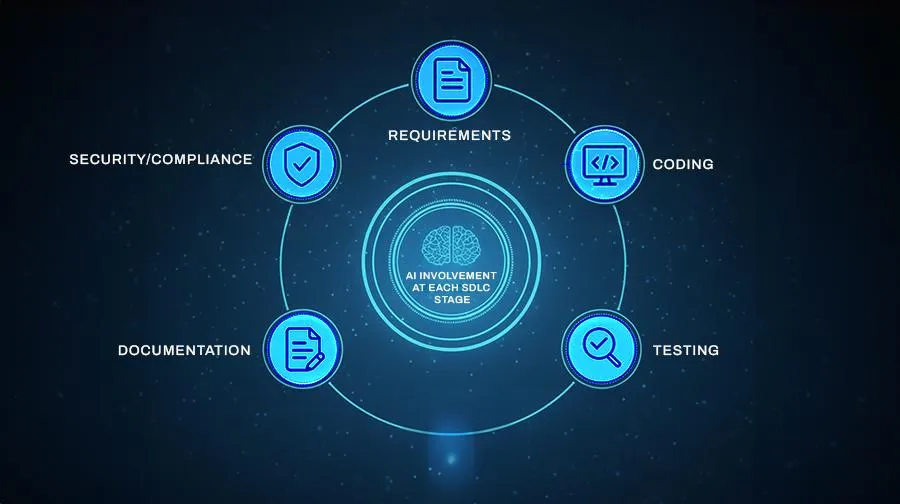
Generative AI is not replacing the SDLC, it is reconstructing it from the inside out. Each stage of development has begun to operate with new speed, new intelligence, and a new level of automation.
1. Requirements, Discovery, and Ideation – AI as a Strategic Research Partner
Before a single line of code is written, product teams spend enormous time gathering insights from customers, internal stakeholders, market reports, feedback loops, and competitive intelligence.
In 2025, generative AI has become the engine accelerating this crucial phase. Instead of manually combing through thousands of data points, customer surveys, support transcripts, competitor changelogs, NPS comments, or research notes—AI synthesises all of it in minutes.
It doesn’t just summarise the data; it organises it.
AI converts scattered information into structured requirement documents, prioritised user stories, acceptance criteria, and even early-feature wireframes.
Product managers who once struggled to consolidate cross-functional input now rely on generative AI as a research partner that can make sense of vast, unstructured information.
Here’s where AI makes the biggest impact during discovery:
- Faster insight generation→ turning days of research into minutes
- More accurate prioritisation→ identifying patterns teams often overlook
- Better cross-functional alignment→ consolidating varied stakeholder inputs
AI-assisted product teams operate nearly 40% faster in early discovery, significantly reducing project delays long before development begins.
2. Coding– AI Becomes the Real-Time Pair Programmer
Inside the IDE is where generative AI is most visible and most transformative.
Developers are no longer staring at empty files, they begin with intelligent suggestions, template-level structures, recommended patterns, and even potential optimisations.
Platforms like VS Code, JetBrains, Visual Studio, and Google Code Assist have turned AI into a built-in collaborator.
This is because AI is doing far more than completing lines of code. It recommends architectural patterns, flags logic flaws, proposes alternative implementations, and improves the performance of existing blocks.
This shift allows engineers to operate at a higher level—spending time on system design, architectural thinking, and business logic decisions rather than getting stuck in repetitive coding loops.
3. Testing and Quality Assurance: The AI-Driven Testing Revolution
Testing has historically been one of the most time-consuming and resource-heavy phases of the SDLC. Generative AI has turned this bottleneck into a velocity multiplier.
AI-powered test engines now automatically generate unit tests, expand coverage, detect weak areas, and interpret complex error logs—often more thoroughly than manual testers.
To make this even more impactful, AI also simulates user flows, builds regression suites, and highlights risky components before QA teams begin verification. Enterprises report that test preparation timelines, which once spanned weeks, now compress to hours.
With AI testing code almost as quickly as engineers write it, the traditional lag between development and production is shrinking dramatically.
For industries where quality is non-negotiable, healthcare, fintech, and automotive, AI-driven QA provides an entirely new level of reliability.
4. Documentation and Knowledge Management: Solving the Enterprise Knowledge Crisis
Documentation has always been the silent killer of software velocity. Teams rarely update it, new hires struggle to find what they need, and tribal knowledge stays locked in senior engineers’ heads. Generative AI solves all of this at once.
AI systems now read entire codebases, review commit histories, scan APIs, and interpret architectural models to produce full documentation sets within minutes.
That includes onboarding guides, troubleshooting instructions, integration notes and architectural summaries.
This has been especially transformative for large enterprises where teams operate across countries and rely on shared knowledge systems.
AI ensures documentation stays accurate, consistent, and endlessly up to date. It eliminates one of the biggest sources of technical debt: outdated or missing documentation.
5. Code Review, Security, and Compliance: AI as the Quality Guardian
With AI accelerating development, enterprises have become increasingly cautious about security, compliance, and code quality. This is why AI-driven review tools have become essential.
These systems now act as a second pair of eyes by reviewing code for vulnerabilities, dependency risks, insecure patterns, data exposure issues, and compliance misalignments.
They provide explanations, remediation suggestions, and even auto-fixes. Security teams use AI to scan entire repositories, detect anomalies, identify dependency vulnerabilities, an` `d generate compliance-ready reports.
Here’s what enterprises gain from AI-driven reviews:
- Stronger security baselinesthrough automated vulnerability detection
- Faster review cycleswith AI highlighting issues instantly
- Higher compliance accuracyvia automated documentation and auditing
As codebases expand and development cycles shorten, AI has become the stability layer ensuring speed doesn’t compromise safety.
To make those reviews truly actionable at scale, many teams also adopt code documentation standards so findings, fixes, and audit trails stay consistent across every repo.
Real Enterprise Case Studies – What Gen AI Transformation Looks Like in Practice
Several global enterprises are using generative AI at scale and demonstrating how deeply it can transform engineering organizations.
Capgemini’s integration of Google Cloud Code Assist resulted in significantly reduced development effort across core product teams. By embedding AI directly into developer workflows, Capgemini accelerated delivery, improved quality, and reduced time spent on repetitive tasks.
TCS partnered with Google Cloud to build persona-based AI agents that help developers by offering contextual recommendations, code guidance, and architectural insights. These agents act like intelligent co-workers that understand both code and domain context. As a result, delivery cycles shortened and developer satisfaction soared.
Across industries, the numbers are consistent. Developers complete tasks faster, teams collaborate more fluidly, and organisations deliver software with fewer defects.
Yet these gains are possible only when enterprises pair AI adoption with governance, training, and architectural discipline.
The Hidden Challenge of Speed Has Increased, Trust Has Not
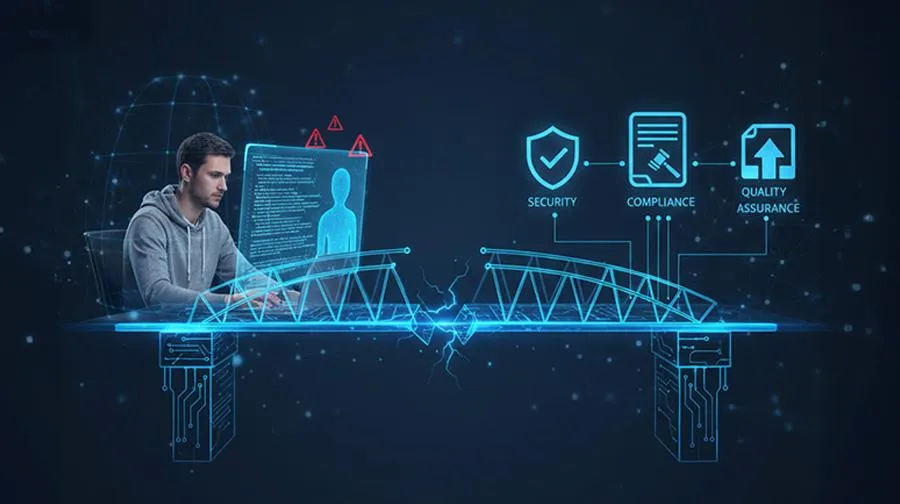
While productivity has surged, trust in AI-generated code has lagged behind.
Only few developers fully trust AI-generated code without manual inspection. Engineers often describe losing time debugging “AI mistakes,” especially when AI hallucinations introduce subtle errors.
An MIT-backed study found that 95% of enterprise AI pilot projects fail to reach full production because of governance gaps, inconsistent usage, or mismatch between AI capabilities and business expectations.
This mismatch highlights a critical truth:
AI accelerates development, but it also amplifies the consequences of weak review and governance.
Enterprises must therefore adopt generative AI intentionally not casually.
How Leading Enterprises Are Redesigning Their Engineering Model
To adapt to this new reality, enterprises are shifting their software delivery model in several ways.
| Transformation Area | What Enterprises Are Doing | Why It Matters |
| Centralised AI Development Platforms | Consolidating models, APIs, datasets, and tools into governed AI hubs with built-in guardrails and observability. | Eliminates tool sprawl, enforces compliance, and standardises AI usage across teams. |
| Upskilling the Engineering Workforce | Training developers in AI validation, prompt engineering, and responsible AI use—shifting them from coders to AI supervisors. | Ensures AI-generated code meets quality, security, and architectural standards. |
| AI-Aware Code Review Processes | Tagging and tracking AI-authored code, performing deeper security scans, and reviewing for hallucinations or logic flaws. | Strengthens trust, reduces risk, and prevents AI-generated vulnerabilities. |
| Outcome-Focused Performance Metrics | Moving from “AI adoption rates” to KPIs like velocity, defect reduction, cost savings, and product quality. | Measures real business impact instead of tool usage, guiding strategic AI investment. |
These shifts reflect a bigger truth that AI is not transforming engineering teams; it’s transforming engineering operating models.
The companies building these AI-first foundations today will be the ones shipping better software, faster, safer, and at dramatically lower cost tomorrow.
The Next Frontier of Agentic AI in Software Engineering
2025 marks the rise of agentic AI systems, AI that doesn’t just generate code but autonomously executes multi-step engineering tasks.
Companies like Microsoft, Google, and Meta are already piloting agents that review logs, fix failing builds, raise pull requests, update documentation, and even perform automated dependency upgrades across large repositories.
GitHub’s internal “Copilot Workspace” experiments, for example, show agents completing entire feature branches with minimal human intervention.
This evolution moves AI from a simple “coding assistant” to a true digital engineer.
With strong guardrails, the long-term potential is enormous: faster iteration cycles, self-healing CI/CD pipelines, and engineering teams operating at a velocity and scale that traditional workflows could never achieve.
Wrapping Up
This new era belongs to teams that can pair human creativity with machine intelligence, where developers supervise logic, AI accelerates execution, and engineering pipelines become self-optimising systems.
The companies that master this balance will ship better products, recover faster from failures, and innovate at a pace their competitors can’t match.
And for enterprises looking to elevate their development lifecycle with responsible, scalable, and high-impact AI, partnering with experts who’ve built AI-native engineering models can make that transition far smoother.
As AI becomes the backbone of modern engineering, enterprises can’t afford to watch from the sidelines.
If you’re looking to adopt AI across your engineering lifecycle, eLuminous Technologies can be your software development partner which will help you build the systems, automation and AI software development foundations needed to compete at this new scale.


Leave a Reply