
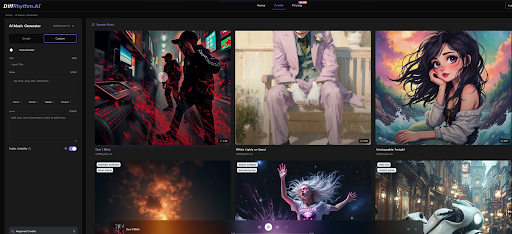
How to Turn Your Written Thoughts into Studio-Quality Audio with DiffRhythm AI
You know the feeling. You are driving, or perhaps sitting in a quiet room, and a phrase strikes you. It has a rhythm, a cadence, a potential to be something more than just words on a page. You can hear the faint outline of a melody in the back of your mind—a drum beat, a swelling violin, or a gritty bassline.
But then, the friction of reality sets in.
To turn that fleeting thought into a listenable song, you traditionally face a mountain of obstacles. You need to understand music theory. You need to navigate complex Digital Audio Workstations (DAWs) like Ableton or Logic Pro. You need to hire vocalists or spend thousands on studio time. For most of us, the barrier is simply too high, so the idea remains trapped in a notebook, silent forever.
This is the “Creativity Gap.” We all have the capacity to feel music, but few of us have the technical tools to build it.
However, the landscape of audio production is undergoing a seismic shift. We are moving away from a world where music creation is exclusive to those with years of training, towards a future where your primary instrument is your imagination. Leading this charge is a new generation of generative audio tools, most notably DiffRhythm AI, which promises to bridge the gap between the text you write and the song you hear.
The “Latent Diffusion” Difference
How It Actually Works (Without the Jargon)
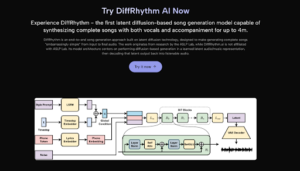
To understand why this specific tool matters, we need to look under the hood. Most early AI music generators worked like predictive text on your phone—guessing the next note based on the previous one. The results were often robotic, wandering, and lacked structure.
DiffRhythm operates differently. It utilizes Latent Diffusion technology.
Think of it like a sculptor working with a block of marble.
- Old AI (Autoregressive): Tried to build a statue by gluing pebbles together one by one. It often fell apart or looked lopsided.
- DiffRhythm (Diffusion): Starts with a block of “static” (noise) and chisels away everything that isn’t the song you asked for. It sees the whole piece at once—the verse, the chorus, the bridge—and refines it until a clear, cohesive track emerges.
In my exploration of the platform, this technical distinction translates to one key user benefit: Cohesion. The songs feel like they have a beginning, a middle, and an end, rather than an endless loop of random sounds.
My Studio Session: A First-Hand Experiment
I wanted to test the claim that this tool makes song generation “embarrassingly simple.” I decided to bypass the standard pop songs and try something more specific to see if the AI could handle nuance.
The Prompt:
- Lyrics: A short poem about a rainy city street and lost time.
- Style: “Lo-fi hip hop, melancholic, soft piano, rain sounds, male vocals.”
The Result:
I hit generate, and within roughly 30 seconds, the audio was ready.
What struck me first was the texture. The track opened with the crackle of vinyl and a muted kick drum—classic tropes of the genre, but executed with surprising clarity. When the vocals kicked in, they didn’t sound like a robot reading text-to-speech. They were melodic. The AI had inferred a melody that fit the somber mood of my lyrics.
Was it a Grammy-winning performance? Not quite. But was it a usable, emotionally resonant demo that captured the exact vibe I had in my head? Absolutely. It transformed a text file into a mood piece in less time than it takes to brew coffee.
Democratizing the Studio: A Comparative Analysis
It is easy to get lost in the novelty of AI, but for creators and professionals, the real question is utility. How does this actually compare to the traditional way of doing things?
Below is a breakdown of the resource shift when using generative audio versus traditional production.
| Feature | Traditional Music Production | Diffrhythm AI Music |
| The Input | Sheet music, instrument recording, MIDI arrangement. | Text Lyrics + Style Prompt. |
| Time to First Draft | Hours to Days (Composition + Recording). | Seconds to Minutes. |
| Skill Requirement | Music Theory, Mixing, Mastering, Instrument proficiency. | Curation & Descriptive Writing. |
| Vocal Integration | Requires hiring a singer or recording yourself. | Integrated Synthesis (Vocals generated with music). |
| Cost Basis | High (Equipment, Studio time, Session musicians). | Low (Subscription/Credit based). |
| Iterative Speed | Slow. Re-recording a chorus takes time. | Fast. Don’t like the vibe? Change one word and regenerate. |
The “Sketchpad” Effect
This table highlights that DiffRhythm isn’t necessarily replacing the professional musician; it’s replacing the empty page. It allows you to prototype ideas instantly. You can test ten different genres for your lyrics in five minutes—something that would be physically impossible with a human band.
Strategic Applications: Who Is This For?
While the technology is fun to play with, its practical applications are vast for specific industries.
1. The Content Creator
YouTube and TikTok are plagued by copyright strikes. Finding safe, high-quality background music is a constant struggle. With DiffRhythm, you can generate a unique 4-minute track that perfectly matches the tempo of your video, owning the commercial rights (depending on your plan) and avoiding the copyright headache entirely.
2. The Songwriter
If you are a lyricist who doesn’t play an instrument, you are often stuck waiting for a collaborator. This tool acts as an infinite session musician. You can hear how your lyrics sound over a reggae beat, then a metal riff, then a synth-pop track, helping you refine the cadence of your words before you ever step into a real studio.
3. The Brand Storyteller
Sonic branding is powerful. Instead of using a generic stock jingle, a brand could generate a specific soundscape that incorporates their slogan or brand values into the lyrics, creating a custom audio identity for a fraction of the agency cost.
A Candid Look at the Constraints
To maintain credibility, we must address the limitations. While my tests were impressive, the technology is not magic, and it is not perfect.
- The “Ghost in the Machine” (Vocal Clarity)
While the musicality is generally high, I noticed that the pronunciation of lyrics can sometimes be slurred or Hallucinated. The AI occasionally struggles with complex phrasing or very fast tempos, leading to vocals that sound a bit “mushy.” It works best with clear, simple lyrical structures.
- The “Slot Machine” Dynamic
Generative AI is probabilistic. You might use the exact same prompt twice and get two completely different songs. Sometimes, the result is a masterpiece; other times, the melody might feel disjointed or the key might shift strangely. It requires a mindset of exploration—you may need to generate three or four versions to get the “gold.”
- Audio Fidelity
While the output is good (MP3/WAV), it doesn’t yet match the pristine, separated layer quality of a track mixed by a human engineer in a million-dollar studio. It is “radio ready” for the internet, but perhaps not yet for an audiophile’s vinyl collection.
The Future of Audio Expression
We are standing at a fascinating intersection of art and algorithm.
Tools like DiffRhythm are not here to silence human musicians. They are here to amplify human intent. They allow the writer to become a composer. They allow the filmmaker to become a sound designer. They allow the dreamer to finally hear the soundtrack of their own mind.
The ability to create music is no longer defined by how fast your fingers can move over a fretboard, but by how clearly you can visualize—and describe—an emotion.
The orchestra is waiting. The only thing missing is your prompt.
Ready to conduct?
The barrier to entry has never been lower. Whether you want to create a birthday song for a friend, a background track for your next project, or just experiment with the fusion of genres, the tools are ready.


Leave a Reply