

The Best Free PDF to Brainrot for ADHD & Focus in 2026
It starts innocently enough. You sit down to read a crucial document—maybe a research paper, a financial report, or a lengthy ebook. You read the first sentence. Then the second. But by the third sentence, your hand is already reaching for your phone. You aren’t tired; you are restless. Your brain feels like it is vibrating, demanding a hit of dopamine that black-and-white text simply cannot provide.
Psychologists call this “Popcorn Brain”—the result of years of conditioning by short-form algorithms. We have trained our minds to expect a new visual reward every 15 seconds. When we force ourselves to engage with static text, we are fighting against our own biology.
For a long time, the advice was simply “try harder” or “turn off your phone.” But a new wave of productivity tools suggests we shouldn’t be fighting this impulse at all. Instead, we should be leveraging it. This is the core philosophy behind Pdf to Brainrot, a tool that acknowledges the reality of the modern attention span and offers a surprisingly effective workaround.
Why Silence is No Longer Golden
The traditional model of studying or reading assumes that silence and stillness are the ultimate states for learning. We imagine the scholar in a quiet library. But for many of us—especially those with ADHD or high-stimulation thresholds—silence is actually deafening. In the absence of stimulation, the brain creates its own distractions: daydreaming, anxiety, or the overwhelming urge to move.
Brainrot AI operates on a principle known as “secondary task engagement.” Think of it like doodling while listening to a lecture. The doodle doesn’t distract you; it occupies the “fidgety” part of your brain so the rest of your mind can actually listen.
By converting a PDF into a video format that pairs the text with high-motion, low-stakes visuals (like gameplay or satisfying loops), these tools occupy your visual cortex. This prevents your eyes from wandering around the room, effectively “locking” your attention in place while the auditory channel delivers the information.
Field Testing: A Week of “Passive” Learning
To see if this was merely an internet trend or a viable productivity hack, I spent a week using pdf to brainrot ai tools to consume content I had been putting off for months. My test subject was a dense 30-page guide on technical SEO implementation—dry, boring, but necessary.
The Experience
I didn’t sit at my desk. Instead, I treated the generated video like a TikTok feed. I watched it while eating lunch. I watched it while walking on the treadmill.
- The Visuals: The screen displayed a hypnotic video of a hydraulic press crushing colorful objects. It was mindless, yet I couldn’t look away.
- The Audio: The AI voice narrated the SEO strategies with surprising inflection, breaking down complex paragraphs into digestible sentences.
The Result
The most shocking observation was the lack of friction. Usually, reading technical documentation feels like wading through mud. You have to force every step. But with the brainrot study method, the information felt like it was bypassing my resistance. I wasn’t “reading”; I was just watching a video. Yet, when I was quizzed on the content later, I retained about 80% of the core concepts—significantly higher than my usual retention rate for dry reading.
Energy Management: A Comparative Breakdown
The biggest difference isn’t just in what you learn, but in how much energy it costs you to learn it. Traditional reading is an “active” process; this method is “passive-active.”
Here is how the energy expenditure compares:
| Metric | Standard PDF Reading | Pdf to Brainrot AI |
| Willpower Required | Very High: You must constantly fight the urge to stop. | Low: The visual loop pulls you in effortlessly. |
| Mental State | Often leads to frustration or “zoning out” (re-reading the same line). | Induces a “Flow State” similar to scrolling social media. |
| Environment | Requires a quiet, well-lit space. | Can be done anywhere (commute, gym, bed). |
| Information Pace | Self-regulated (prone to skimming or stalling). | Fixed pace (keeps you moving forward). |
| Dopamine Response | Low/Delayed (reward comes only after finishing). | Immediate/Continuous (visuals provide instant gratification). |

The Mechanics of the “Brainrot” Engine
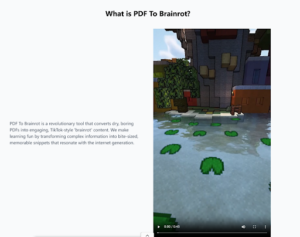
It is important to understand that this isn’t just overlaying text on a video. The best pdf to brainrot tools utilize a specific stack of technologies to ensure the content sticks.
1. Intelligent Scripting
Raw PDFs are often full of academic jargon. The AI doesn’t just read the text; it often “translates” it. It identifies the key arguments and restates them in a rhythm that suits the spoken word. It removes the friction of complex sentence structures.
2. The “Subway Surfers” Effect
Why are the background videos always gameplay or satisfying loops? Because these visuals are engineered to be *non-narrative*. If the background video had a story (like a movie clip), your brain would focus on that story. Gameplay loops are abstract enough to be engaging but meaningless enough to be ignored. They act as a visual pacifier.
3. Sensory Synchronization
The subtitles in these videos are not static. They pop, shake, and change color. This forces your eyes to track the text. It creates a multi-sensory loop: you hear the word, you see the word, and you see a visual trigger simultaneously. This triangulation helps cement the memory.
Honest Limitations: When NOT to Use It
While I am enthusiastic about the potential here, we must remain grounded. This tool is a supplement, not a total replacement for literacy.
- Nuance Loss: If you are reading a legal contract where every comma changes the meaning, do not use this. The AI might smooth over a detail that is actually critical.
- The “Illusion of Competence”: Because the video is easy to watch, you might feel like you understand the topic better than you actually do. Watching a video about quantum physics is not the same as solving the equations yourself.
- Visual Fatigue: While it helps with boredom, staring at high-contrast, fast-moving videos for hours can strain your eyes differently than static text. It is best used in bursts of 15-20 minutes.
The Future of Consumption
We are moving toward a world where the line between “entertainment” and “education” is permanently blurred. For decades, we believed that learning had to be hard to be effective. We believed that if you weren’t suffering through the text, you weren’t really studying.
Pdf to Brainrot challenges that puritanical view. It suggests that if we can lower the barrier to entry—if we can make learning as addictive as doomscrolling—we might actually learn *more*, not less.
It is not about dumbing down the content. It is about smartening up the delivery. If your brain wants to run on a dopamine track, let it. Just make sure you are loading that track with the cargo of knowledge you need to carry.
So, the next time you have a deadline approaching and a PDF you cannot bear to open, don’t beat yourself up. Try feeding it to the algorithm. You might find that your “brainrot” is actually the most fertile ground for new ideas.


Leave a Reply