
Turning RPA Pilots into Production
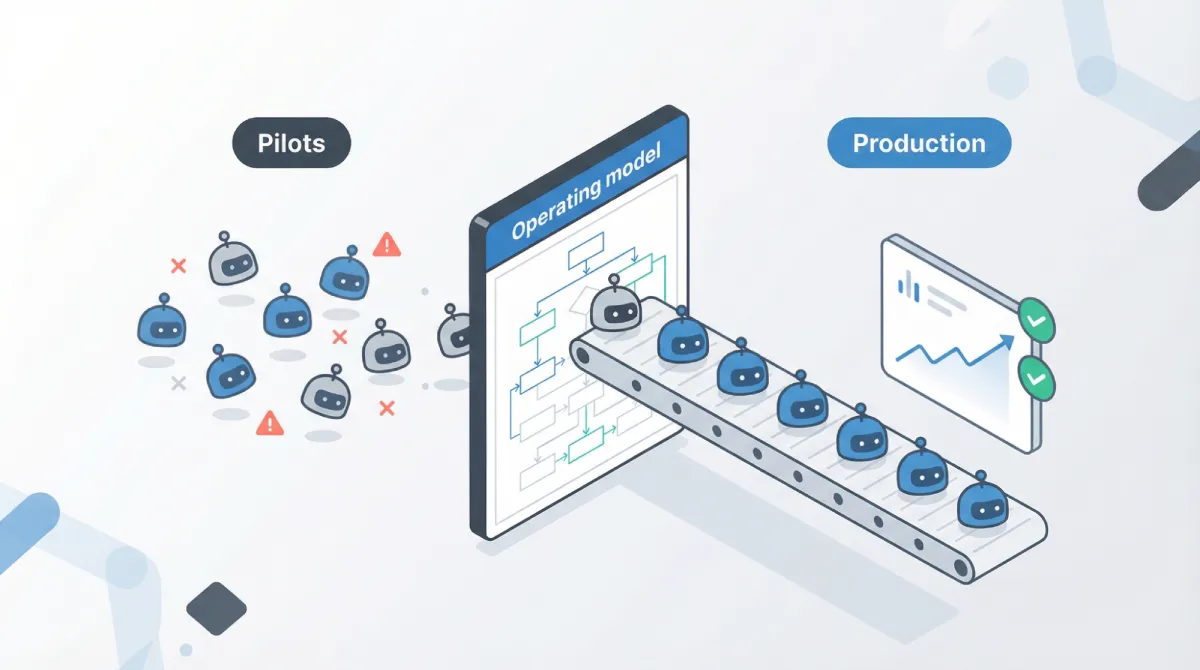
Automation should cut keystrokes and shrink turnaround times, yet 30–50% of robotic process automation (RPA) pilots stall before production, according to EY’s 2025 implementation snapshot. The blocker isn’t the software; it’s the operating model. Treat business-process automation as an enterprise change initiative, map the pain points first, and you’ll convert prototypes into measurable productivity—rather than leaving another bot orphaned.
Start with processes, not tools
Map the current workflow before you compare RPA suites or low-code platforms. A 2024 ABBYY survey of 400 executives found that 30 % of failed RPA projects stemmed from poor process understanding and another 38 % from avoidable complexity, according to CIO Dive. Ask yourself:
- Which steps consume the most hours each week?
- Where do mistakes cost customers or regulators the most?
- Which workflows are stable enough to standardize today?
Effective automation targets repetitive, rule-driven handoffs that touch more than one system. Sketch the path from first input to final exception so you know exactly what happens now, then decide what the software should do next.
Prioritize use cases with clear business impact
An RPA market study by Monstarlab’s China team found that leading adopters invested five to ten times more in RPA capabilities than their peers yet still struggled most with deciding which opportunities to automate first; Monstarlab’s business process automation solutions begin with a discovery sprint that scores each candidate by hours saved, error reduction, and strategic impact.
Choose the right mix of automation approaches
Most teams need more than one tool. Gartner’s 2025 Hyperautomation Snapshot shows that organizations use at least three automation technologies on average: robotic process automation (RPA), process orchestration, and integration platform as a service (iPaaS). Start with the result you want, then select the smallest set that delivers it:
- Workflow orchestration clarifies handoffs between people and systems.
- RPA bots handle legacy screens when no API is available.
- Integration or iPaaS connectors pass data between modern apps.
- Decision engines or lightweight machine-learning models automate yes/no checkpoints.
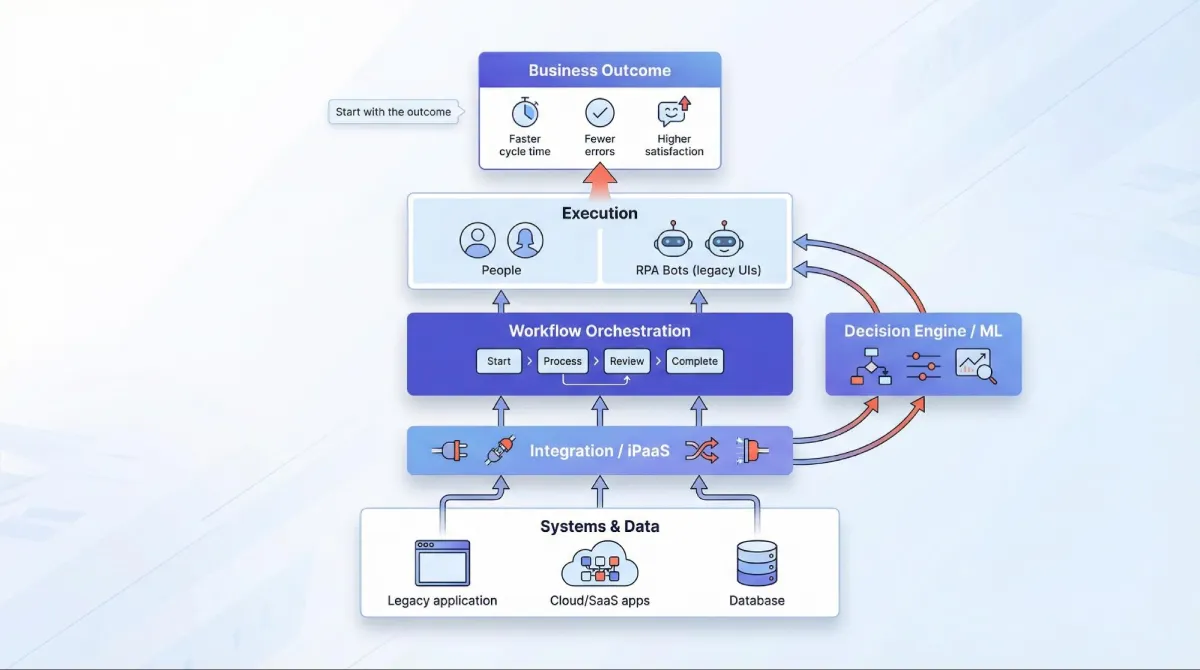
Use a lean mix of orchestration, RPA, integration, and decision engines to reach your desired business outcome.
A modest process tweak plus one integration often saves more time than blanketing the workflow with bots. Map the outcome, pick the leanest ingredients, and you will cut complexity while raising reliability.
Design for people as well as processes
The smartest bot fails if the people who use it feel sidelined. In the 2025 Workplace Tech Resistance survey, one in seven employees (14 %) refused to use a new tool and 39 % called themselves reluctant adopters, BusinessWire reports. To keep your rollout off that list, build three safeguards into the project plan:
- User experience first. Prototype screens with frontline staff and remove clicks until the workflow feels lighter than the manual version.
- Radical transparency. Explain what the automation does, why it decides the way it does, and how exceptions are handled; trust grows when the black box opens.
- Change coaching, not just training. Show how roles evolve, pair veterans with “automation champions,” and measure adoption, not just uptime.
When employees help design and test each step, automation lands as a teammate, not a threat.
Measure, learn, and iterate
Going live is only halftime. UiPath’s 2025 customer benchmark found that 40 % of companies struggle to monitor bot performance after launch, according to SEO Sandwitch. Close that gap with a simple loop:
- Record core metrics each week: hours saved, error rate, and exception volume.
- Hold a five-minute “automation stand-down” with users to capture what feels clunky.
- Update the rules or upstream data, redeploy, and reset the counter.
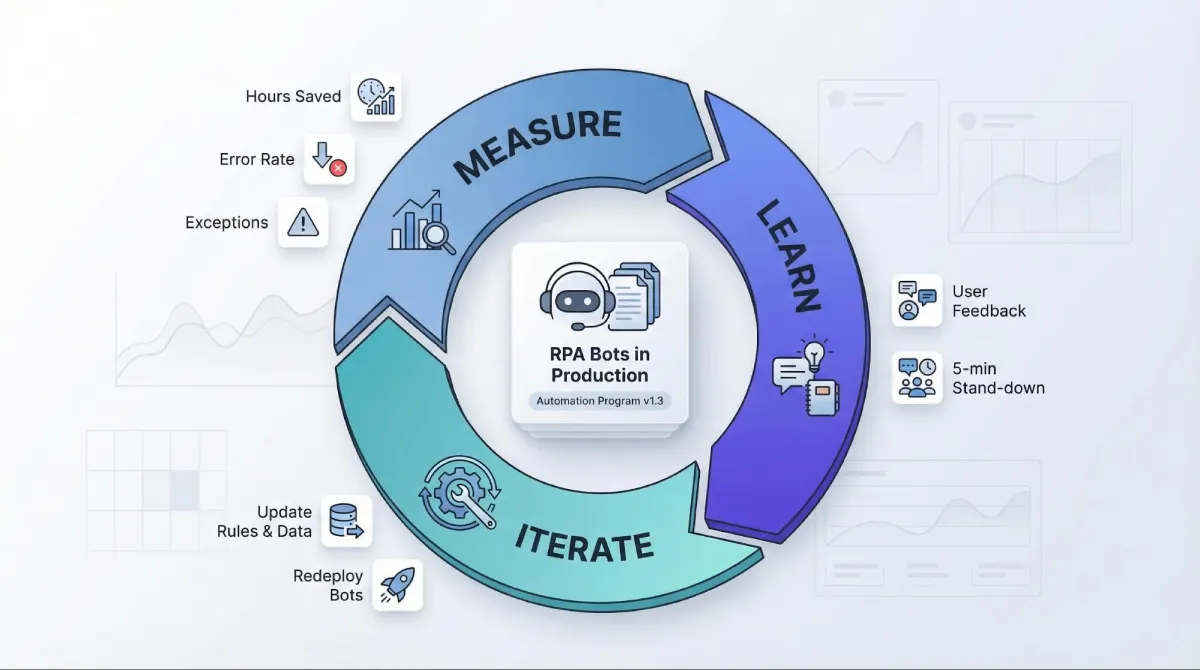
Treat each RPA bot like versioned software and keep improving it with a simple measure–learn–iterate loop.
High-performing programs review every bot at least quarterly, retiring or redesigning any that no longer beat manual work. Treat each automation like software with a version history so its value keeps compounding long after the launch email.


Leave a Reply