
Why 2025 Is the Breakout Year for Every American Sign Installation Company
In 2025, cranes, construction fences, and “Now Open” banners define the skyline of many U.S. cities again. Retail chains are refreshing stores, logistics operators are building new hubs, and infrastructure projects funded by the Bipartisan Infrastructure Law are moving from drawings to job sites — all of them needing compliant, durable, and highly visible signage.
For B2B buyers — especially print and large-format shops — this is transforming the “sign installation company” from an afterthought into a strategic partner. Retail and infrastructure spending are growing in mid–single digits, and executives expect that trajectory to continue across 2025. At the same time, the global sign market is projected to grow from $110 billion in 2024 to $114.5 billion in 2025, with further acceleration ahead.
As a result, searches like “sign installation company near me,” “outdoor sign installation company near me,” and “real estate sign installation company near me” are no longer niche queries. They are part of how serious brands, landlords, and print companies’ source operational capacity in a market where permits are strict, deadlines are tight, and brand standards are unforgiving.
This article explains why 2025 is a breakout year for American sign installation companies, how the market is evolving in New York, Illinois, and Texas, what realistic costs look like, and how B2B buyers should select partners — with Easy Way Install as a practical example of how a modern national sign installation company operates.
The New Landscape: Why Demand Is Surging in NY, IL and TX
Structural growth in signage, not just a temporary spike
Despite digital marketing, physical signage is not shrinking. It is reorganizing.
- The broader sign market is growing robustly, from $110.0 billion in 2024 to an estimated $114.51 billion in 2025, a 4.1% CAGR.
- The signage market overall is projected to grow from $52.7 billion in 2025 to $97.3 billion by 2035, with digital signage taking 42% of the market and retail as the largest end-use segment.
- In the U.S. alone, sign and banner shops generated about $2.2 billion in 2024, and the number of businesses in this segment has climbed to roughly 39,600, up 6.2% year over year.
For any signage company in USA, this translates into a simple reality: there are more signs to fabricate than most in-house crews can safely and legally install at scale.
Retail expansion and refresh cycles
Retailers are not only surviving; many are expanding. Major chains continue to open net new locations while remodeling existing stores, driving demand for new storefront signs, interior wayfinding, and parking signage.
Each store opening or refresh requires:
- Primary identity signage
- Secondary directional and parking signs
- Temporary “coming soon” and “now hiring” signage
This work lands directly on print providers, sign manufacturers, and — critically — the installation partners who can hit dozens of locations in parallel.
Why NY, IL and TX are especially hot
New York, Illinois, and Texas combine dense urban cores with fast-growing suburban belts. They share a common feature: strict sign codes and permit processes.
- New York City requires permits for most signs larger than six square feet, plus compliance with zoning rules and building codes.
- Chicago generally requires a sign permit for any sign placed on land, buildings, or structures, and some locations need both a sign permit and a Grant of Privilege for signs that project into the public way.
- Austin mandates sign permits for outdoor signage and issues them primarily to registered, insured outdoor advertisers, with a defined sign code and documented permit process.
An American sign installation company that genuinely understands New York sign installation, sign installation Chicago, and sign installation Austin is not merely “putting up signs”. It is absorbing regulatory risk on behalf of landlords, developers, and B2B print partners.
Key Trends Reshaping American Sign Installation in 2025
1. Storefronts as physical UX for omnichannel retail
For large brands, the storefront sign is now treated as a critical part of the customer experience, not just an identifier. Deloitte’s 2025 retail outlook notes that retailers are pushing toward holistic, frictionless experiences, where physical and digital channels reinforce each other.
Implications for a sign installation company:
- Higher design complexity — channel letters, halo-lit logos, mixed materials.
- Tighter tolerances — corporate brand teams enforce exact spacing, color, and illumination standards.
- Compressed timelines — signage is installed last, just ahead of inspections and opening.
Print companies and sign suppliers near me that once saw installation as a small add-on now need dependable partners that can execute consistent storefront rollouts across coastal flagships and suburban strip centers.
2. Infrastructure and street signage as a compliance discipline
A street sign installation company in 2025 operates inside a heavily regulated environment.
- Federal rules require standardized project signage on infrastructure sites receiving IIJA or Inflation Reduction Act funds.
- Airport and transit authorities are upgrading wayfinding, with digital and static signage governed by strict safety, ADA, and evacuation criteria.
- Cities periodically crack down on illegal advertising signs; a recent example is a large Victoria’s Secret billboard in Midtown Manhattan, which faced potential fines up to $150,000 for violating size and permit rules.
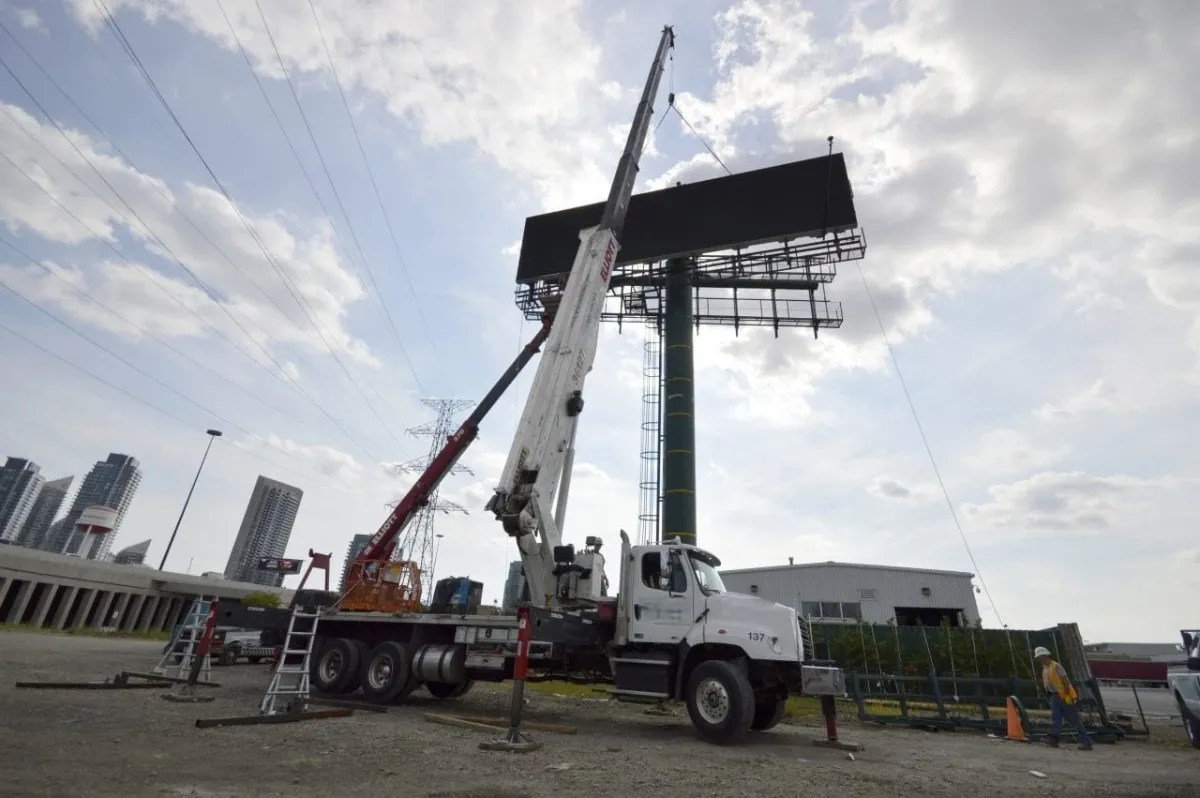
For municipalities and contractors, this elevates the value of an experienced outdoor sign installation company near me that understands structural load calculations, clearances, reflectivity standards, and right-of-way rules — not just drilling holes in poles.
3. Real estate signs going from DIY to managed service
Yard signs and commercial real estate boards remain highly effective lead drivers in residential and CRE markets. Industry data and service menus show:
- Residential real estate sign post installation, including removal and storage, often prices around $40–$60 per post, with tiered rates for commercial ground signs.
- Many real estate sign post company operators now offer online ordering, time-bound rentals (60–120 days), and out-of-area surcharges for exurban listings.
For brokerages expanding across metros like New York, Chicago, and Austin, a dedicated real estate sign installation company or a broader national sign installation company with CRE experience is more efficient than managing dozens of local handymen.
4. Multi-city brand control and national rollouts
National and regional brands increasingly want a single point of contact for signage across dozens of locations. A modern signage company business profile that appeals to these clients typically includes:
- Crews or partners across multiple states
- Standardized installation methods and photo documentation
- Ability to coordinate with separate print vendors
This is where a truly national sign installation company — such as Easy Way Install — becomes an extension of the brand’s own operations rather than a transactional contractor.
5. Compliance, safety, and insurance as core differentiators
With six-figure fines, injury risks, and structural safety at stake, the bar for a professional signage company in 2025 is high:
- OSHA-compliant practices and fall protection
- Appropriate lifts, traffic control, and electrical licensing where required
- Strong general liability and workers’ compensation coverage
For B2B buyers, especially print shops and sign fabricators, partnering with a fully insured American sign installation company protects not only the client’s property but also their own reputation and contracts.
The Economics: What Sign Installation Really Costs in 2025
Costs vary by market, height, access, and complexity, but there are solid reference points for planning.
Industry analyses and installer pricing show:
- Commercial sign installation averages about $464, with a common range between $181 and $804 for typical jobs, according to Angi.
- Full-scope business sign projects (design, fabrication, permitting, installation) range:
- Basic non-illuminated signs: $1,000–$3,500
- Standard illuminated storefront signs: $3,000–$7,000
- Custom channel letters: $4,000–$10,000+
- Monument or pole signs: $5,000–$20,000+
- Real estate sign installation typically runs $40–$100 per post for installation plus rental, depending on region and term length.
A simplified view for B2B planners:
| Sign / Service Type | Typical Buyer | Typical Cost Range (Install Component Only) | Notes |
| Small wall or panel sign (non-lit) | Independent retailers, offices | $150–$500 | Ground-level, simple mounting |
| Standard storefront channel letters (1st floor) | Chains, franchises, print shops | $400–$1,200 | Lift, power, template layout |
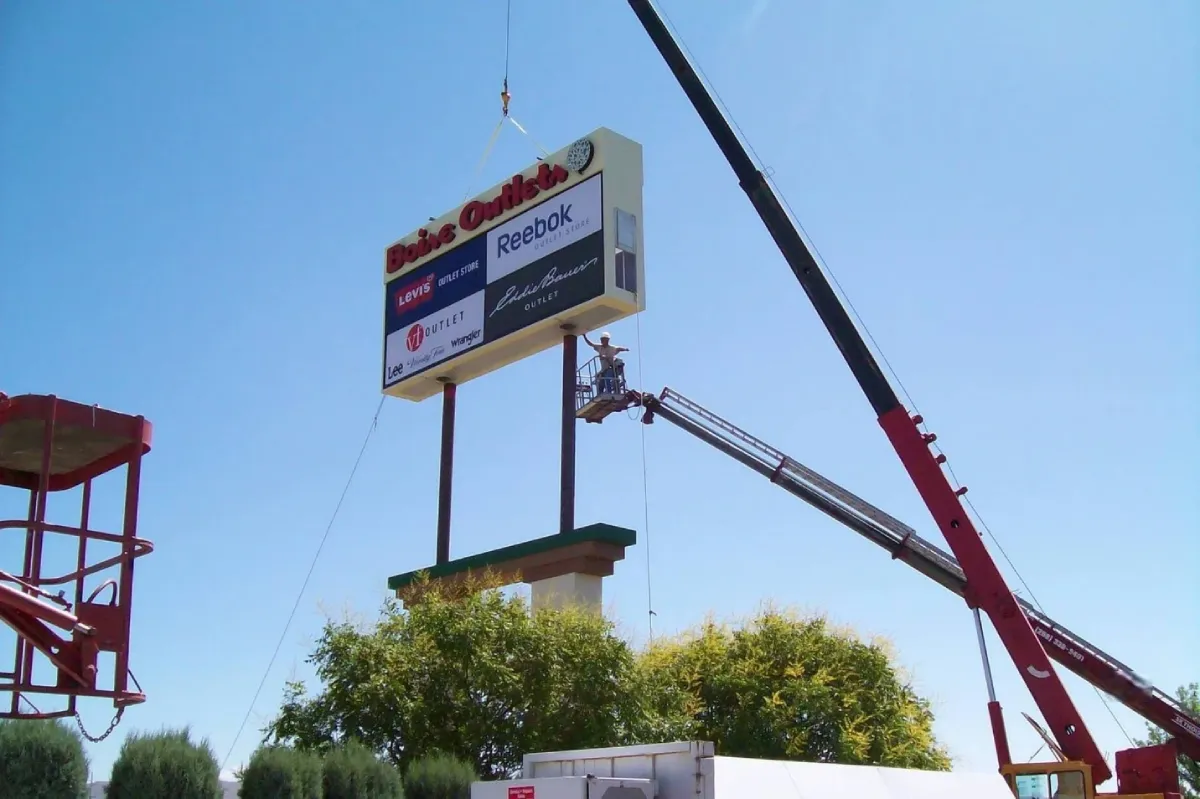
| Large pylon / monument sign | Retail centers, auto dealers | $1,500–$5,000+ | Footings, crane, traffic control |
| Interior / indoor signage company installs | Corporate, healthcare, campuses | $200–$1,000 per location | Wayfinding, lobby logos |
| Real estate sign post installation | Brokerages, REITs, developers | $40–$100 per post | Often includes removal/storage |
| Street sign installation | Municipalities, contractors | $150–$600 per sign | Safety and traffic control add cost |
Key cost drivers:
- Height and access — second-story and rooftop signs require lifts or cranes.
- Electrical work — illuminated signs need licensed electrical connections.
- Union or prevailing-wage rules — especially relevant in major cities.
- Rush timelines — weekend or overnight installs for retail turnovers.
For B2B buyers, the question is not only “What does this one sign cost?” but “What is the reliable per-location cost if we standardize across dozens of sites?”
How B2B Buyers Should Choose a Sign Installation Partner
For print companies, sign fabricators, and multi-site brands, the choice of installation partner directly impacts margin, client satisfaction, and risk exposure.
1. Distinguish clearly between fabrication and installation
A signage company often handles design and fabrication. A sign installation company specializes in turning that physical asset into a safe, code-compliant installation. Some firms do both; others, like Easy Way Install, focus intentionally on installation and project execution.
If you are a print provider or manufacturer:
- Treat the installer as part of your supply chain.
- Verify that their capacity matches your growth plans.
- Align on who owns permit submittals, engineering, and inspections.
2. Evaluate the “signage company business profile”
Before committing, analyze the provider’s profile with the same rigor you’d apply to any critical vendor:
- Geographic coverage — proven track record in New York, Illinois, Texas and surrounding regions; ability to act as a signage company in USA for multi-state programs.
- Portfolio depth — outdoor signs, indoor signage, street and traffic signs, and real estate programs.
- Process transparency — job tracking, photo documentation, and clear status updates.
- Safety record — documented policies, training, and incident history.
The goal is to move beyond “sign suppliers near me” and instead build a relationship with a partner able to handle both straightforward storefronts and complex infrastructure-adjacent jobs.
3. Require local code expertise
In NY, IL, and TX, code and permit details are not optional:
- In NYC, larger storefront signs need DOB approval and, often, a licensed sign hanger.
- In Austin, sign permits are issued under the city’s land development code, with dedicated processes for freestanding, awning, projecting, roof, and wall signs.
When you evaluate a sign installation company near me, verify instances where they have actually navigated these jurisdictions — not just generic claims.
4. Plan for lifecycle, not just installation day
Serious buyers increasingly expect:
- Maintenance and repairs — LED replacements, repainting, panel swaps.
- De-branding — end-of-lease or rebrand removals.
- Program management — updating dozens of locations over several years.
Choosing a partner that can function as a long-term real estate sign installation company, an outdoor sign installation company near me, and an indoor signage company reduces the overhead of managing multiple vendors.
Mini Case Studies: How This Plays Out in Practice
Case 1: Regional retailer rolling out across New York
A mid-sized specialty retailer signs a lease package for ten locations across Brooklyn, Queens, and northern New Jersey.
Constraints
- All stores must open before the holiday season.
- Corporate design requires illuminated channel letters and blade signs.
- Several sites fall under stricter landmark or zoning overlays.
Approach
Rather than sourcing separate installers for each borough, the retailer’s primary print vendor partners with an American sign installation company that already handles sign installation New York projects. The installer:
- Reviews drawings for DOB compliance and coordinates with a licensed sign hanger.
- Sequences jobs around landlord turnovers and utility sign-offs.
- Provides photo documentation for each location, feeding the retailer’s brand team.
Result
All ten sites open with consistent storefront presentation, no fines, and minimal re-work — and the print vendor strengthens its own position as a full-service signage partner.
Case 2: National CRE firm standardizing real estate signage in Austin and Chicago
A commercial real estate firm wants unified branding across 20 properties spread between Austin and Chicago.
Constraints
- Mix of downtown towers, suburban office parks, and redevelopment sites.
- Need for both temporary “Now Leasing” boards and permanent monument signs.
- Strict street-front rules in both cities and tight timelines around refinancing milestones.
Approach
Instead of using multiple small vendors, the firm appoints a national sign installation company that acts as both a street sign installation company and a real estate sign post company across these metros. The partner:
- Audits existing signage and maps new standards.
- Coordinates sign installation Chicago and sign installation Austin in parallel, aligning with local permit offices.
- Sets up a recurring schedule for sign refreshes as vacancies change.
Result
The firm gains a single dashboard view of all signage, lower per-unit install costs through standardization, and faster deployment for new listings.
Where Easy Way Install Fits in 2025
Easy Way Install operates squarely in this environment: a focused, B2B-oriented national sign installation company serving brands, print providers, and real estate firms.
Key characteristics aligned with the trends above:
- Geographic strength in NY, IL, and TX — including New York City, Chicago, and Austin — with the ability to coordinate projects nationwide.
- Breadth of services across outdoor business signs, real estate signage, and street signs, acting as both a real estate sign installation company and an outdoor sign installation company near me for many clients.
- Digital infrastructure, including the Easy Way Install app, which lets B2B clients schedule, track, and document installations across multiple sites.
- B2B orientation, positioning the firm as a dependable back-end partner for print shops, signage company operations, and national brand rollouts rather than a retail-only service.
For a print provider deciding between building an in-house crew and partnering with a specialist, Easy Way Install effectively becomes the installation arm — a scalable American sign installation company integrated into your workflows.
Conclusion: 2025 Is the Year to Professionalize Sign Installation Partnerships
In 2025, the combination of retail expansion, infrastructure spending, and real estate activity is creating sustained demand for professional signage installation across the U.S. The sign market is growing, regulations are tightening, and brands are raising their expectations of physical environments.
If you want a partner that can handle outdoor business signs, indoor branding, real estate posts, and street signage across multiple cities with consistent quality, Easy Way Install offers that structure and scale.
Book a consultation with Easy Way Install to review your 2025 pipeline, standardize installation methods, and lock in reliable capacity across NY, IL, TX, and beyond.
FAQ
How much does commercial sign installation cost in New York, Chicago, or Austin?
For a typical storefront or wall sign, commercial sign installation generally falls between $181 and $804, with an industry average around $464 for standard jobs. Complex projects — multi-story locations, heavy structures, or difficult access — can push installation well above that range, especially once cranes, electrical work, and traffic control are involved. In dense markets like New York City and Chicago, permit and labor conditions often add a premium compared with smaller metros.
When do I need a real estate sign installation company near me instead of doing it in-house?
If you manage more than a handful of listings at a time, or operate across multiple suburbs or cities, a professional real estate sign installation company near me is typically more efficient. They handle storage, routing, installation, removal, and sometimes photo confirmation, usually at $40–$100 per sign post, freeing your agents to focus on leasing and sales rather than logistics.


Leave a Reply