

10 graphic design subscription services compared
Key takeaways
- Entry prices in this category run from $599 to $15,000 a month. Every one of those plans is marketed as unlimited.
- “Unlimited” describes requests you can submit, not work delivered. Throughput is decided by how many requests run at once.
- Capacity is sold three ways: active slots, monthly hours, and daily hours. Comparing monthly prices across those models means little without normalizing them.
- Commitment length is the hidden cost. Some services are month-to-month, others need three months, and one requires a full year.
Design subscriptions start at $599 a month and run to a $15,000 floor with a twelve-month commitment attached. Both ends of that range are advertised with the same word: unlimited.
The word is technically honest and practically misleading. You can submit as many requests as you like almost everywhere. What differs is how many get worked on at once, and that number decides whether a subscription feels like a design team or a queue.
The model itself is sound. A flat monthly fee turns design from a series of quotes into one predictable line item, with no hourly billing and no recruiting. It works well for teams with steady work and badly for teams with one project a quarter.
Below are ten subscriptions, what each delivers for the money, and the honest limitation on each.
What to compare before price
Monthly rates are the least useful number on any pricing page here, because they describe wildly different amounts of work.
Capacity is sold three ways. Active slots govern how many requests move at once. Monthly hours give you a block of designer time to draw down. Daily hours give a fixed allotment each business day that may or may not roll over. A $995 plan with two active slots and a $1,199 plan with two daily hours are not comparable until you work out what each buys in a week.
Then check the commitment, which ranges from cancel-anytime to twelve months, and whether motion or web build sits on your tier or a higher one.
The ten services
1. Awesomic
Best for: teams whose design work spills into web build, video, and copy.
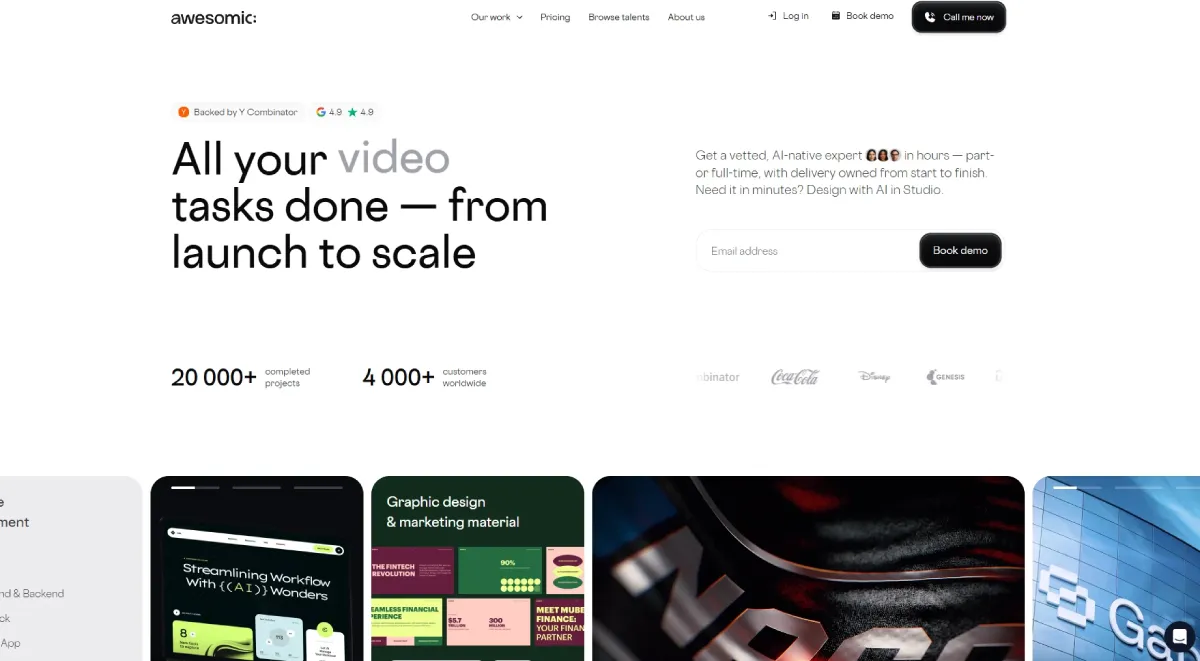
Awesomic runs the subscription model as a talent marketplace rather than a design studio. A task goes in, and the platform matches it to a vetted specialist in up to 24 hours, with unlimited revisions until sign-off. If the match is wrong, a rematch is free, which solves the biggest failure mode of the dedicated-designer model: being stuck with someone competent but wrong for your brand.
Scope separates it from most flat-fee competitors. The roster covers graphic design, branding, UI/UX and product design, pitch decks, and ad creative, plus no-code web build in Webflow, Framer, and WordPress, and video and motion. The All-in-one tier folds in copywriting and QA, so a launch needing a landing page, ad creative, and copy stays with one vendor.
Pricing is published, not gated behind a call. AI Designer is $200 per month for AI-generated landing pages and app design. Graphic Pack is $1,490, or $1,190 billed quarterly, with part-time talent and Slack integration. All-in-one is $2,995, or $2,396 quarterly, covering every service line. A 1-to-1 tier adds full-time talent plus a project manager at custom pricing, and monthly billing carries no commitment.
The company reports 20,000-plus completed projects for 4,000-plus customers, a 4.9 rating, and a 0.82% acceptance rate among applying designers. It is a Y Combinator company and Red Dot Award winner.
The trade-off: the discounted quarterly rates require a three-month minimum, and the two main tiers are part-time talent, so teams wanting someone embedded full-time need the custom 1-to-1 tier. At $1,490, this graphic design subscription sits above the cheapest options here and earns the difference only if you use the breadth.
2. Delesign
Best for: small teams wanting the lowest genuine entry price.
Delesign pairs each client with a dedicated senior designer and a design manager, working unlimited requests and revisions through a queue. Designer swaps are free, and a 15-day money-back guarantee lets you keep the work. Marketer Growth is $599 per month, with SEO Writer at $399, Web Developer at $649, and Agency Booster at $799 adding web design and video.
The trade-off: the queue is serial at roughly two hours of designer time per business day, there is no free trial, and animation-heavy work can take 7 to 15 days.
3. ManyPixels
Best for: startups that want to pick their designer and keep them.
ManyPixels covers unlimited requests and revisions across a dozen-plus formats, including motion and video editing, with next-business-day first drafts. You choose your designer rather than being assigned one, and get full IP with native Adobe, Figma, or Canva files. Advanced is $699 per month, or $559 yearly; Business is $1,199, or $959 yearly.
The trade-off: there is no free trial and no sub-$500 option, and the base tier runs a serial queue, so parallel work means upgrading.
4. GraphicsZoo
Best for: teams that want a named art director without agency pricing.
GraphicsZoo matches a dedicated team with a named art director and account manager. Unlimited requests, revisions, brands, and users come on every tier, with 1 to 2 business day turnaround across six categories including motion and video. Essential is $850 per month, or $700 annually, at one project at a time. Premium is $1,450 for two projects and Elite $2,750 for four.
The trade-off: $850 is a high entry for a single concurrent project, and the tiers differ only by how many projects run at once rather than by what they cover.
5. No Limit Creatives
Best for: high-volume ad and ecommerce creative.
No Limit Creatives prices by concurrent design slots rather than scope, across 150-plus capabilities spanning ads, ecommerce, branding, print, video, and web. Graphics turn around in 1 to 3 days and video in 2 to 4, and every plan is month-to-month. Digital Ads starts at $900 per month at two slots, Ecom is $1,250, Marketing $1,600, and Full Stack $2,000, with 10% off annual billing.
The trade-off: there is no free trial and no refund on early cancellation, everything runs through its own platform rather than Slack, and support is weekdays only.
6. DotYeti
Best for: brands that want turnaround to tighten as they scale up.
DotYeti sells flat-rate unlimited design worked two requests at a time, with turnaround tightening by tier from 2 to 3 days on Base to same or next day at the top. Higher tiers unlock motion, video, 3D, web development up to 20 hours a month, and copy. Base is $995 per month, Scale $1,595, Summit $2,595, and Apex Studio from $3,995, with a 14-day guarantee and no contract.
The trade-off: you are capped at two parallel requests through the $2,595 tier, and Apex pricing is vague.
7. Flocksy
Best for: teams wanting one dedicated crew across design, video, and copy.
Flocksy sells capacity in daily hours and staffs the same team on every brief: a designer, a video and motion editor, an illustrator, and a copywriter across 140-plus services. Unused hours roll over for 30 days. Entry is $1,199 per month for 2 daily hours billed annually, rising through $1,699, $2,199, $2,599, and $2,999 as hours increase.
The trade-off: those prices assume annual billing and monthly costs roughly 30% more, the entry tier has no coordinator or art director, and video is gated to higher plans.
8. Design Buffs
Best for: B2B SaaS marketing teams buying design in measured hours.
Design Buffs sells subscription design in monthly hour blocks to B2B SaaS and tech marketing teams, with a dedicated creative project manager and assigned designer pool. Scope covers marketing and graphic design, presentations, illustration, motion, and UI. Essential is $1,500 per month for 40 hours, or $1,238 annually; Growth is $2,800 for 80 hours. Webflow development is a $999 monthly add-on.
The trade-off: there is a three-month minimum, only two tiers are published, and web build costs extra.
9. Designjoy
Best for: founders who want senior work fast and can afford a premium.
Designjoy is a flat-fee subscription run by a single operator, handling web, brand, UI/UX, and Webflow development through a Trello board. Average turnaround is around 48 hours, and you can pause or cancel at any point. The single plan is $4,995 per month, a limited-time rate against a $5,995 list price, with a one-week trial carrying a 75% refund.
The trade-off: it is among the priciest single plans here, works one request at a time, caps you at two users, and has no team redundancy behind the solo operator.
10. Superside
Best for: mid-market and enterprise teams replacing an agency roster.
Superside staffs dedicated senior teams across video, motion, branding, web, presentations, and copy through its Superspace platform. Unlimited users and storage are included, unspent Flex budget rolls over for up to three months, and a team is typically live in around three weeks. Pricing starts at a $15,000 monthly minimum on a 12-month commitment, plus a $1,000 monthly software fee.
The trade-off: that floor and the annual term rule out small teams entirely, and there is no self-serve or month-to-month option.
How to choose
Work out your monthly volume first, then let it point at a price band, because the cheapest plan is only cheap if it keeps up.
- Under five requests a month: Delesign at $599 or ManyPixels at $699 covers it, and a serial queue will not hurt at that volume.
- Steady weekly output across formats: GraphicsZoo, DotYeti, or Awesomic’s Graphic Pack sit in the $850 to $1,490 band where concurrency and scope both improve.
- Design plus web build, video, and copy: Flocksy, Design Buffs with the Webflow add-on, or Awesomic’s All-in-one tier keep it under one vendor.
- Enterprise volume with a dedicated team: Superside is built for it, if the $15,000 floor and annual term fit your budget.
Before committing, price the plan you would actually use rather than the headline tier, and read this guide to how design subscriptions work if the queue mechanics are unclear. The gap between advertised and real cost is almost always concurrency, add-ons, or a billing term.
The short version
A design subscription is a good deal when design is continuous and a poor one when it is occasional. The break-even sits around three or four requests a month; below that, per-project work is usually cheaper.
Shortlist two services in the same price band, send both the same brief during a trial or guarantee window, and compare the second draft rather than the first. First drafts show talent. Second drafts show whether the service listened.
Frequently asked questions
How much does a graphic design subscription cost?
Published entry prices run from $599 (Delesign) and $699 (ManyPixels) through the $850 to $1,500 band where most services sit, up to $4,995 for Designjoy and a $15,000 minimum at Superside. What changes across that range is concurrency, scope, and seniority rather than whether requests are unlimited.
Is a design subscription cheaper than hiring a designer?
It depends on volume and on what you count. A subscription removes recruiting time, payroll, benefits, and software costs, and can be paused or cancelled in a way a hire cannot. For teams with steady but not full-time needs, that flexibility is where the savings sit. A team with enough work to keep one person busy every day will eventually find hiring cheaper per hour.
What should you check before signing up?
Four things, in this order: how many requests are worked at once, whether the quoted turnaround describes a first draft or a finished file, how long the commitment runs, and whether motion, video, or web build sits on your tier. Those four explain nearly every complaint about design subscriptions, and every one is answerable before you pay anything.


Leave a Reply