

5 Best Semrush API Alternatives in 2026: SE Ranking, Ahrefs, DataForSEO & More
TL;DR: What Is the Best Semrush API Alternative?
SE Ranking is the best Semrush API alternative for teams that need AI visibility, keyword research, rank tracking, backlink data, competitor analysis, and site audit capabilities through a single API. It covers the same core modules as Semrush at a significantly lower price point. The documentation is clean, the REST API is well-structured, and the data quality is competitive for both organic and paid search metrics across major markets. For agencies building client dashboards or SEO product teams that need multi-module data without enterprise-level costs, SE Ranking delivers the most complete package per dollar spent.
If you’re asking which Semrush API alternative to use, you’re probably running into one of three problems:
- Semrush API is too expensive for your query volume
- It’s missing an endpoint you need
- You want to compare what else exists before committing
Five tools cover the full range of SEO API use cases: SE Ranking, Majestic, Ahrefs, Serper, and DataForSEO. Each has a distinct strength, and none of them is a perfect drop-in replacement for every Semrush module. This article compares all five in detail. No filler.
Comparison Table: Semrush API Alternatives
| Tool | Main Strength | Backlinks | Keywords | SERP Data | Site Audit | Pricing Model |
| SE Ranking | All-in-one SEO API | ✓ | ✓ | ✓ | ✓ | $318/mo |
| Ahrefs | Backlink index depth | ✓ | ✓ | Limited | ✗ | API from $500/mo |
| Majestic | Link intelligence | ✓ | ✗ | ✗ | ✗ | From $49.99/mo |
| Serper | Fast SERP at scale | ✗ | ✗ | ✓ | ✗ | From $50/mo |
| DataForSEO | Raw data at scale | ✓ | ✓ | ✓ | ✓ | Pay-per-use |
SE Ranking API
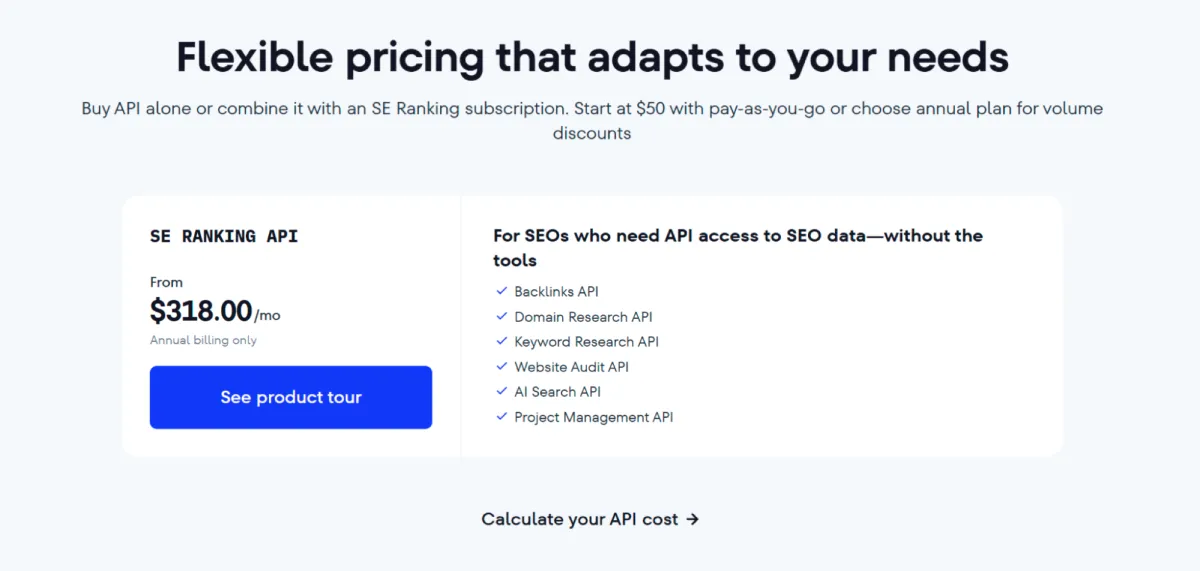
SE Ranking is the strongest of the SEMrush API alternatives for teams that need broad SEO data coverage without building relationships with multiple vendors. It is not the deepest tool in any single category, but its API spans more modules than any other option at this price tier.
What Are the Key Features of SE Ranking API?
- Keyword Research API: Search volume, CPC, keyword difficulty, related terms, and SERP feature presence data across 100+ countries.
- Rank Tracking API: Daily and on-demand position tracking for target domains across Google, Bing, and Yahoo.
- Backlink API: Domain trust score, referring domains, anchor text distribution, and new/lost link monitoring.
- Competitor Analysis API: Organic and paid traffic estimates, top-ranking keywords, and ad copy data for any domain.
- Site Audit API: Technical SEO issue detection covering crawl errors, Core Web Vitals flags, redirect chains, and duplicate content.
- White-Label Reports: Exportable report data formatted for agency client workflows.
What Are the Pros and Cons of SE Ranking API?
Pros:
- Widest feature set among the best SEMrush API alternatives at this price tier
- Clean REST API with detailed, well-maintained documentation
- Flexible subscription plans — credits scale with plan tier
- Strong keyword database coverage for European and emerging markets
- Suitable for both product builds and internal reporting pipelines
- White-label support for agencies reselling SEO reports
Cons:
- Backlink index is smaller than Ahrefs and Majestic
- API rate limits can restrict high-volume pipelines on lower-tier plans
- No true pay-per-use option — an active subscription is required
What Is the Pricing of SE Ranking API?
- Core Plan: 25,000 credits/month; subscription starts at $103.20/mo billed annually.
- Growth Plan: Includes 100,000 Data API credits/month; subscription starts at $223.20/mo billed annually.
- Standalone Availability: You can purchase access without buying the normal SaaS dashboard. The annual billing plan starts at $318.00 per month.
- Yearly Credit Volume: The baseline $318 package provides 24 million credits for the entire year. You pay $3,816.00 upfront.
- Endpoint Specific Costs: SERP records cost 10 credits each. A single domain overview query deducts 100 credits instantly. Backlink queries charge exactly 1 credit for every single row returned in the payload.
- Machine Learning Premium: Any request interacting with the LLM prompt endpoints costs a massive 2,000 credits per single call.
- Free Trial Access: New developer accounts receive 100,000 free credits for 14 days.
SE Ranking provides two distinct APIs: the Data API, which uses a pay‑as‑you‑go credit system for raw data retrieval, and the Project API, which uses your subscription limits for project management functionality.
Majestic API
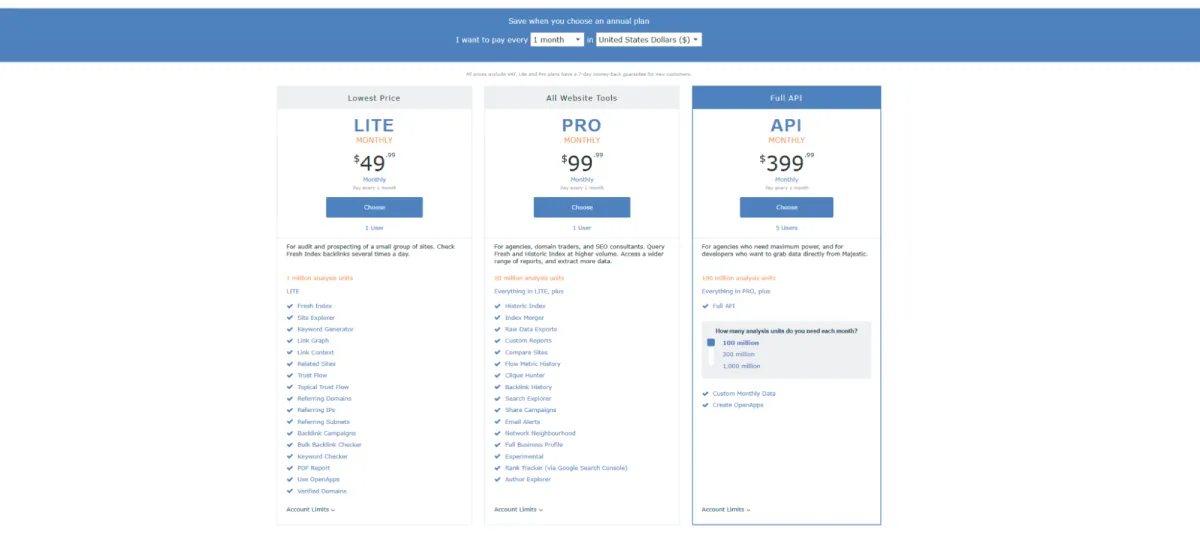
Majestic is a long-standing competitor of Semrush’s API in the backlink data space. It does not try to compete across SEO modules. The API is purpose-built for link intelligence, and it does that job well.
What Are the Key Features of Majestic API?
- Trust Flow and Citation Flow: Majestic’s proprietary link quality metrics, widely used as a quick proxy for domain authority assessment.
- Fresh and Historic Indexes: Two separate crawl datasets — Fresh Index (last 90 days) and Historic Index (multi-year backlink data).
- Bulk Backlink Checker: Batch lookups for large lists of URLs or root domains.
- Referring Domains and IPs: Source breakdown with IP diversity data for spam detection.
- Topical Trust Flow: Classifies backlinks by topic category for relevance analysis.
- Anchor Text API: Full anchor text profiles at domain or URL level.
What Are the Pros and Cons of Majestic API?
Pros:
- One of the largest backlink indexes among alternatives to SEMrush API
- Trust Flow is a trusted metric for quick link quality screening
- Historic Index is valuable for long-term link growth analysis
- SDKs available for PHP, Python, Java, and .NET
- Very cost-effective when backlink data is the only requirement
Cons:
- No keyword research, rank tracking, or site audit data — backlinks only
- Not a full alternative to SEMrush API for multi-module SEO work
- Developer experience feels dated compared to newer APIs
- Trust Flow and Citation Flow are proprietary and do not map directly to Google’s link evaluation signals
What Is the Pricing of Majestic API?
- Lite plan: $49.99/month — includes API access with 1 million analysis units
- Pro plan: $99.99/month — 20 million analysis units, bulk operations unlocked
- API Pro: $399.99/month — full API access with higher rate limits for production use
- Pay-as-you-go API units available for one-off or irregular projects
Ahrefs API
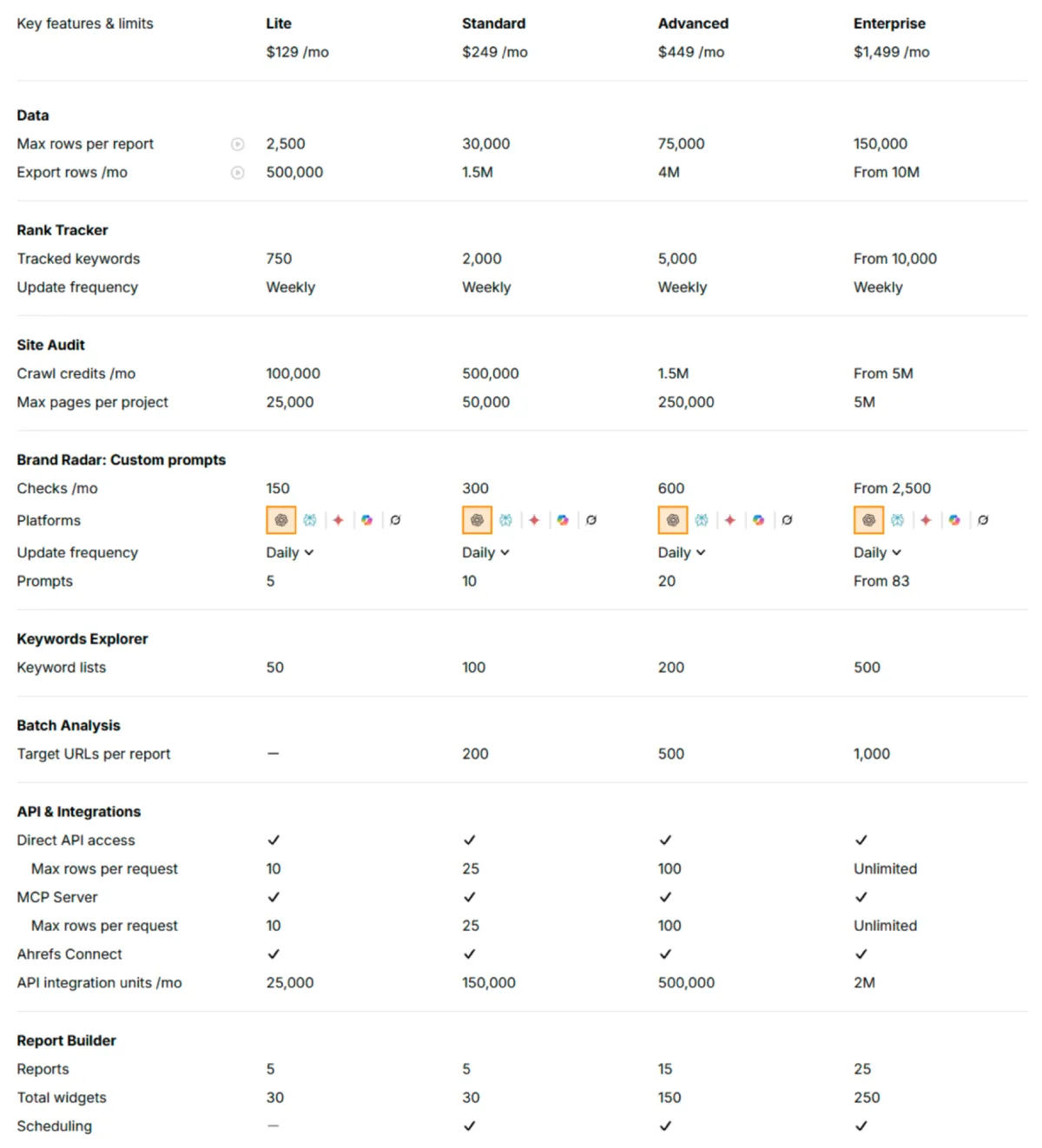
Ahrefs is the best competitor to Semrush’s API for backlink data depth. Its crawl index is consistently ranked among the largest and most frequently updated in the industry. The Ahrefs API is newer than its web interface and currently covers fewer endpoints than what the UI exposes.
What Are the Key Features of Ahrefs API?
- Backlink Index Access: Referring domains, backlinks, anchor text, and link attributes pulled at scale.
- Domain Rating (DR) and URL Rating (UR): Ahrefs’ authority metrics accessible via API call.
- Organic Keywords API: Top organic keywords for any domain with position, volume, and estimated traffic data.
- Keyword Explorer Data: Search volume, keyword difficulty, clicks-per-search, and SERP history.
- Batch Analysis: Bulk domain or URL lookups for large-scale link audits.
- Content Performance Data: Partial content metrics accessible through specific endpoints.
What Are the Pros and Cons of Ahrefs API?
Pros:
- Deepest backlink index among all best SEMrush API competitors on this list
- High-frequency crawl keeps data fresh
- Domain Rating is one of the most recognized authority metrics in SEO
- Keyword data is reliable for high-volume markets including US, UK, AU, and DE
- Well-maintained and actively developed
Cons:
- API pricing starts at $500/month, making it one of the most expensive SEMrush API alternatives here
- No site audit endpoint in the current API offering
- API feature set is narrower than the Ahrefs web interface
- API unit consumption per row returned makes cost forecasting complex
- Not practical as a budget alternative to SEMrush API
What Is the Pricing of Ahrefs API?
- API access starts at $500/month for the basic tier, separate from standard Ahrefs subscriptions
- Enterprise API pricing is negotiated directly with Ahrefs
- Costs are based on rows returned per query, not flat query counts
- No free tier; a limited API sandbox is available for pre-purchase evaluation
Serper API
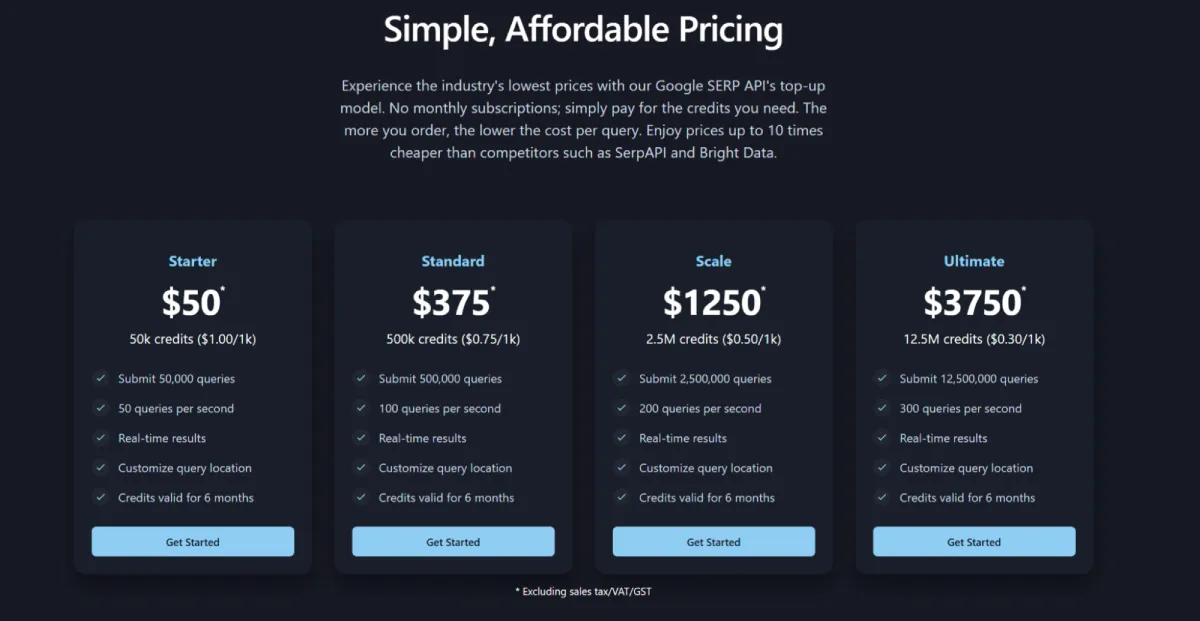
Serper is not a direct SEMrush API alternative if you need keyword metrics or backlink data. It does one thing: return Google SERP results at high speed and low cost. For SEO teams building rank trackers, SERP feature monitors, or keyword research tools that need live search data as input, it is very useful.
What Are the Key Features of Serper API?
- Google Search Results: Organic listings, featured snippets, People Also Ask boxes, Knowledge Panels, and local pack data.
- Google Images, News, and Video Endpoints: Separate API endpoints for each result type.
- Google Shopping Results: Useful for e-commerce SEO and PPC competitive analysis.
- Location and Language Targeting: Run queries for specific countries, languages, and cities.
- Autocomplete API: Returns Google autocomplete suggestions for keyword ideation.
- Batch Queries: Submit multiple search queries in a single API call to reduce latency.
What Are the Pros and Cons of Serper API?
Pros:
- Extremely fast response times — typically under one second
- Very low cost per query compared to other SERP data providers
- Clean JSON output that parses easily
- Generous free tier: 2,500 queries on signup, no credit card required
- Good for building rank trackers or content tools where SERP structure is the primary input
Cons:
- No keyword volume, difficulty, or CPC data — raw SERP results only
- No backlink data of any kind
- Not a full SEMrush API competitor for complete SEO workflows
- Google-only; no Bing, YouTube, or Amazon SERP endpoints currently
- Usage caps can be reached quickly at pipeline scale
What Is the Pricing of Serper API?
- Starter — $50: 50,000 credits, $1.00 per 1K, 50 queries per second, real-time results, customizable query location, credits valid for 6 months
- Standard — $375: 500,000 credits, $0.75 per 1K, 100 queries per second, real-time results, customizable query location, credits valid for 6 months
- Scale — $1250: 2,500,000 credits, $0.50 per 1K, 200 queries per second, real-time results, customizable query location, credits valid for 6 months
- Ultimate — $3750: 12,500,000 credits, $0.30 per 1K, 300 queries per second, real-time results, customizable query location, credits valid for 6 months
DataForSEO API
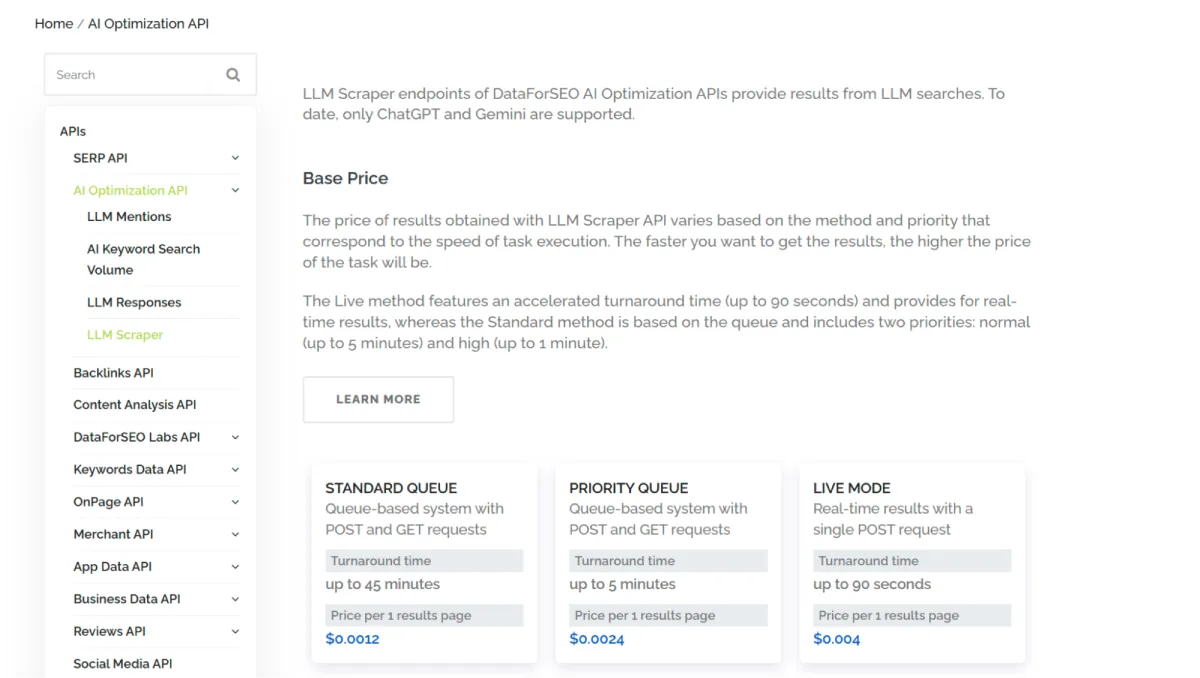
DataForSEO is built differently from every other tool on this list. It is a raw data API — no dashboards, no web interface, just endpoints. For developers and data engineering teams, it is one of the most complete best SEMrush API alternatives available anywhere.
What Are the Key Features of DataForSEO API?
- SERP API: Live and cached results from Google, Bing, Yahoo, YouTube, and Google Maps.
- Keywords Data API: Search volume, CPC, competition scores, and keyword suggestions drawn from Google Ads and Bing data.
- Backlinks API: Domain-level and URL-level backlink data including referring domains, anchor text, and link attributes.
- On-Page API: Full technical SEO audit capabilities — crawl error detection, page speed data, and structured data validation.
- Domain Analytics API: Organic traffic estimates, top keywords, and competitor keyword overlap.
- DataForSEO Labs: Keyword clustering, search intent classification, and bulk keyword analysis at scale.
What Are the Pros and Cons of DataForSEO API?
Pros:
- Widest endpoint coverage among SEMrush API competitors — SERP, keywords, backlinks, and audits in one API
- True pay-per-use pricing with no monthly minimum required
- Detailed documentation with code examples in multiple languages
- Live and cached response options let you balance cost against freshness
- Best choice for building SEO products from the ground up
Cons:
- API-only — no UI or dashboards, which requires dedicated development resources
- Backlink data quality is less consistent than Ahrefs or Majestic
- Pricing can become unpredictable at high query volumes without careful rate management
- Steeper learning curve for non-developers
What Is the Pricing of DataForSEO API?
- Fully pay-per-use — no monthly subscription required
- SERP API: from $0.002 per live task to $0.0006 per cached task
- Keywords Data API: from $0.0025 per keyword lookup
- Backlinks API: approximately $0.002 per domain-level request
- Free trial credits on signup; no credit card required to start
How to Choose an SEO API?
There is no single best SEMrush API competitor for every use case. Match the tool to the job, not the other way around. Choosing among the best SEMrush API alternatives comes down to three questions:
- What data do you need?
- At what volume?
- What is your budget?
Most teams get this wrong by starting with price and working backwards. Start with your data requirements instead.
Define your data needs first
If you need backlinks only, Ahrefs or Majestic will outperform everything else on this list for that specific job. If SERP data at high speed and low cost is the requirement, Serper is the answer. If you need a full stack — keywords, backlinks, site audits, and rank tracking — SE Ranking or DataForSEO are the right options to evaluate.
Match the pricing model to your usage pattern
DataForSEO’s pay-per-use model works well for irregular or bursty usage. Continuous pipelines with predictable monthly volume are better served by a subscription like SE Ranking. Ahrefs’ API pricing is only justifiable if backlink depth is critical to your product and the data quality difference is measurable.
Think about developer experience
DataForSEO has the most detailed documentation. SE Ranking and Serper have the cleanest API structures for quick integration. Majestic’s SDK coverage is good, but the overall developer experience lags. Ahrefs’ API is well-documented but still missing several endpoints that exist in the web UI.
Check data freshness requirements
Ahrefs crawls the web most aggressively among the best SEMrush API competitor options listed here. DataForSEO’s live SERP endpoints return real-time results. SE Ranking updates rank tracking data daily. Majestic’s Fresh Index refreshes within a 90-day window.
Consider your audience
Agency tools need white-label outputs — SE Ranking supports this directly. Product builders who need scale and architectural flexibility should look at DataForSEO. Internal SEO teams filling a specific data gap can use Serper or Majestic as targeted supplements to their existing stack.
Conclusion
Each of these SEMrush API alternatives serves a different kind of SEO team. SE Ranking covers the widest range of data types at a competitive price. Ahrefs wins on backlink depth and index size. DataForSEO gives the most flexibility for teams with engineering resources. Serper is the fastest and cheapest option for SERP data. Majestic remains the go-to for link intelligence at scale.
The right pick depends entirely on what you are building and what data gaps you actually need to fill. Most of these SEMrush API competitors offer free trials or startup credits — test before you commit.
FAQ
1. What is the best Semrush API alternative for backlink data?
Ahrefs has the deepest backlink index and is the strongest SEMrush API alternative specifically for link data. Majestic is a close second and more affordable when keyword or SERP data is not required. Both outperform SE Ranking and DataForSEO on backlink coverage alone.
2. Is DataForSEO a good alternative to Semrush API?
Yes, for developers. DataForSEO is one of the most complete alternatives to SEMrush API for teams building SEO products or large-scale data pipelines. It covers SERP, keywords, backlinks, and on-page data through a single pay-per-use API. The trade-off is that it requires technical resources to use effectively — there is no UI.
3. Which Semrush API alternative is the cheapest?
Serper is the cheapest entry point if SERP data is all you need. DataForSEO is the most cost-efficient for multi-data-type access at scale, with no monthly minimum. Among the best SEMrush API alternatives with full-stack SEO data coverage, SE Ranking offers the strongest price-to-feature ratio.
4. Can I combine multiple Semrush API competitors in one workflow?
Yes, and many teams do. A common setup pairs SE Ranking for keyword and rank data with Ahrefs or Majestic for backlinks, plus Serper for real-time SERP snapshots. Using these SEMrush API competitors together lets you optimize for data quality and cost by data type rather than accepting one tool’s trade-offs across all categories.
5. Does Semrush offer a free API tier?
Semrush does not offer a meaningful free API tier, which is one reason SEO teams look for alternatives to SEMrush API. Both DataForSEO and Serper provide free credits at signup that let you run real queries and test output quality before committing to a paid plan. SE Ranking and Majestic offer free platform trials, though API access typically requires a paid subscription.


Leave a Reply