

Mercari Japan for US Shoppers: A Relaxed Guide to Great Finds (and Getting Them to Your Door)
For about five seconds, it’s pure victory.
Then you notice the listing is in Japan. And your brain immediately goes: Okay… how do I actually buy this? Will they ship to the US? Can I even check out?
That’s exactly why Mercari Japan has become a go-to for a lot of US shoppers. It’s one of Japan’s biggest secondhand marketplaces, and it’s full of the kind of stuff that’s hard to find elsewhere: beauty products, fashion, hobby items, media, collectibles, and a steady stream of “wait, this still exists?” listings.
The only catch is that Mercari Japan is built for domestic buyers. Most sellers expect to ship within Japan, and the checkout experience isn’t designed around US addresses. So in this guide, we’ll keep things simple: how to shop Mercari Japan without getting overwhelmed, what to watch out for, and how people in the US usually handle checkout and shipping without turning every purchase into a mini research project.
If you want a straightforward way to buy from Japan’s Mercari marketplace as a US shopper, it helps to follow a workflow that can handle the domestic purchase and the international delivery steps—so you can focus on the fun part (finding the right listing) instead of wrestling with logistics.
What Mercari Japan actually is (and why normal people use it)
Mercari is often described as “Japan’s flea market app,” and that’s close. It’s a huge secondhand marketplace where people list things they don’t need anymore and other people grab them quickly. Inventory moves fast, and that’s part of the charm—you’re not looking at the same stale listings for months.
And no, it’s not only for hardcore collectors.
Plenty of general shoppers use Mercari Japan for pretty practical reasons:
- a Japanese beauty product they can’t easily find in the US anymore
- fashion and accessories that are hard to source outside Japan
- gifts that feel more unique than “another candle”
- books, media, and hobby items that are overpriced elsewhere
If you’ve ever thought, “I want the Japan version, not the watered-down international one,” Mercari is often where it shows up.
The one thing to understand upfront: browsing is easy, buying is where it gets tricky
Mercari Japan is a domestic platform. That means a lot of listings assume:
- the buyer has a Japan-friendly checkout method
- the seller only needs to ship within Japan
- the buyer doesn’t need international handling
So US shoppers can browse all day, but when it’s time to actually buy, you may hit friction.
This is where many people get discouraged—but it’s not a dead end. It just means you typically need a “bridge” between Mercari and your US address: something that can complete the domestic purchase and then ship internationally.
Once you accept that Mercari Japan isn’t a US-style store, it gets easier to work with. You treat it like what it is: a massive secondhand marketplace with amazing inventory… plus a few extra logistics steps if you’re overseas.
How to shop Mercari Japan without spiraling into chaos
Mercari Japan can be a little addictive. New listings pop up constantly, and the best stuff can disappear quickly. The trick is to shop it like a great thrift store: with a plan, not panic.
Start by deciding what “a good deal” means to you
Some people want the lowest price, no matter what. Others want the best condition. Others care most about completeness (box, accessories, inserts, etc.). None of those are wrong—just don’t switch priorities mid-scroll. That’s how people end up buying something they didn’t actually want.
Let photos do the talking
On secondhand marketplaces, photos are the description. Zoom in. Look at details, not vibes.
- Fashion:tags, seams, wear points, stains, logo close-ups
- Beauty:seals (if visible), packaging condition, how full it looks
- Electronics:ports, scratches, signs it was tested
- Collectibles:included parts, base, paint condition, box condition (if you care)
A listing doesn’t need to be perfect—it just needs to be clear enough that you can say, “I know what I’m getting.”
Don’t brush off vague condition language
Sometimes sellers are short because they assume the buyer already understands the item. If the description is super vague and the photos don’t fill in the gaps, treat it as a “pause” moment—especially if the item is expensive or hard to replace.
Three common mistakes US shoppers make on Mercari Japan
Here’s the truth: most bad experiences aren’t scams. They’re misunderstandings.
Mistake 1: Forgetting that shipping depends on box size, not just weight
This surprises people all the time. A lightweight item can still be expensive to ship if the box is big. Shoes, bags, boxed collectibles—those can push shipping up quickly.
If you’re planning to buy more than one thing, it often makes sense to think like a “haul builder”: buy within a short window, let packages arrive, then ship together when it’s efficient.
Mistake 2: Assuming the item is complete
This matters most for collectible-style items, but it can apply to everyday purchases too. Some things come with accessories, inserts, straps, manuals, or packaging that affects value. If you care about completeness, look for photo proof or explicit confirmation.
Mistake 3: Treating every purchase the same
A low-cost accessory doesn’t need the same caution as a high-value fashion piece. Save extra verification or inspection for the items where being wrong would actually hurt.
A simple cost mindset that makes the whole thing feel less stressful
If you want Mercari Japan shopping to feel predictable, separate your total cost into two buckets:
Base costs: item price, any service/platform fee tied to your purchase method, domestic shipping within Japan, international shipping, and sometimes taxes/duties depending on category/value.
Optional add-ons: things like package checks, open-box inspection, special handling, or preserving original boxes.
This mental split changes everything. Instead of feeling like costs appear out of nowhere, you’re choosing what you need. That’s how you keep the experience fun—especially if you plan to shop Japan more than once.
So how do US shoppers actually complete the purchase?
In practice, many US buyers use a proxy workflow for Mercari Japan—especially when domestic-only shipping or local checkout steps get in the way.
The key isn’t just “can someone buy it for me?” The key is whether the process stays calm after you buy: can you consolidate if you’ve ordered multiple items, choose shipping speed based on value and urgency, and add inspection only when it’s worth it?
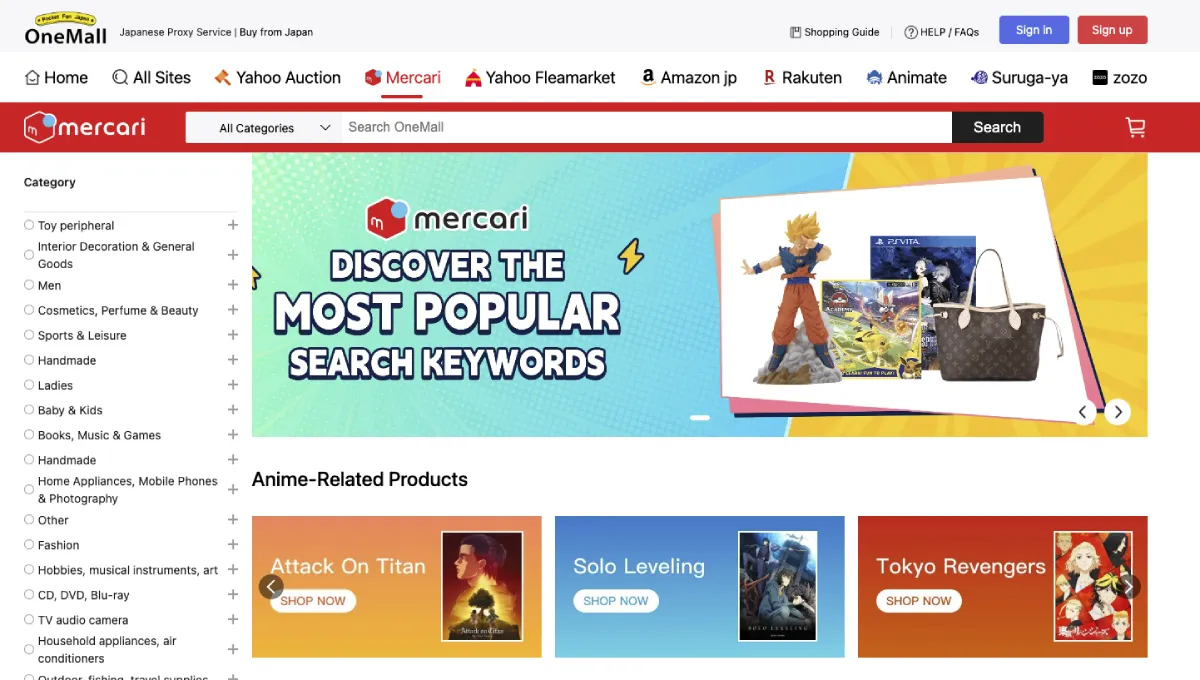
When checkout or Japan-only shipping becomes the blocker, many US shoppers use a Mercari proxy that can purchase in Japan and ship internationally, then choose shipping and consolidation based on what they bought. One example of a service people use for this is OneMall (onemall.jp), which helps overseas shoppers access Mercari listings and then choose shipping and consolidation based on what they bought.
What’s worth buying on Mercari Japan if you’re not a collector?
You don’t need to be deep into anime or streetwear to find Mercari useful. Some of the most “general shopper” wins are:
- Japanese beauty/drugstore itemsyou can’t consistently find in the US
- unique gifts(stationery, character goods, small accessories)
- books and mediathat are out-of-print or expensive elsewhere
- vintage fashionwith a different vibe than typical US resale feeds
If you’ve ever scrolled a US resale platform and thought, “Everything is the same,” Mercari Japan can feel refreshing.
A calm way to start (so you don’t get lost scrolling for three hours)
Start with a category you already understand. Pick a short wishlist. Watch listings for a week so you learn what normal pricing looks like. Then make one small purchase—not a giant haul, not a complicated experiment.
Once you’ve seen the full flow—from choosing a listing to receiving the package—Mercari Japan starts to feel less like a foreign system and more like… shopping. Just with better finds.
Final thought: Mercari Japan isn’t “hard,” it’s just not built like a US store
The biggest mistake is expecting Mercari to behave like Amazon. It’s a domestic secondhand marketplace—fast, varied, full of gems—and US shoppers need a bridge for checkout and delivery.
But if you approach it with a little structure—read listings carefully, keep costs predictable, and ship in a way that matches what you’re buying—it can be surprisingly smooth.
And really, that’s the goal: the fun part should be the find, not the checkout.


Leave a Reply