
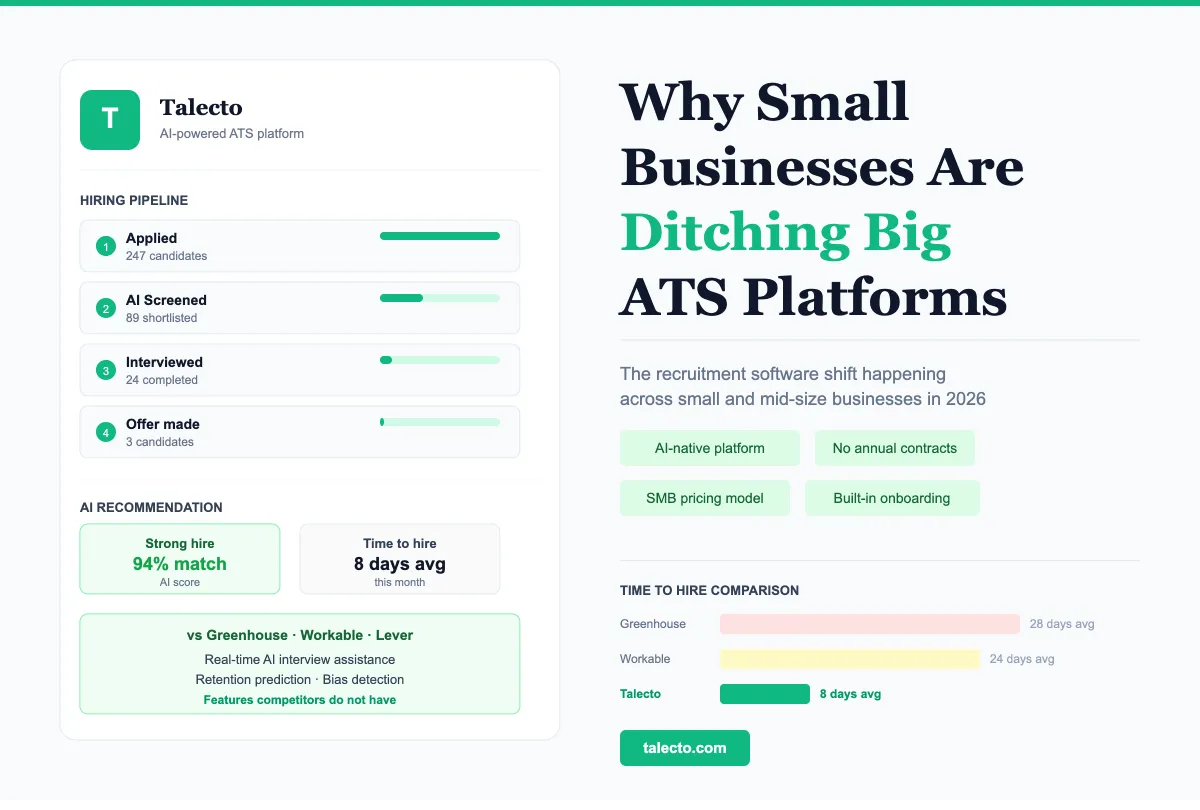
Why Small Businesses Are Ditching Big ATS Platforms in 2026
For years, small and mid-size businesses assumed that enterprise recruitment software was simply out of reach. The platforms that large companies used to manage hiring were expensive, complicated, and built for HR teams of ten or more. So smaller businesses made do with spreadsheets, email threads, and the occasional free tool that never quite fit how they actually hired.
That is changing fast in 2026. A new generation of applicant tracking systems has emerged that gives small businesses access to the same capabilities that enterprise companies pay tens of thousands of dollars for annually, without the bloated pricing, mandatory annual contracts, or six-week onboarding processes.
The shift is significant. And the reason small businesses are walking away from the legacy platforms tells you everything about where recruitment technology is heading.
The Problem With Legacy ATS Platforms
The dominant names in applicant tracking, Greenhouse, Workable, Lever, and similar platforms, were built for a specific kind of company. Large, with dedicated HR staff, complex approval workflows, and enough hiring volume to justify the learning curve and the cost.
For a company hiring five to fifty people a year, these platforms create more friction than they solve. The pricing structures are opaque. The feature sets are overwhelming. The customization requires either internal technical resources or expensive consultants. And the AI capabilities, where they exist at all, are basic scoring tools that feel more like a checkbox than a genuine competitive advantage.
Small business owners and founders are pragmatic. When a tool costs more time than it saves, they stop using it.
What Small Businesses Actually Need From Recruitment Software
The requirements for a small or growing business are fundamentally different from an enterprise.
Speed matters more than process. A small team cannot afford a three-week candidate pipeline. Every open role costs the business money and productivity. The right ATS for a small business moves candidates through stages quickly, surfaces the best ones automatically, and keeps hiring managers informed without requiring them to log in every day.
Simplicity matters more than features. An enterprise ATS with two hundred configuration options is a liability for a team that does not have a dedicated HR administrator. Small businesses need software that works out of the box and gets smarter the more you use it, not software that requires a manual to operate.
AI needs to be genuinely useful, not decorative. The difference between an AI feature that saves real time and one that generates a score nobody understands is enormous. Small businesses in 2026 are looking for AI that writes job descriptions, matches candidates to roles, suggests interview questions based on the specific position, and helps identify the strongest applicants before a human ever opens a CV.
The Greenhouse Alternative That Is Gaining Traction
One platform that has been getting attention from small and mid-size businesses looking to move away from legacy tools is Talecto. Built specifically to bridge the gap between enterprise capability and small business usability, it has become a genuine Greenhouse alternative for small business teams that need serious recruitment infrastructure without the enterprise price tag.
What makes it stand out is the AI layer. Where most ATS platforms treat AI as an add-on, Talecto was built with AI at the core. Candidates are scored and matched automatically. Interview questions are generated based on the role and the candidate’s background. During live interviews, the system provides real-time assistance to interviewers, suggesting follow-up questions and flagging areas worth exploring. The final recommendation, strong hire, hire, maybe, or no hire, is generated automatically based on the full interview transcript.
For a small business hiring manager who is also running operations, sales, or product, this kind of support changes how hiring feels. It becomes less of a context switch and more of a guided process.
How Recruitment Analytics Help Small Teams Hire Smarter
One of the underappreciated advantages modern ATS platforms offer small businesses is visibility into the hiring process itself. Most small businesses have no idea where their best candidates come from, how long each stage of their pipeline takes, or which job boards are worth the spend.
Enterprise companies have had access to this data for years. It is one of the reasons they hire efficiently at scale. Small businesses now have access to the same recruitment analytics software capabilities, and the insight is transformative.
Knowing that seventy percent of your hires in the past year came from LinkedIn while your job board spend was split equally across four platforms is the kind of data that immediately changes budget decisions. Knowing that your average time to hire has increased from three weeks to six weeks over the past quarter tells you something is broken in the process before it becomes a crisis.
For small businesses, this data is not a nice-to-have. In a competitive hiring market where the best candidates have multiple offers within days of applying, speed and efficiency are a genuine competitive advantage.
The Pricing Shift That Is Making This Possible
Part of what is driving small business adoption of more sophisticated ATS platforms is a fundamental shift in how recruitment software is priced.
The legacy model was seat-based or contract-based, meaning you paid for a minimum number of users regardless of how many you actually needed, locked into an annual commitment, with implementation costs on top. For a company hiring sporadically, this model was punishing.
The new generation of platforms has moved toward subscription models that scale with actual usage. You pay for what you use, upgrade when you grow, and cancel when you need to. The risk of trying a new platform is dramatically lower than it was five years ago, which is exactly why more small businesses are willing to make the switch.
What This Means for Small Business Hiring in 2026
The gap between enterprise and small business recruitment technology is closing. The platforms that dominated the market by being the only option for companies that needed serious infrastructure are facing real competition from tools that are faster, more intuitive, more AI-native, and priced for the way small businesses actually operate.
For small business owners and founders evaluating their recruitment stack in 2026, the question is no longer whether you can afford sophisticated hiring software. The question is whether you can afford to keep hiring the slow, manual, spreadsheet-driven way while your competitors fill roles faster with better-fit candidates.
The tools exist. The pricing is accessible. The only thing left is making the switch.


Leave a Reply