
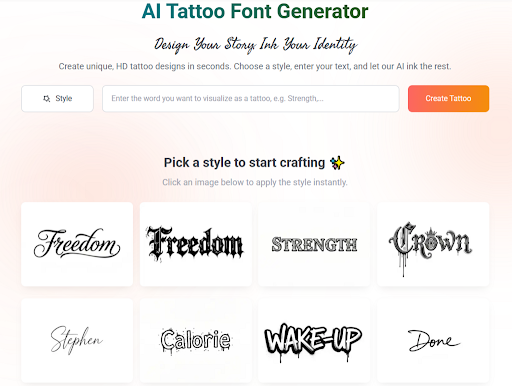
Modern Gothic: Balancing Readability and Edgy Aesthetics Using a Tattoo Font Generator
Gothic typography, often referred to as Blackletter or Old English, has been a cornerstone of tattoo culture for decades. From the heavy, vertical strokes of traditional German scripts to the sharp, aggressive lines of modern “Chicano” style lettering, Gothic fonts evoke a sense of history, power, and rebellion. However, as the tattoo industry evolves, a significant problem has emerged: traditional Gothic fonts are often notoriously difficult to read.
For many enthusiasts, the “cool factor” of a complex Blackletter piece is frequently undermined by the fact that the text looks like an illegible ink blot from a distance. This is the primary pain point for modern collectors who want the dark, edgy aesthetic of the Gothic era but require the clarity of contemporary design. Fortunately, the rise of specialized digital tools like a professional tattoo font generator is changing the game, allowing for a “Modern Gothic” revival that balances legibility with raw artistic impact.
The Evolution of the Gothic Script
To understand why readability is such a struggle, we must look at the origins of Blackletter. Developed in Western Europe during the 12th century, these scripts were designed to save space on expensive parchment. The letters were packed tightly together, creating a dense “black” texture on the page—hence the name “Blackletter.”
In the context of tattooing, these dense structures are visually striking but functionally risky. As ink ages and spreads under the skin (a process known as “blowout” or settling), the tight gaps in traditional Gothic letters can close up, turning a meaningful word into an unrecognizable shadow. This is why the modern approach involves using a tattoo font generator to modify these ancient structures into something more “skin-friendly.”
The “Modern Gothic” Logic: How AI Solves Legibility
Modern Gothic isn’t about stripping away the soul of Old English; it’s about optimizing it. When you use a high-quality tattoo font generator, you are not just picking a static image. You are using an algorithm designed to maintain the “edgy” DNA of the font while introducing critical design adjustments:
- Increased X-Height: By subtly increasing the height of lowercase letters, the negative space within the characters (the “counters”) becomes larger. This ensures that even after years of aging, the “e” doesn’t turn into an “o.”
- Simplified Serifs: Traditional Gothic is famous for its “thorns” and “feet”—the tiny decorative spikes on every stroke. A modern generator can clean these up, keeping the sharp look without the visual clutter that confuses the eye.
- Optimized Kerning: Proper spacing is the secret to a readable tattoo. Digital tools allow you to widen the gap between letters, ensuring the silhouette of each character remains distinct against the body’s natural curves.
Why a Tattoo Font Generator is Essential for the “Dark Aesthetic”
Choosing a font for a tattoo is a permanent decision, and relying on a standard “Microsoft Word” Gothic font is a recipe for regret. Those fonts are designed for high-resolution printers and white paper, not for the living, breathing, and stretching canvas of human skin.
Using a specialized tattoo font generator provides several advantages that traditional font libraries cannot match. First, it allows for “Style Hybridization.” You can take the aggressive structure of a Gothic font and infuse it with the flow of a modern signature script. This creates a unique “Neo-Gothic” look that is exclusive to the wearer.
Second, it provides an instant visual proof of “Ink Density.” Darker fonts like Gothic require a lot of pigment. Seeing the design generated digitally helps you and your artist understand how much “black-work” will be involved, which is crucial for determining the placement and size of the piece.
Case Study: The “Less is More” Approach to Blackletter
Consider a client who wants to tattoo the word “Resilience” across their forearm in a traditional Old English style. In the past, an artist might hand-draw this, perhaps making it too dense. By the time the tattoo is five years old, the “i,” “l,” and “i” might merge into a single dark block.
By running the word through a tattoo font generator, the user can select a “Modern Gothic” variant that uses thinner “hairline” strokes for the decorative parts and thicker “stems” for the core structure. This creates a high-contrast look that is significantly more legible from a distance. The AI-driven tool can even suggest “open-ended” versions of the letters where the strokes don’t quite touch, leaving room for the skin to breathe and the ink to settle without compromising the design.
The Intersection of Culture and Technology
The revival of Gothic fonts in the digital age is a testament to the enduring appeal of the “Dark Aesthetic.” From heavy metal bands to luxury streetwear brands, the Gothic look is synonymous with a certain “cool.” But in the world of professional tattooing, “cool” must be paired with “craft.”
AI technology has allowed us to deconstruct what makes Gothic fonts beautiful and rebuild them for the modern world. We are no longer limited by the physical constraints of a 15th-century printing press. We can now generate scripts that are “Liquid Gothic”—fonts that look like they were carved into stone but possess the fluid grace of a brushstroke.
Practical Tips for Designing Your Gothic Piece
If you are looking to get a Gothic-inspired tattoo, here is a checklist to ensure your design remains a masterpiece for life:
- Check the “Closed” Letters: Pay special attention to letters like ‘b’, ‘d’, ‘g’, and ‘q’. Use your generator to ensure the inner loops are large enough.
- Test the Scale: A Gothic font that looks great as a large backpiece might fail as a small wrist tattoo. Always scale your generated design to the actual size it will be tattooed.
- Contrast is King: Ensure there is a clear distinction between the thick and thin lines. This contrast is what gives Gothic its “sharp” and “dangerous” edge.
- Avoid “Over-Flourishing”: While swirls are tempting, too many flourishes in a Gothic design can lead to visual “noise” that obscures the actual word.
Conclusion: Embracing the New Dark Age
The “Modern Gothic” movement proves that tradition and technology are not enemies; they are partners. By using a tattoo font generator, we can pay homage to the scribes of the past while ensuring our tattoos meet the high standards of modern legibility.
The goal of any script tattoo is to tell a story or represent an identity. If that message is lost in a sea of illegible ink, the tattoo has failed its purpose. By embracing the AI-driven tools available today, you can ensure that your ink remains as sharp, edgy, and readable on day one as it does in year twenty. The “Dark Aesthetic” is back, and thanks to modern design logic, it’s clearer and bolder than ever before. Don’t just pick a font—generate a legacy.


Leave a Reply