
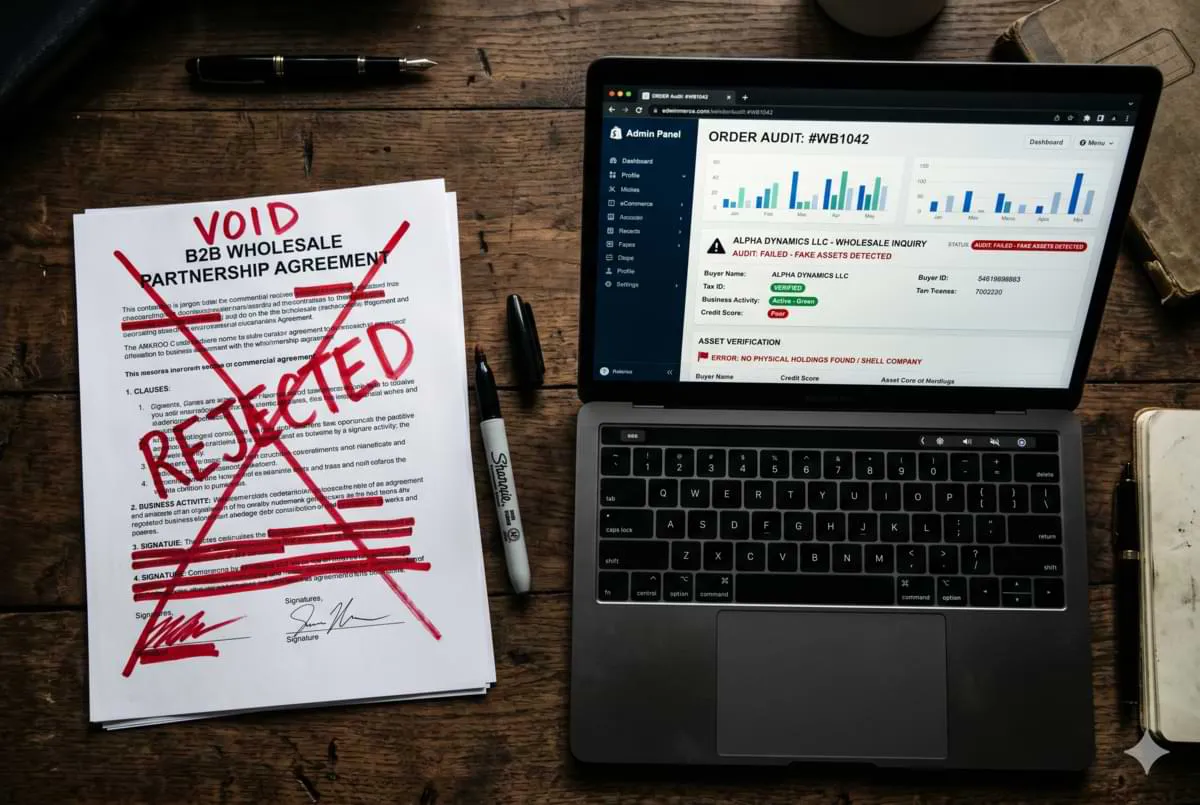
How to Audit B2B eCommerce Partners Without Getting Burned
Vetting a B2B buyer or wholesale partner means forensically verifying their financial history, corporate standing, and operational reality before extending credit or shipping inventory. You strip away the branding. You demand their tax IDs. You verify their assets. Most eCommerce founders operate on blind optimism. They accept massive purchase orders based on a slick email signature and a promised wire transfer. You skip the background check, you lose your margins.
What Is B2B eCommerce Due Diligence?
Due diligence is the deliberate, cynical process of assuming every new corporate client is entirely insolvent until their paperwork proves otherwise. You spent months configuring your Porto theme. Your site architecture is flawless. The checkout process converts at industry-leading rates. Then a massive wholesale inquiry hits your inbox. Amateurs pop champagne over a six-figure purchase order. Veterans freeze.
Verification removes emotion from the equation. It forces the purchasing entity to prove they actually possess the capital to clear your invoice.
- Corporate Standing: Is the business legally permitted to operate in its jurisdiction?
- Financial Solvency: Do they have a history of paying vendors, or are they drowning in unpaid liens?
- Identity Verification: Does the purchasing manager actually work for the company they claim to represent?
Fraudsters buy domains for ten dollars. They steal corporate logos. A polished website proves absolutely nothing.
How Do You Investigate a Vendor’s Solvency?
Start with friction. Legitimate purchasing managers expect onboarding hurdles. They have their EIN, tax exemption certificates, and credit references ready to email in a single PDF. Scammers complain. They invent arbitrary deadlines to force you into making an emotional decision.
Once they submit their documentation, do not trust it. You must pull data from independent sources.
- Demand Legal Tax IDs: Get the exact corporate name and Employer Identification Number (EIN).
- Run the Background Data: Execute a free public records search to unearth hidden civil judgments, criminal history, or undisclosed aliases attached to the executive team.
- Cross-Reference the State Registry: Look up their entity in the Secretary of State database where they claim to be headquartered.
You are looking for discrepancies. The buyer claims they have dominated the logistics sector for twenty years. You check the state registry. The LLC was registered three days ago.
What Are the Immediate Red Flags in B2B Inquiries?
Professional scammers target high-ticket, highly liquid goods. Electronics. Designer cosmetics. Supplements. Heavy machinery parts. They require inventory they can flip on secondary markets within forty-eight hours of taking delivery.
They also operate on manufactured urgency. They will claim a previous supplier fell through. They need you to bypass your standard net-30 approval process to save their fourth quarter.
| Legitimate B2B Buyer | Fraudulent B2B Entity |
| Uses corporate email address tied to a registered domain. | Uses a free email provider or a domain registered last week. |
| Negotiates pricing aggressively and asks about bulk tiers. | Accepts your highest price without question. |
| Requests standard net-30 or net-60 payment terms. | Offers overpayment schemes or demands obscure wire routing. |
| Shipping address matches the corporate headquarters or known 3PL. | Shipping address points to a residential home or a short-term freight forwarder. |
IP mismatch is a massive indicator. The inquiry IP address originates in Eastern Europe. The shipping address is a temporary warehouse in Miami. They disappear on Monday.
How to Spot Fake Warehouses and Shell Companies?
A vendor guarantees they can manufacture 50,000 units by Q4. A buyer claims they need ten pallets of electronics delivered to their primary distribution center. Do they actually have the physical footprint to support these claims?
Shell companies hold zero physical property. They rely entirely on digital smoke and mirrors.
- Check the Address on Google Earth: Look at the street view. If their “global distribution center” is a strip mall UPS store, cancel the contract.
- Verify the Real Estate: Look up municipal property tax records. Who owns the building at the address they provided?
- Look for Co-Working Spaces: Fraudsters frequently use virtual office addresses to look legitimate.
They will tell you they operate out of a massive industrial park. You pull the address data. They lease it by the hour.
What Documentation Actually Matters?
You need documents that carry legal weight. A branded letterhead means nothing. A generic NDA means nothing.
Demand a Resale Certificate. If they are buying wholesale, they are claiming tax exemption. Every state requires specific documentation for this. If they cannot produce a valid, state-issued resale certificate matching their corporate entity, they are not a legitimate reseller.
Request a Certificate of Good Standing from their state of incorporation. This document proves the state currently recognizes them as an active, compliant business entity that pays its franchise taxes.
If they offer bank letters of credit, call the issuing bank directly. Do not use the phone number printed on the letter. Find the bank’s main corporate number. Call the trade finance department. Forged bank letters are standard operating procedure in wholesale fraud. Photoshop takes ten minutes.
The Takeaway on B2B Verification
- Assume insolvency: Treat every large, unsolicited wholesale order as a potential threat.
- Create friction: Make buyers jump through administrative hoops to weed out lazy scammers.
- Verify independently: Pull state filings and legal data yourself.
- Protect the inventory: Your stock is infinitely safer sitting on your own warehouse racks than shipping out to an unverified buyer.
Data protects cash flow. Blind trust is a fast track to bankruptcy.


Leave a Reply