
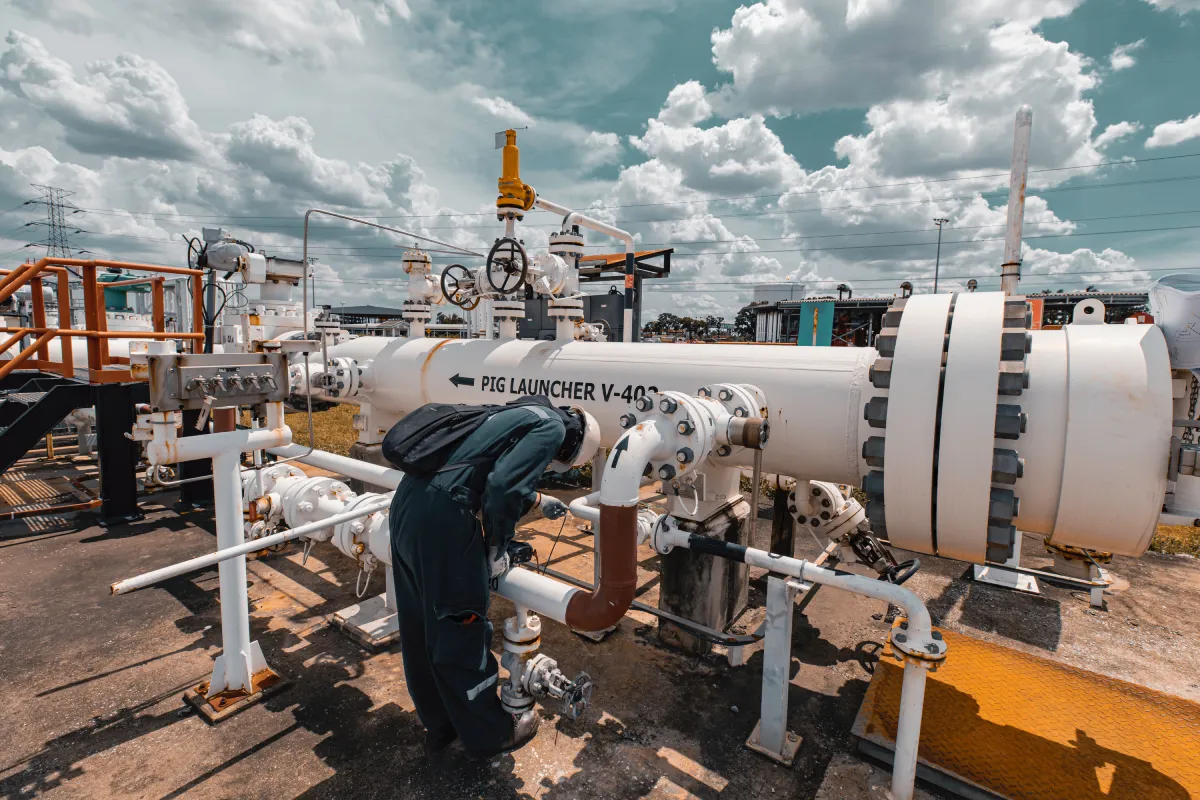
In Refinery and Petrochemical Environments, a Compressor Failure Isn’t Just an Equipment Problem — It’s a Production and Safety Issue That Demands the Right Service Partner from Day One
The cost of compressed air system downtime in most industrial facilities is unpleasant. In a refinery or petrochemical plant, it’s in a different category entirely. A compressor supporting instrument air — the pneumatic pressure that controls valves, positioners, and safety systems across the facility — doesn’t fail quietly. Its failure cascades into control loop disruptions, process upsets, and in some configurations, automatic shutdown sequences designed to prevent exactly the kind of loss-of-control scenarios that compressed air failures can cause.
This is why the maintenance philosophy for compressed air systems in petrochemical environments can’t be imported directly from general industrial practice. The equipment is often similar. The stakes are not.
This guide is written for reliability engineers, mechanical maintenance supervisors, and operations managers who manage compressed air systems in high-consequence environments and want a framework for thinking about the maintenance program, the service relationships, and the risk management approach that the environment actually requires.
Understanding the Specific Risk Profile of Petrochemical Compressed Air
Compressed air in refinery and petrochemical applications serves several distinct functions, each with its own failure consequence profile.
Instrument air is typically the most critical. Most modern refinery control systems use pneumatic actuators that require a continuous supply of clean, dry compressed air at stable pressure to hold valve positions and respond to control signals. Loss of instrument air pressure triggers fail-safe positions across affected control loops — often closing valves, stopping flows, and initiating shutdown sequences. Depending on the plant’s design and the location of the failure, the effects can range from an isolated unit upset to a facility-wide production stop.
Process air and utility air applications are generally less critical but still consequential. A process air failure to a specific reactor may require a controlled shutdown of that unit. Utility air failures affect maintenance activities, pneumatic tools, and support systems. The priority level of each application should be assessed during the maintenance program design, not during the emergency response.
The environmental hazard layer changes the technical work as well. Maintenance and repair in classified areas — locations where flammable gases or vapors may be present — require specific equipment, procedures, and permitting that are standard in refinery practice but not in general industrial maintenance. A service provider that isn’t familiar with working in classified hazardous locations presents a safety risk independent of their technical competence on the compressor itself.
Facilities running compressed air for refinery applications need a service approach built around all of these dimensions from the beginning — the technical work, the environmental context, and the documentation and compliance obligations that the industry requires.
The Compressed Air System as an Integrated Whole
One of the most persistent errors in compressed air maintenance is treating each compressor as an independent unit rather than as part of an integrated system. The compressor generates the air, but the air quality, pressure, and delivery reliability depend on everything downstream: the aftercoolers and separators, the refrigerated and desiccant dryers, the filtration stages, the receiver storage, the distribution piping, and the pressure reducing stations serving different use areas.
Failures in the downstream system can look like compressor problems. A clogged coalescing filter increases differential pressure across the system and can cause compressor overpressure trips. A failing desiccant dryer passes moisture that causes instrument air quality failures at the point of use. A distribution line leak sufficient to exceed the system’s capacity to maintain pressure looks, in its downstream effects, indistinguishable from a compressor capacity problem.
This means that maintenance inspections and condition monitoring need to cover the full system, not just the compressor package. Service providers who scope their work narrowly — servicing the compressor unit without looking at the broader system — miss failure modes that the integrated view would catch. This is particularly important for facilities where the compressed air system has grown incrementally over time, with additions and modifications that may not have been fully integrated into the maintenance documentation.
Ingersoll Rand Equipment: Where Experience Matters
Ingersoll Rand has a long deployment history in industrial and petrochemical applications, and their rotary screw, reciprocating, and centrifugal platforms are present in facilities across the industry. The prevalence of their equipment means service infrastructure is broadly available, but the breadth of availability conceals meaningful variation in technical depth.
Ingersoll Rand equipment across different model generations has specific maintenance requirements: oil separation intervals calibrated to operating conditions, inlet filter performance standards that affect valve life in reciprocating units, cooling system configurations that require specific attention in high-ambient-temperature environments, and control system parameters that need to be verified after any service affecting the operating setpoints.
The reciprocating units — which remain in service in many older facilities due to their durability — have valve service requirements that are particularly time-sensitive. Intake and discharge valves in reciprocating compressors are wear items that fail progressively, and deferred valve maintenance accelerates damage to cylinders and pistons. Facilities that have converted from calendar-based to hours-based valve service intervals typically see both better reliability and lower total maintenance cost.
For ingersoll rand technical services on units in critical service, the choice between OEM service and a qualified independent provider should be based on demonstrated technical experience with the specific equipment, not on brand affiliation alone. The most important qualification is whether the technicians have worked on the specific model under similar operating conditions, not just whether they carry the right logo.
Building a Maintenance Program That Matches the Risk
The architecture of a maintenance program for compressed air systems in petrochemical facilities should reflect the actual consequence profile of different failure modes, not a generic schedule applied uniformly.
Critical systems — instrument air compressors serving continuous process operations, or units with no installed standby capacity — warrant more frequent inspection intervals, more aggressive condition monitoring, and a parts stock that supports fast repair. These systems should have specific emergency response protocols with defined escalation paths and committed service response times.
Supporting systems — utility air and other non-critical applications — can be maintained on longer intervals without the same level of active monitoring, though they should still have documented maintenance schedules and service records.
The documentation layer of the maintenance program matters both for operational reliability and for regulatory compliance. Process Safety Management (PSM) regulations applicable to many petrochemical facilities include mechanical integrity requirements for certain equipment categories. Compressed air systems supporting safety-critical functions may fall within the program’s scope, requiring documented inspection procedures, test records, and deficiency tracking. A maintenance program designed without awareness of these obligations may be technically sound while leaving the facility exposed on the compliance side.
For facilities in the Chicago industrial corridor, partnering with air compressors chicago il service providers who understand both the technical requirements and the regulatory context of petrochemical operations gives you a service relationship that serves both dimensions consistently.
Condition Monitoring: The Investment That Pays for Itself
The case for predictive maintenance in petrochemical compressed air systems is straightforward when downtime costs are calculated honestly. Most facilities that have implemented condition monitoring programs find that the cost of the monitoring is recouped many times over through failures caught early — before they require emergency response and before they cascade into broader process disruptions.
Oil analysis is the most accessible entry point. Sending oil samples to a laboratory on a defined schedule provides continuous visibility into bearing condition (through metal particle analysis), lubrication quality, and contamination status. A developing bearing failure produces identifiable metal wear particles in the oil weeks before it produces the vibration and temperature signatures that indicate imminent failure. The cost of an oil analysis program is a small fraction of the cost of a single unplanned compressor outage.
Vibration analysis adds a direct window into the mechanical condition of rotating components — compressor elements, motor bearings, coupling alignment, and impeller balance in centrifugal units. A consistent vibration baseline established during normal operation makes developing anomalies visible early and provides the documentation needed to justify scheduled maintenance outages before the equipment deteriorates further.
Thermographic inspection of electrical components — motor starters, power distribution panels, and control enclosures — catches thermal anomalies in electrical connections and components that can precipitate failures independent of the mechanical condition of the compressor itself.
What the Emergency Response Framework Should Include
Even the best preventive maintenance programs experience failures. The response framework for compressed air failures in a petrochemical facility should be defined in advance, not improvised during an active event.
The framework should identify which compressors are in critical service, what the standby or backup capacity is for each critical system, what the facility’s production impact is for different outage durations, and what response time commitments are in place with the service provider.
Tooling and parts availability are central to response time. A service provider that doesn’t have the relevant parts in regional stock or in-transit availability will produce response times that are fundamentally limited by parts logistics, not by dispatch speed or technician competence. Understanding the parts supply chain for your specific equipment is a prerequisite for building a realistic emergency response plan.
The communication protocol — who gets notified when, what information they need, how decisions about scope and approach get made during an active repair — should be documented and tested before it’s needed. Facilities that have rehearsed the emergency response process handle actual emergencies substantially more efficiently than those that work it out in real time.
Choosing the Right Service Partner
The evaluation criteria for a compressed air service partner in petrochemical applications are more demanding than for general industrial service, and appropriately so.
Technical qualifications specific to the equipment in service are the starting point. Experience working in classified hazardous locations and familiarity with the permit-to-work and safety management systems used in the industry are equally important — a technically qualified technician who isn’t experienced in refinery work creates procedural and safety complications that a facility has to manage around.
Response time commitments, parts availability, and documentation quality are the operational qualifications. A service provider that cannot commit to specific response times, doesn’t maintain local parts inventory, and produces service records that don’t meet facility documentation standards is not fully qualified for the role, regardless of technical capability.
The relationship should be established and tested before an emergency, not during one. A service provider who has worked at the facility, knows the equipment, understands the site safety protocols, and has a track record with the maintenance team is a fundamentally different resource than one being called for the first time when a critical system is down.
The compressed air system is infrastructure that the whole facility depends on. The service relationship that supports it deserves to be treated with the same rigor as the system itself.


Leave a Reply