

What Makes Microlearning Actually Work: Lessons From Building Corporate Training Platforms
When clients ask us about microlearning, I usually start with one simple clarification: short content is not the point. Microlearning works when the product helps people remember, decide, and return at the right moment. That is why one platform improves retention, while another becomes a graveyard of short lessons no one revisits.
Key Takeaways
- Short lessons alone do not improve learning.
- Spacing, recall, and feedback create the actual effect.
- Delivery, analytics, admin, and integrations decide whether the platform works in real life.
- Gamification helps when it builds habits.
- AI helps when it improves content operations instead of adding noise.
Why Does Microlearning Work Only When It Combines Spacing, Retrieval, and Feedback?
A lot of people hear “microlearning” and picture short videos. That is only the wrapper. The real mechanism is much more practical: people remember more when they revisit knowledge, retrieve it actively, and get feedback while the topic is still fresh. A short lesson becomes useful when it helps someone practise a decision, not just consume information.
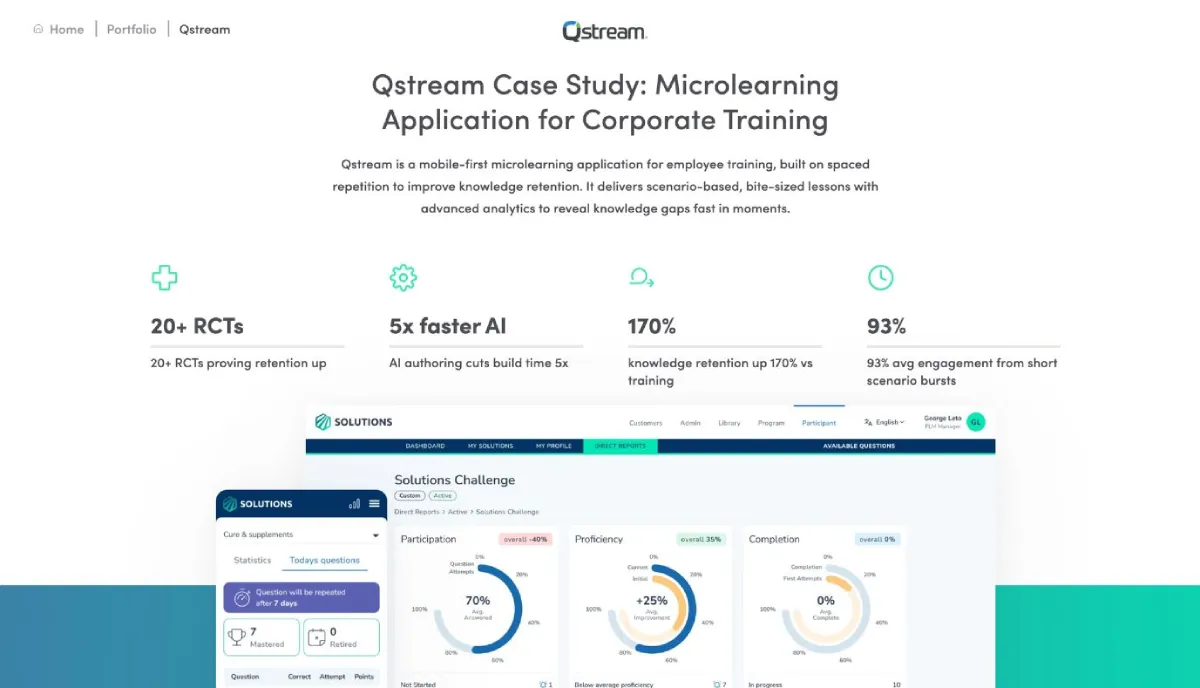
This is exactly why, when we explain the difference to clients, we often point to the story behind Qstream Case Study Selleo: Microlearning Application for Corporate Training. What makes that case strong is not one feature, but the way scenario-based learning, short daily bursts, quizzes, feedback, and analytics work as one loop. From a product perspective, that is where microlearning stops being a format and starts becoming a system.
What Makes a Corporate Microlearning Platform Work in the Flow of Work?
In corporate training, strong content solves only part of the problem. The other part is making sure learning appears where people already work and where managers can see what is actually happening. A platform starts working when it reduces friction for both the learner and the team running the programme.

That is why delivery matters so much. If a lesson arrives in the wrong place, even good content loses momentum. “Flow of work” is not a slogan. It is a delivery decision. Mobile, email, Teams, Slack, Webex, SMS, or CRM embedding all change whether learning feels natural or disruptive.
The same goes for analytics. Completion rates look neat in a dashboard, but they do not tell a team what to do next. What really helps is visibility into knowledge gaps, progress, and where coaching is needed. That is the point where manager dashboards stop being a nice extra and become part of the learning system itself.
Enterprise constraints shape the product even earlier than most teams expect. Permissions, audit trails, SSO, HRIS connections, and compliance logic all affect the architecture. The content may be small, but the platform around it is not.
- Match the delivery channels to real work.
- Track knowledge gaps, not only completions.
- Build admin and reporting for scale.
- Plan rollout, UAT, and integration scope early.
How Do Gamification, CMS Autonomy, and AI Support Long-Term Engagement?
This is the part that gets oversimplified most often. People hear “engagement” and jump straight to points, badges, or an AI assistant. From our perspective, the more useful question is what keeps the platform valuable after launch. That usually comes down to habit loops, content control, and disciplined AI use.
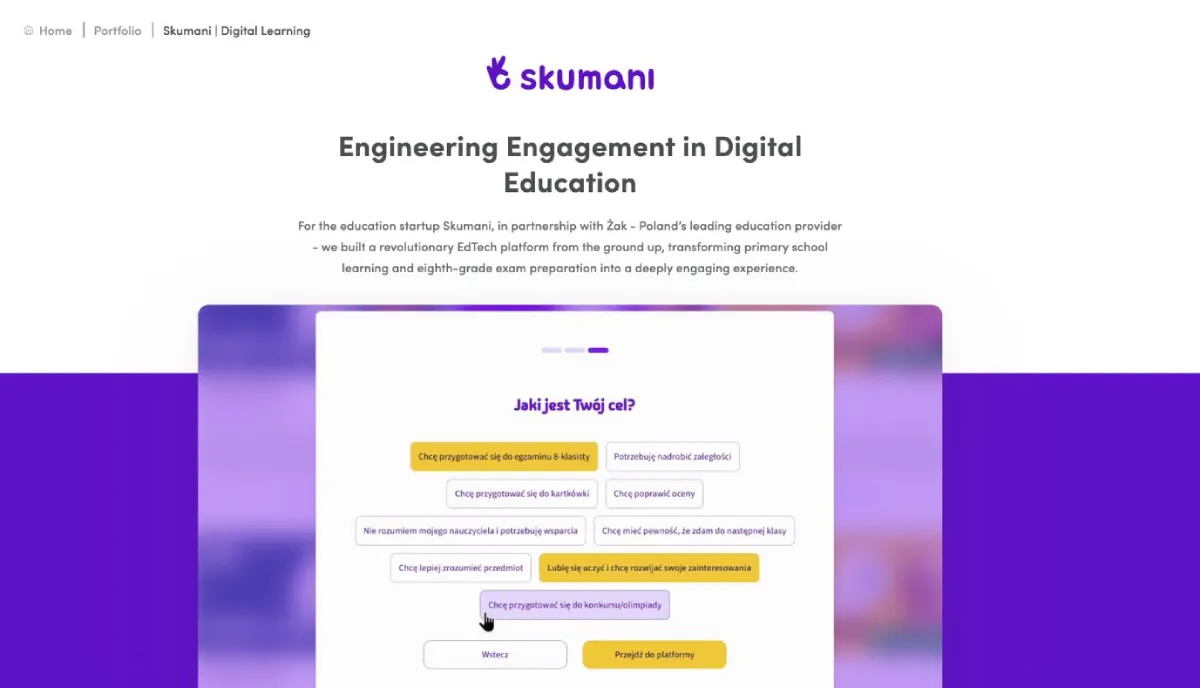
A good example is the product story behind Case Study Selleo from EdTech: Skumani, because it shows how those parts can reinforce each other instead of competing for attention. Daily streaks, XP, badges, and leaderboards only make sense when the team also controls courses, quizzes, video lessons, and the knowledge base behind AI teachers. If every content change depends on developer time, the platform slows down very quickly.
AI fits into this picture too, but only with clear boundaries. The most useful role for AI is shortening the path from brief to usable learning asset. AI becomes valuable when it works on trusted inputs inside a controlled workflow. That is a very different model from using it as an endless content generator.
When Should Teams Build, Extend, or Stabilize a Microlearning Platform?
This is usually the real business question hiding behind the learning question. Some teams need a standard LMS and a fast rollout. Others need a product-shaped platform because workflow, reporting logic, or the data model are part of the value. The decision gets clearer when you stop comparing feature lists and start looking at workflow fit, ownership, and platform debt.
An off-the-shelf LMS works well when the process is standard. A custom platform makes more sense when integrations, roles, permissions, or reporting define the core experience. And when product debt is already blocking the roadmap, stabilisation comes before expansion. That is not a theory. It is simply the cleaner order of work.
The same pattern appears in planning. Teams need to define goals, users, source systems, and ownership early. Hidden costs and UAT effort can change the timeline more than the feature list does. A good implementation plan protects the roadmap before it protects the feature count.
- Use off-the-shelf when the workflow is standard.
- Build custom when the workflow creates product value.
- Stabilise first when platform debt blocks delivery.
- Separate platform scope from content scope.
- Protect ownership and avoid vendor lock-in.
FAQ
How short should a microlearning lesson be?
Length is not the main variable. What matters is whether the lesson fits a real moment of work and supports recall.
Does microlearning improve retention?
Yes, when it uses the right mechanics. Systems built around repetition, retrieval, and feedback outperform simple short-form content.
Why is scenario-based learning stronger than passive content?
Because it trains decisions, not just recognition. That makes it far more useful in compliance, product knowledge, and leadership contexts.
Which analytics matter most?
Knowledge gaps, progress, role-based visibility, and manager dashboards. Those signals help teams act on learning data instead of just storing it.
When is custom LMS better than off-the-shelf?
When integrations, permissions, reporting, and ownership shape the product itself. If those elements create value, generic setup stops being enough.
How should AI be used in microlearning?
Use it to improve content operations and guidance. Do not use it as an uncontrolled content machine.


Leave a Reply