
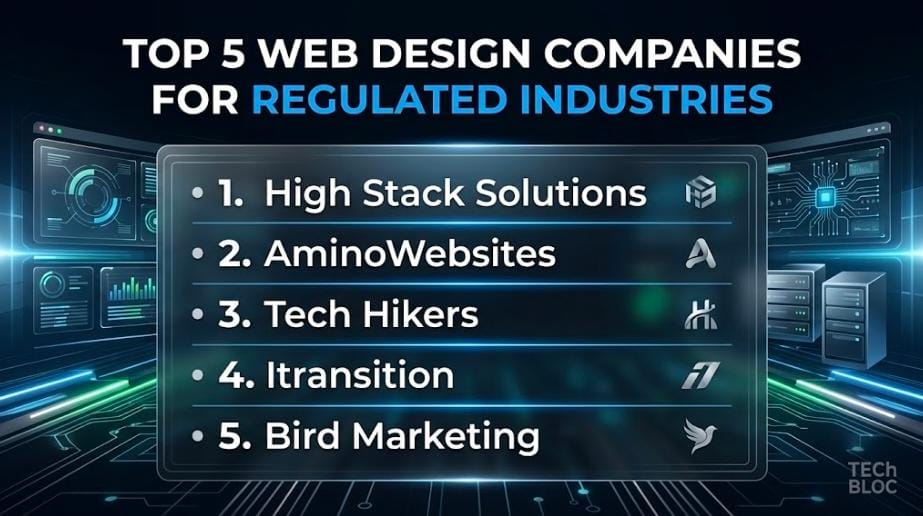
Top 5 Web Design Companies for Regulated Industries
If you sell CBD, kratom, vapes, or research peptides, or you run a telehealth or crypto platform, a regular web agency will not cut it. One wrong checkout setting can freeze your merchant account. One missing disclaimer can sink a processor application.
The best web design companies for regulated industries in 2026 are High Stack Solutions (best overall for CBD, kratom, Delta, vape, mushroom, and peptide eCommerce), Coalition Technologies (SEO-led growth), Tech Hikers (peptide SEO), Itransition (telemedicine software), and Bird Marketing (crypto and Web3).
Based on your requirements, choose the one that already knows your exact industry and its rules, not the one with the flashiest portfolio. In this article, we have reviewed each agency’s service pages, case studies, compliance guidance, and their ratings as a dedicated regulated industries service provider.
Quick Comparison: Who Does What Best
Each agency on this list owns a different corner of the regulated web. Use this table to jump straight to the one that matches your business.
| Agency | Best For | Regulated Niches | Standout Strength | Pricing Model |
|---|---|---|---|---|
| 1. High Stack Solutions | Best overall for high-risk eCommerce | CBD, kratom, Delta, vape, mushrooms, research peptides | Compliance, high-risk payments, and automation under one roof | Custom quote after a free 30-minute call |
| 2. Coalition Technologies | SEO-led growth | Shopify, WooCommerce, BigCommerce, Magento | 860+ published case studies | $2,500 |
| 3. Tech Hikers | Peptide SEO and organic growth | Research peptides | Builds compliant stores and ranks them on Google | $25 to $49/hour (GoodFirms listing) |
| 4. Itransition | Telemedicine platforms | Telehealth and healthcare | HIPAA-ready builds with EHR and FHIR integrations | About $50,000 to $100,000+ per app |
| 5. Bird Marketing | Crypto and Web3 brands | Crypto, DeFi, NFT, exchanges | Wallet integrations and KYC/AML-ready user flows | Free proposal; pricing within 24 hours |
Why Regulated Brands Need Specialist Web Design in 2026
Good regulated industry web design is not about looks. It is about building a site that regulators, payment processors, and platforms will all accept. In 2026, that bar moved several times in a single year.
The Rules Changed Fast This Year
- Vape: Shopify told merchants in June 2026 to remove every vape product, including zero-nicotine and FDA-authorized items, by July 8 (TaxCloud).
- Hemp and Delta: President Trump signed a funding bill on September 2, 2026, that pushed most federal hemp THC restrictions to December 11, 2026 (Forbes). Fully synthetic cannabinoids still lose hemp status on November 12.
- Kratom: The DEA moved in July 2026 to temporarily place concentrated 7-OH in Schedule I, while stating that natural kratom leaf is not the target (DEA).
- Vape shipping: The amended PACT Act requires ATF registration, age verification, and age-checked delivery for online vape sales (ATF).
- Telehealth: Healthcare data breaches affected about 61 million people in 2025 (HIPAA Journal).
- Crypto: About 1 in 5 U.S. adults have invested in, traded, or used crypto, according to a January 2026 survey (Pew Research Center).
Generic agencies rarely track any of this. That gap is exactly why high-risk ecommerce web development has become its own specialty.
1. High Stack Solutions: Best Overall for High-Risk eCommerce
High Stack Solutions builds compliant WooCommerce and Shopify stores for CBD, kratom, Delta, vape, mushroom, and research peptide brands. It is the only agency on our list that covers six high-risk product niches with one team. What stood out to us is how tightly it ties design to compliance and payments.
Pros
- Covers six regulated niches, so a brand can expand from CBD into mushrooms or vape without switching agencies.
- Bakes compliance into the build: age verification, COA display, and state-level rules come standard.
- Plans for processor risk with high-risk gateways and a live backup, so one termination will not freeze checkout.
- Pairs every build with automation, POS sync, and ongoing maintenance, which cuts manual work as you scale.
- Runs on a founder-led model: you speak with the founder on strategy calls, not a sales rep.
Cons
- Pricing is not published, so you need a strategy call to get a quote.
- It focuses on high-risk product eCommerce, so it is not the pick for HIPAA telehealth platforms or crypto exchanges.
2. Coalition Technologies
Coalition Technologies is a Los Angeles agency best known for SEO, with a large web design team behind it. It runs dedicated pages for cannabis, CBD, kratom, vaping, alcohol, and firearms, and lists more than 860 case studies.
Pros
More than 860 published case studies
Covers many regulated verticals
Its Kratom Country case reports 450% organic user growth in a year
Month-to-month contracts
Cons
Regulated niches share space with dozens of other industries
Payment failover and PACT Act compliance aren’t headline services
You often work through managers rather than one builder
3. Tech Hikers: Best for Peptide Store SEO and Organic Growth
Tech Hikers is a Sacramento-based web design and digital marketing agency founded in 2016. Its regulated offer pairs peptide website development with peptide website SEO. The pitch is simple: when ads are off the table, organic search becomes your growth engine.
We appreciated how specific its compliance checklist is. It calls for an age gate before any pricing shows, an FDA notice, buyer qualification language, and an active RUO confirmation at checkout.
Pros
- It builds and ranks stores, so SEO architecture and compliance get designed together.
- Its compliance setup includes checkout confirmation steps that support processor approval.
- It builds affiliate programs into stores at launch, a smart channel when ads are restricted.
- Focused builds take about 10 to 14 days, and you own 100% of the code.
Cons
- Its own store counts vary across pages (50+ in one place, 100+ in another), so ask for client references.
- It runs a small team of 2 to 9 people, per its GoodFirms profile, which may limit capacity for big projects.
- Peptides are one vertical inside a broader local agency, and its GoodFirms profile shows no client reviews yet.
4. Itransition: Best for Telemedicine Software Development
Itransition is a large engineering firm with 25+ years of experience and a dedicated practice for telemedicine software development. It builds telehealth platforms that comply with HIPAA, CCPA, GDPR, PIPEDA, and NIST standards. This is the team you call when patient data and clinical workflows are on the line.
Pros
- Deep compliance coverage, plus working knowledge of FHIR, ICD-10, CPT, and DICOM standards.
- Proven at scale, with measurable case study results and a 4.9 rating across 542 Clutch reviews.
- Flexible sourcing: consulting for in-house teams, partial outsourcing, or a full end-to-end team.
- Security-first engineering that follows OWASP and other app security frameworks.
Cons
- It is budget-heavy: Itransition puts basic telehealth apps around $50,000 and advanced ones at $100,000+.
- It is overkill for a small clinic that only needs a marketing site with a booking form.
- It is not an eCommerce agency, so it will not help you sell physical regulated products.
5. Bird Marketing: Best Crypto Web Design Agency
Bird Marketing is an award-winning digital agency with US offices in New York, Los Angeles, and Austin. Its crypto team builds sites for token launches, DeFi platforms, exchanges, NFT marketplaces, and Web3 startups. We liked that it treats trust as a design problem, which matters a lot in crypto.
Pros
- Strong social proof: 4.9/5 on Trustpilot (98 reviews) and 5/5 on Clutch (65 reviews), per its site.
- Real Web3 features, from wallet connections to staking and buy/sell interactions.
- A full-service team that covers SEO, PPC, branding, and hosting in one place.
- Clear timelines, with informational crypto sites typically taking 4 to 6 weeks.
Cons
- Crypto is one of 50+ industries it serves, so it is less specialized than a crypto-only studio.
- Most featured case studies on its crypto page are not crypto projects, so ask to see crypto-specific work.
- Compliance-ready layouts do not replace securities or money transmission legal advice, so you still need counsel.
How to Choose the Right Regulated Industry Web Design Partner
Run through this quick checklist before you sign anything:
- Match the niche first. A crypto expert will not know COA rules, and a CBD expert will not know HIPAA.
- Ask about high-risk payment processing. Which processors have they worked with, and do they set up a backup gateway?
- Confirm the platform. For vape and research peptides, Shopify is off the table. Ask why they recommend what they do.
- Check who writes compliance copy. Disclaimers, product descriptions, and policies should come from people who know your rules.
- Verify the proof. Visit live client sites and look for third-party reviews, not just testimonials on the agency’s own site.
- Clarify ownership. You should own your domain, hosting, code, and content outright.
- Plan for change. Ask how they handle new laws after launch, from SKU removals to 301 redirects.
Conclusion
Choosing among web design companies for regulated industries comes down to one question: who already understands your rules? The right partner builds compliance, payments, and platform choice into the foundation, not as an afterthought. Here is our quick recap:
With the December 11 hemp deadline and fresh platform bans reshaping the market, waiting costs more than acting. Shortlist the agency that matches your niche, ask the three-layer risk questions above, and get a store built to last.


Leave a Reply