
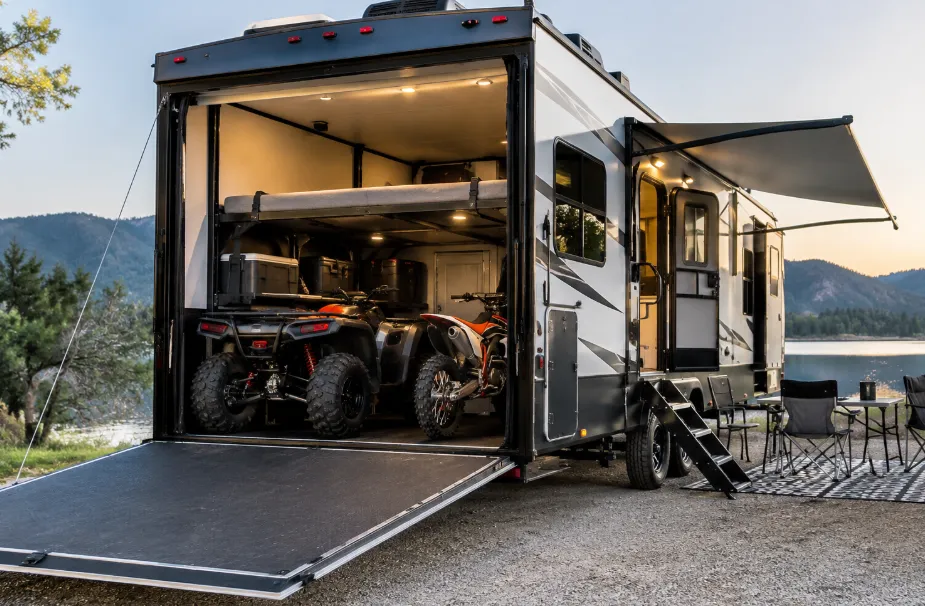
How Toy Haulers Combine Travel Comfort With Gear Storage
Packing bikes, riding equipment, tools, and camping supplies can leave your truck overloaded and your sleeping space crowded. Bringing an ATV or side-by-side adds another challenge: transporting the machine while keeping your family comfortable once you arrive.
A toy hauler solves much of that problem by combining RV living quarters with a cargo garage. The right model gives your equipment a designated travel space and provides a kitchen, bathroom, and beds at camp. Choosing well means checking how both spaces work with your actual gear.
Choose between travel trailer and fifth-wheel layouts
Travel trailer toy haulers connect to a rear hitch. Fifth-wheel models use a hitch mounted in a compatible pickup bed and often offer larger living areas, though individual sizes vary.
Both configurations belong to established RV categories. Manufacturers shipped 16,253 travel trailers and 3,901 fifth wheels during August 2026, according to the RV Industry Association.
Those figures include conventional RVs as well as applicable toy-hauler models. They describe new wholesale shipments, not used availability or quality.
Choose the configuration your tow vehicle can handle and your destinations can accommodate. A spacious trailer is less useful if its length limits the campsites you want.
Start your search with your gear and travel routine
Before comparing used toy haulers for sale, list what you plan to carry, how many people will travel, and where you expect to camp.
A couple transporting motorcycles may prioritize maneuverability and a permanent bed. A family carrying a large UTV may need more garage space, additional sleeping capacity, and a bathroom accessible from the cargo area.
Shopping used can broaden your options within a budget, but condition matters alongside price. Compare usable dimensions, weight ratings, and maintenance records before becoming attached to a particular floor plan.
What makes a toy hauler different from a regular RV?
A toy hauler has a cargo area designed for transporting equipment, usually accessed through a rear ramp door. Depending on the model, the garage may include reinforced flooring, cargo anchors, ventilation, and furniture that folds or lifts out of the way.
The living area typically offers familiar RV amenities, such as cooking facilities, a refrigerator, a bathroom, and sleeping accommodations.
Some layouts separate the garage from the main cabin. Others use one open space for cargo, dining, and sleeping. That distinction affects privacy, cleaning, and how much setup you need after unloading.
Measure usable garage space instead of brochure dimensions
Measure your equipment’s length, width, height, and loaded weight. Include mirrors, roof accessories, handlebars, and any attachments that stay installed during transport.
Then check the garage’s usable floor space and door opening. Cabinets, folded furniture, wheel wells, and partitions can reduce clearance.
Confirm these details before buying:
- Ramp opening width and height.
- Ramp capacity and loading angle.
- Space around the equipment for securing straps.
- Manufacturer-approved cargo anchors and their ratings.
- Access to doors, controls, and emergency exits.
A machine that fits inside may still be difficult to load. Low ground clearance can make the transition between the ramp and garage floor especially important.
Check comfort after the equipment comes out
Toy-hauler garages can become useful living spaces once unloaded. Depending on the equipment provided, you may have drop-down beds, convertible sofas, a dining table, or room for a temporary workspace.
Check what daily use involves. Can everyone sit comfortably? Does the bed require moving storage bins? Is the bathroom accessible when furniture is deployed?
Garage heating and air conditioning vary by model. Do not assume the cargo area has the same temperature control or insulation as the bedroom.
Some ramp doors are designed to become patios, but that requires the appropriate rated components. Follow the manufacturer’s limits rather than improvising supports.
Understand payload and towing before loading
Garage dimensions tell you what fits. Weight ratings tell you what the trailer can carry.
Gross vehicle weight rating, or GVWR, is the trailer’s maximum permitted loaded weight. Cargo carrying capacity identifies available carrying capacity under the label’s stated conditions. Water, equipment, supplies, and added accessories all affect the load.
Your truck also has limits for payload, axle loads, towing, and combined weight. Tongue or pin weight uses part of its available payload alongside passengers, luggage, and hitch equipment.
Check the specific vehicle’s labels and towing documentation. A model name or advertised maximum tow rating is insufficient.
Weigh the loaded combination and verify relevant limits. Loading and unloading heavy equipment can change weight distribution, so follow the trailer manufacturer’s instructions.
Keep fuel, fumes, and sleeping areas safely separated
Fuel-powered equipment introduces considerations that bicycles and camping chairs do not. Follow the RV and equipment manufacturers’ storage instructions, inspect for leaks, and use the garage ventilation as directed.
Never run a motorcycle, ATV, or portable generator inside the garage. Open doors do not make an enclosed space safe from carbon monoxide.
Follow portable-generator safety precautions when using off-grid power. Place portable generators outdoors, away from occupied spaces and openings, with exhaust directed away. Installed RV generators require their own operating instructions and exhaust checks.
Test carbon monoxide, smoke, and propane alarms as applicable. Investigate fuel odors before using the garage for sleeping.
Test the layout in three different stages
A useful floor plan must work beyond the showroom. Walk through three situations before deciding.
Loaded for travel: Imagine every machine, storage bin, and strap in position. Can you reach essential items without shifting heavy equipment?
Stopped overnight: Suppose rain or a late arrival prevents unloading. Can you access the bathroom and a safe sleeping area? A garage bed may be unavailable while equipment occupies the floor.
Fully set up: Picture equipment outside, beds lowered, furniture unfolded, and the patio deployed if provided. Where will muddy riding gear go? Is there adequate space behind the trailer for the ramp?
This walkthrough reveals compromises that a listed sleeping capacity can hide. It also helps you decide whether a separate garage or open layout suits your trips.
Inspect a used toy hauler’s cargo and living systems
Inspect the roof, seals, walls, and floors for moisture damage. Pay particular attention to the ramp door, hinges, supporting structure, and the floor near cargo anchors.
Request a demonstration of bed lifts, slide-outs, appliances, plumbing, and electrical systems. Check tire condition and age, brakes, suspension, and signs of uneven wear.
Ask about modifications, previous loads, storage conditions, and service history. Added batteries, generators, furniture, and accessories can affect available capacity.
An independent RV inspection can help identify issues beyond a visual walkthrough. Budget for repairs, maintenance, insurance, and storage alongside the purchase price.
Frequently asked questions about toy haulers
What is a toy hauler used for?
A toy hauler combines RV accommodations with cargo space for motorcycles, ATVs, UTVs, bicycles, or other equipment. Its ramp simplifies loading, while approved anchors secure cargo during travel. At camp, some garages convert into sleeping, dining, or lounge areas after equipment is removed and the space is prepared.
Can you sleep in a toy hauler garage?
Some toy-hauler garages have manufacturer-designed beds and can serve as sleeping areas when properly configured. Follow instructions for unloading, ventilation, and occupancy, and investigate any fuel odors. Check temperature control, clear exits, and working alarms. Never operate an engine or portable generator inside the garage.
How much weight can a toy hauler carry?
Capacity depends on the specific trailer’s ratings, installed equipment, and actual loaded weight. Check its cargo label, GVWR, axle ratings, and component limits. Water, gear, supplies, and modifications all consume capacity. Garage size and ramp capacity do not establish how much weight the entire trailer can safely carry.
Do you need a heavy-duty truck for a toy hauler?
Some smaller toy haulers may suit properly equipped lighter trucks, while larger models require greater towing and payload capacity. Match the specific loaded trailer to the vehicle’s ratings, including tongue or pin weight, passengers, and hitch equipment. Verify documentation and scale weights instead of relying on truck class alone.
Are toy haulers useful if you do not own an ATV?
Yes. A toy hauler can accommodate bicycles, sporting equipment, tools, or flexible living space without transporting an ATV. Its usefulness depends on how you will use the garage. Compare the extra space against trailer weight, setup requirements, and any comfort compromises before deciding whether it suits your camping routine.
Choose a trailer that works throughout the trip
Measure your gear, confirm towing compatibility, and test the layout loaded and unloaded. Inspect the ramp, cargo anchors, garage floor, and living systems before buying.
Prioritize the space and features you will use on actual trips. A suitable toy hauler carries your equipment securely while giving everyone a practical place to cook, rest, and sleep.


Leave a Reply