
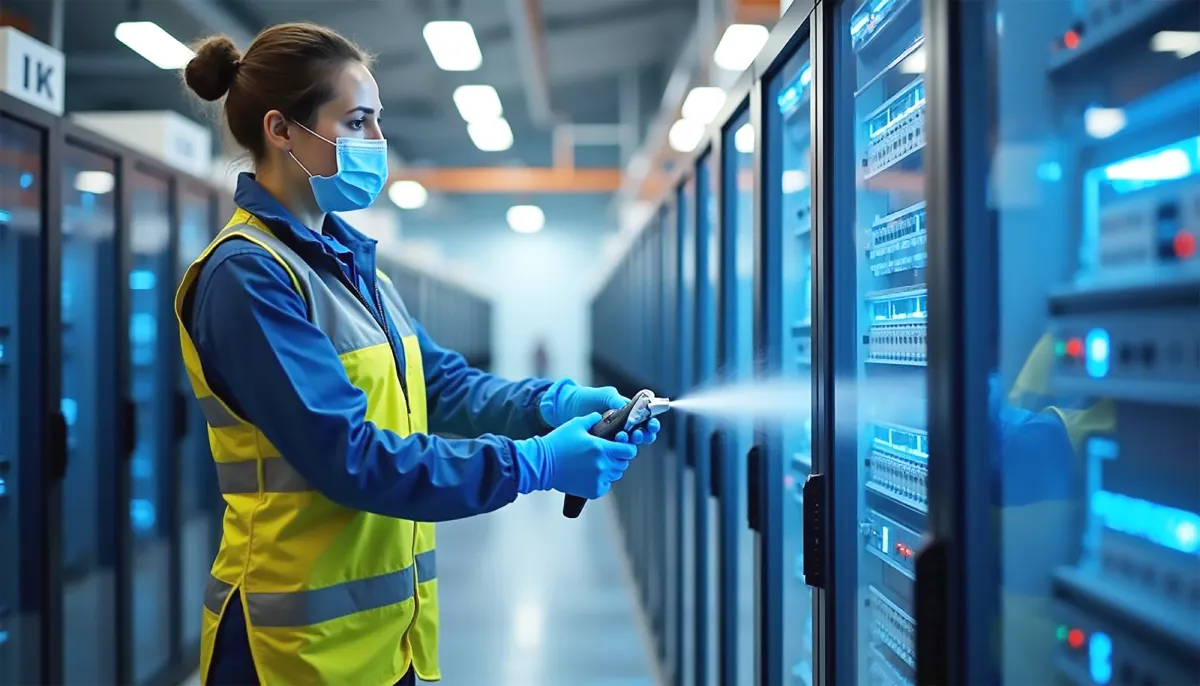
Data Center Cleaning Is a Reliability Issue: What Dust Actually Does to Your Hardware
Outages in data centers are usually traced to power, cooling or human error. Contamination rarely makes the list, because it almost never fails loudly. It works slowly inside the servers until a fan, a circuit board or a connector gives up. Understanding how that happens is the first step towards treating data center cleaning as part of reliability engineering rather than housekeeping.
Why “looks clean” is not good enough
A data hall can look spotless at eye level and still be contaminated where it matters. The particles that cause trouble are largely invisible, and they settle where nobody walks: on server intakes and heat sinks, on top of racks, in cable trays and in the subfloor plenum that delivers cold air to the equipment.
Higher power density makes the problem worse, not better. More heat per rack means more air pushed through every server, and every cubic metre of air carries particles past the electronics. The faster the airflow, the more dust ends up where it can do damage.
That is why professional data center cleaning starts with the path the cooling air takes, not with the floor people walk on. The goal is not a tidy room. It is a room where the air reaching the IT equipment is as clean as the equipment requires.
Four ways contamination damages IT equipment
Contamination does not cause one specific fault. It works through several mechanisms, some mechanical, some electrical and some chemical. The four below account for most of the damage seen in practice.
| Mechanism | What happens |
| Blocked airflow | Dust builds up on intakes, fans and heat sinks. Components run hotter, fans spin faster to compensate, and thermal margins shrink. |
| Moisture-absorbing dust | Some dust absorbs moisture from the air. On a circuit board it can form a conductive film that leads to leakage currents, short circuits and corrosion. |
| Zinc whiskers | Microscopic metal filaments grow from zinc-coated surfaces, such as the underside of some raised-floor tiles. Once dislodged, the cooling air carries them into the servers. |
| Corrosive gases | Sulphur compounds and other pollutants react with copper and silver on boards and connectors, causing corrosion and intermittent faults. |
Corrosive gases are a filtration issue rather than a cleaning issue, but they belong in the same conversation. Particles and gases are measured and managed together, and dust that has settled on a board makes it more vulnerable to both moisture and chemical attack.
Humidity turns dust into a conductor
Dust on a circuit board is largely harmless as long as it stays dry. The risk arises when it absorbs enough moisture to become wet and conductive. The relative humidity at which this happens is called the deliquescent relative humidity, and it depends on what the dust is made of.
ASHRAE recommends that the deliquescent relative humidity of the particulate contamination in a data center should be above 60 % RH. In other words, the dust should not turn wet under the humidity levels the room actually experiences. Data centers that bring outside air in for cooling deserve extra attention here, because both the amount and the type of dust depend on the outdoor environment.
Zinc whiskers: the risk hiding under the floor
Zinc whiskers are one of the most overlooked contamination risks in data centers with raised floors. The undersides of some steel floor tiles are zinc-coated, and so are some of the stringers and pedestals that support them. Over time, fine metal filaments can grow from these surfaces, sometimes 1 to 2 mm long.
As long as they stay attached, they do no harm. The problem begins when tiles are lifted or cables are pulled under the floor. The whiskers break loose, the cooling air carries them into the IT equipment, and in circuits operating above roughly 25 V they can cause short circuits and arcing. ASHRAE states plainly that data centers must be free of zinc whiskers.
This is also why subfloor work must be planned carefully. Lifting tiles without controlling the airflow can move contamination straight from the plenum into the servers.
What “clean” means in numbers
The advantage of the standards is that cleanliness becomes something you can measure rather than assume. ASHRAE’s guidelines for data centers set targets for both airborne particles and corrosive gases, and each can be documented with established methods.
| Parameter | Target | How it is measured |
| Airborne particles | ISO 14644-1 Class 8: max. 3,520,000 particles ≥ 0.5 µm per m³ of air | Particle counter at defined measuring points |
| Corrosive gases | ISA 71.04 severity level G1: copper and silver corrosion below 300 Å per month | Copper and silver coupons exposed for one month, or continuous monitoring |
| Zinc whiskers | None present | Inspection of tile undersides, confirmed by laboratory analysis |
From housekeeping to reliability
Dust is unlikely to take down a data center tomorrow. What it does is erode margins: thermal margins in the servers, electrical margins on the circuit boards and the general margin between normal operation and an unexplained fault. Those margins are exactly what a data center is designed to protect.
Treating contamination like any other part of preventive maintenance changes the approach. Start with a baseline measurement, clean where the measurements show a need, and measure again to document the result. Then the condition of the data hall becomes a known value rather than an assumption.
Gabriell Summerland is an authorised electrical contractor and CEO of Bluecircle, a Danish company specialising in critical power, commissioning and technical cleaning of data centers.


Leave a Reply