
A Business Owner’s Guide to WordPress Plugin Development in 2026
WordPress powers a huge share of the web largely because of one thing: plugins. The plugin directory turns a simple publishing platform into anything from a storefront to a booking system to a full CRM. But there’s a point in almost every growing business where the available plugins stop fitting — and the question becomes whether to build something custom.
If you’re a business owner weighing that decision, here’s what custom WordPress plugin development actually involves, when it’s worth it, and how to avoid the expensive mistakes.
What a custom plugin is (in plain terms)
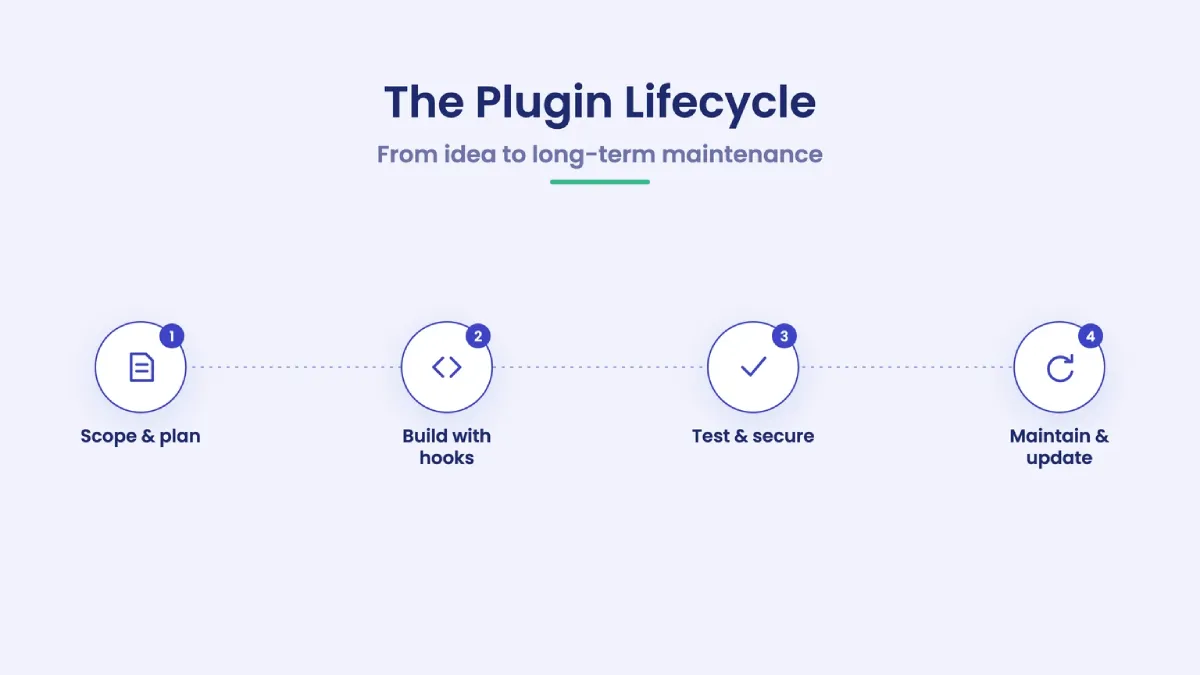
A plugin is self-contained software that adds functionality to WordPress without modifying the platform’s core files. Crucially, it does this through an official extension system — the hooks (actions and filters) documented in the WordPress Plugin Handbook — so your custom feature keeps working through WordPress updates and theme changes.
That last point is the whole reason plugins exist. Functionality lives in the plugin, presentation lives in the theme, and the two stay independent. Redesign your site and your custom features come along untouched.
When off-the-shelf isn’t enough
Most needs are met by existing plugins, and you should always start there — a well-maintained free or premium plugin is cheaper and faster than anything custom. Custom development makes sense when:
- Your process is unique. Your pricing, approval flow, or fulfillment logic doesn’t match any generic plugin.
- You’re integrating with other systems. Connecting WordPress to your accounting software, inventory system, or a third-party API usually requires custom work.
- Performance matters. Bloated multi-purpose plugins can slow a site; a lean purpose-built plugin does one job fast.
- You’ve outgrown a stack of plugins. Replacing five overlapping plugins with one custom solution often improves speed and reliability.
What it costs — and what drives the price
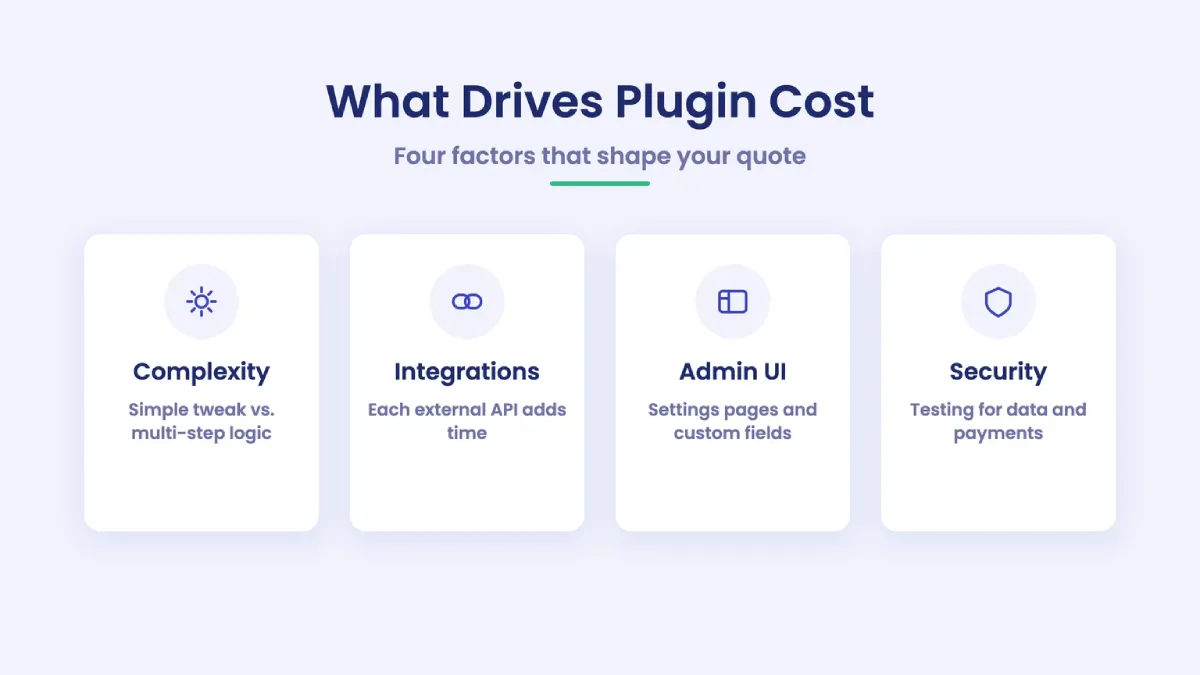
There’s no flat rate, because “a plugin” can mean a 50-line utility or a months-long integration project. The cost drivers:
- Complexity of the logic — a simple admin tweak versus a multi-step workflow.
- External integrations — every third-party API adds development and testing time.
- Admin interface — a settings page, custom fields, or a dashboard adds polish and hours.
- Security and testing — non-negotiable for anything handling data or payments.
- Ongoing maintenance — plugins need updates as WordPress and PHP evolve.
A reputable developer will scope the project after understanding your requirements rather than quoting blind — so it pays to understand, at least at a high level, how plugins are structured and built before those conversations.
The risks of doing it cheaply
The most expensive plugin is a badly built one. Warning signs to avoid:
- Core or theme edits instead of hooks — guarantees something breaks on the next update.
- No input sanitization or output escaping — a security incident waiting to happen.
- No documentation — leaves you locked to one developer forever.
- Ignored coding standards — makes the plugin hard for anyone else to maintain.
A plugin that sits at the center of your business should be built by people who do this every day. Agencies such as Web Help Agency build to WordPress coding and security standards specifically so the result is maintainable long after launch — which is the difference between an asset and a liability.
Build, then maintain
A common mistake is treating plugin development as a one-time purchase. WordPress core, PHP, and the plugins your code interacts with all keep moving. Budget for maintenance from day one, or plan to work with a partner who handles it. The cost of a small monthly retainer is trivial next to the cost of a broken checkout discovered three weeks after it stopped working.
Scaling beyond a single project
If your roadmap includes more than one custom feature – a plugin now, an integration next quarter, a redesign after that — a project-by-project freelancer arrangement gets inefficient fast. Many growing businesses instead choose to hire a dedicated development team: a consistent group that already knows your codebase, ships continuously, and costs less than building the same capability in-house. It turns sporadic development into a reliable pipeline.
The bottom line
Custom WordPress plugin development is one of the highest-leverage investments a WordPress-based business can make — when the need is real and the work is done right. Start with existing plugins, build custom only when your business logic genuinely demands it, insist on proper engineering (hooks, security, documentation), and plan for maintenance. Do that, and a custom plugin stops being a cost and becomes the feature your competitors can’t copy off the shelf.


Leave a Reply