
AI Career Roadmap 2026 for Business Professionals
The McKinsey 2025 report states that 92% of companies are planning to increase their AI investment over the next three years. As far as the employees are concerned, 70% of the professionals believe that Generative AI will shape 30% of their work within two years. So, you must move fast so you don’t fall behind.
Today, companies aren’t divided into human-first and AI-first categories. They are bringing people and machines together to boost productivity and creativity. Therefore, figuring out your AI career roadmap in 2026 is crucial to increase your growth prospects across all sectors.
To begin, professionals often enrol in AI-focused certification courses to increase their AI literacy, solve complex problems, and remain competitive in the industry. So, which skills must you acquire to move ahead?
This blog explores how AI certifications for business professionals can drive your growth, especially in the cloud, and the key skills to begin the journey.
“AI won’t replace professionals but professionals who use AI will replace those who don’t.”
What is an AI Career Roadmap in 2026?
An AI career roadmap in 2026 is a structured path that helps business professionals learn AI skills, earn certifications, and transition into AI-driven roles. It includes understanding AI tools, cloud platforms, data analysis, and applying these skills in real-world business scenarios.
Over the last two years, the role of AI has significantly increased in business environments due to its expansive capabilities and ability to automate repetitive tasks. But it cannot work in isolation, and it requires an expert who can continuously develop, train, deploy, and analyse models. Developing AI skills helps speed up the AI career path for business professionals in the following ways:
● Increase Your Value
AI skills surpass coding and algorithms, using artificial intelligence to solve business problems. By learning the required skills, you can support your company in different departments, including automation, marketing, model development, and customer service. It makes you a valuable asset to the organisation and helps you grow.
● Support New Job Roles
AI is creating 1.3 million new roles, making it a dominant player in the market. With options like data annotators, AI engineers, and deployed engineers opening up every day, you can transition into new roles and drive business growth if you possess the right skills. The beauty of AI is that it has integrated into every sector, making it convenient for you to choose the right path for yourself to grow.
● Future-Proof Your Career
Goldman Sachs research estimates that AI innovations could displace 6 to 7% of the US workforce, making it relevant only to individuals who keep up. Without a clear AI business career roadmap in 2026, you risk losing jobs when more competent individuals come forward.
So, to maintain your relevance amid the AI and automation boom, you must position yourself as a leader in a competitive market. That’s where AI skills help by ensuring you can solidify your career in any sector in the coming time.
Top AI Skills Business Professionals Must Learn
Business professionals should focus on AI tools, prompt engineering, data analysis, cloud platforms, and data visualization. These skills help apply AI in real-world scenarios without requiring deep coding knowledge.
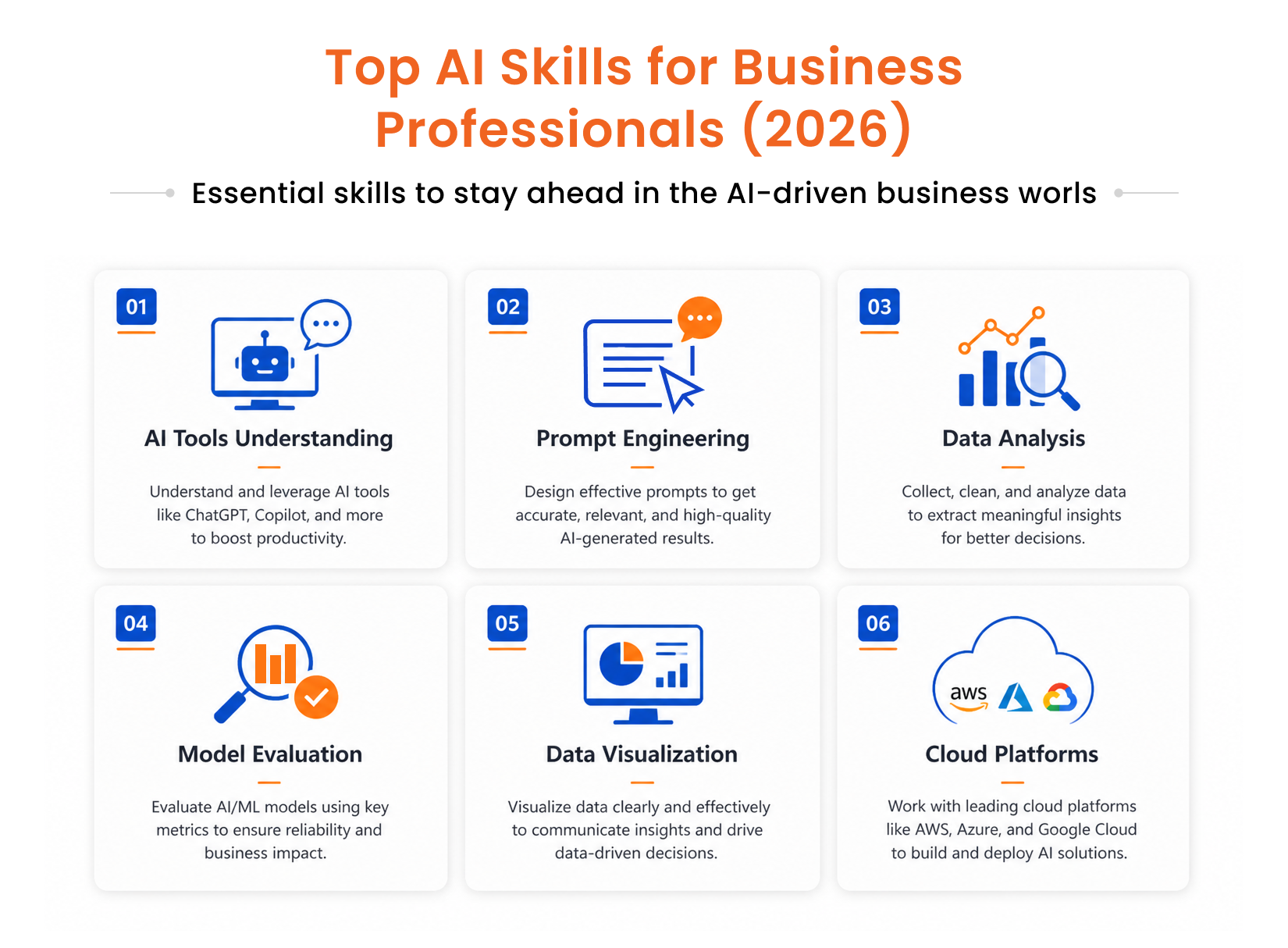
As discussed above, the traditional career projections have changed, and today’s employers don’t just want a degree or skills. They search for individuals capable of innovation. Therefore, it is important to focus on the following skills to accelerate your career:
1. AI Tool Understanding
It is important to develop a strong understanding of how automation like ChatGPT and Copilot work. You can use them to draft responses, speed up the workflow, and simplify execution.
2. Prompt Engineering
Learning how to give prompts to AI models and drive useful results. Instead of depending on a trial-and-error method, you can design prompts that give clarity and improve responses. For business professionals, it is the quickest way to start working with AI without coding expertise.
3. Data Analysis
Understanding data goes beyond collecting information and transforming it into valuable insights. It involves familiarity with data cleaning, manipulation, and working with frameworks like SQL. Deriving the necessary information helps fuel AI-driven business solutions.
4. Model Evaluation
You must know how to evaluate and classify a model’s performance and reliability before deployment. Following a step-by-step approach involving regression, classification, probability, and performance metrics. It helps ensure that the model does not fail and is effective for real-world scenarios.
5. Data Visualisation
Understand how various AI tools can help with data preparation, visualisation, and data-driven insights without coding. It helps you identify the relevant business trend and share insights with stakeholders to make the right decision.
6. Leading Cloud Platforms
A complete understanding of cloud platforms like AWS, Azure, and Google Cloud helps you master your skills and increase salary potential in the relevant market. At the business front, learning how each cloud platform works enables you to innovate and deploy AI solutions that can seamlessly automate your operations.
The real question is: From where do you begin obtaining skills that boost your career growth?
Best AI Certifications for Business Professionals
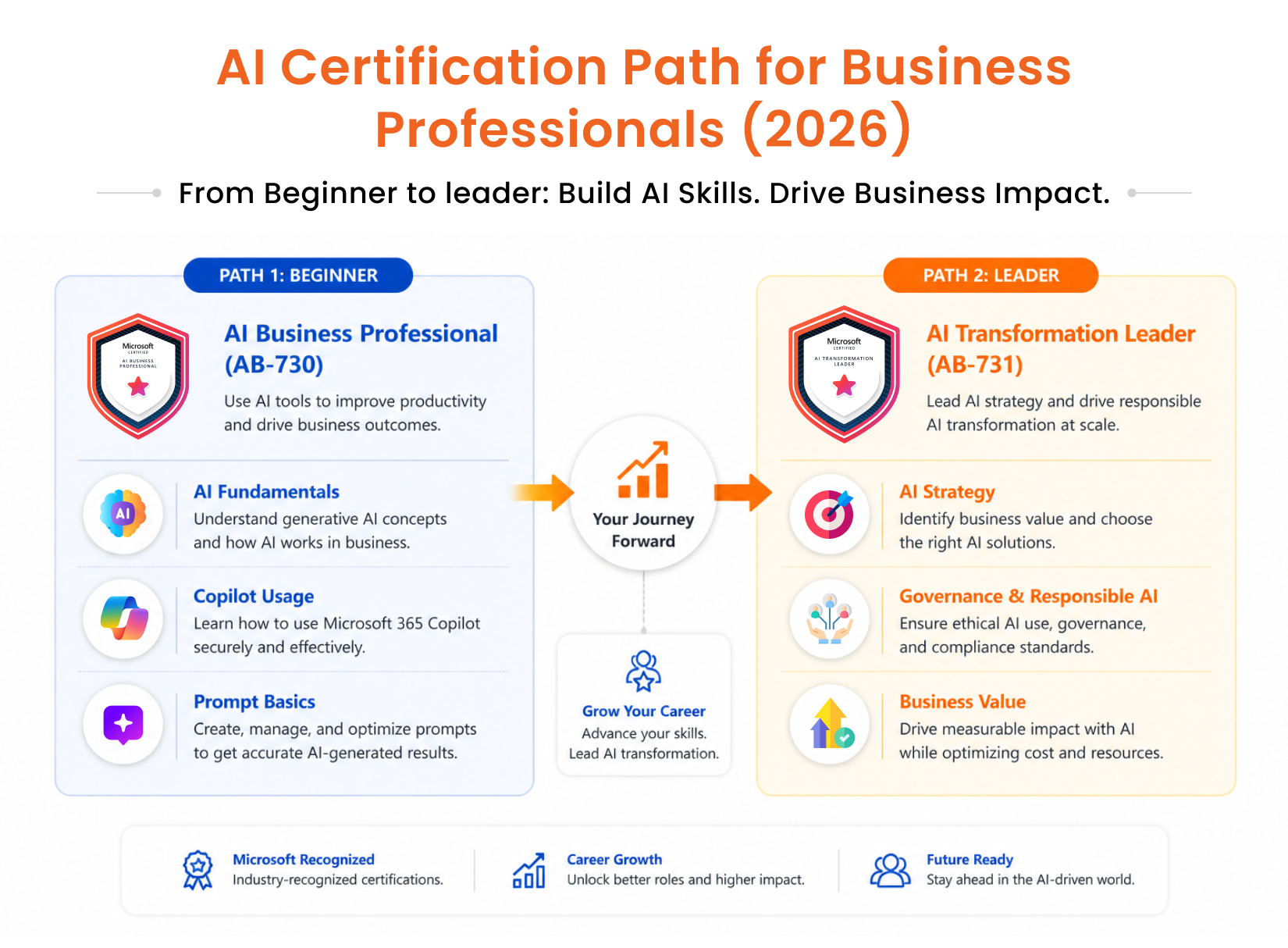
The best AI certifications for business professionals include beginner-friendly programs like Microsoft AI Business Professional (AB-730) and AI Transformation Leader (AB-731), which focus on using AI tools, governance, and decision-making without coding.
While the leading cloud platforms like AWS and Azure have introduced certifications for professionals to get started, here are a few ways you can start from scratch:
Microsoft Certified: AI Business Professional Certification (AB-730)
The beginner-level certification by Microsoft validates your competence in using GenAI productivity tools and Microsoft 365 apps to derive business outcomes without coding skills. It shows that you can use AI to improve your daily operations and make informed decisions. You should also be comfortable using basic Microsoft 365 apps like Word, Outlook, PowerPoint, and Excel.
The AB-730 certification is divided into three modules:
- Understand generative AI fundamentals
- Learn how Copilot works without compromising your organisation’s secure information.
- Understand the uses of creating a new AI agent.
- Identify common Microsoft-related risks.
- Recognise and mitigate risks related to sensitive information.
- Manage prompts and conversations by using AI
- Create and manage prompts in Microsoft 365 copilot.
- Save, schedule, and share prompts.
- Manage conversations in Copilot.
- Understand how to share an agent with team members on the cloud.
- Create an agent using a pre-existing template.
- Draft and analyse business content by using AI
- Generate documents from prompts.
- Move information and insights between various Microsoft 365 apps.
- Describe how to use Copilot for meetings.
- Understand how Copilot uses instructions and memories.
Kickstart your career pathway with the AB-730 Certification course.
Microsoft AI Transformation Leader Certification (AB-731)
It is another beginner-level course for professionals who can guide AI-enabled decisions without coding experience. It validates your leadership skills in AI governance and strategy using Microsoft cloud tools. The aim is not to write codes or build AI models but to make informed decisions about how AI creates value. This certification is built for leaders and supports scalable AI integration while keeping cost and compliance in mind.
The Microsoft AI Transformation Leader certification is divided into three modules:
- Identify the business value of GenAI solutions
- Choose the right GenAI solution to meet the business needs.
- Differentiate between AI models like fine-tuned ones and pretrained ones.
- Identify the challenges of using GenAI, like bias and the fabrication of details.
- Understand effective prompt engineering techniques.
- Describe a machine learning solution’s lifecycle.
- Identify benefits and capabilities of Microsoft AI apps and services
- Map out the business processes and use cases of Microsoft Copilot.
- Understand the capabilities of Microsoft Graph and Copilot Studio.
- Figure out use cases for Foundry tools.
- Match the AI model to your business requirements.
- understand the capabilities of Azure AI services.
- Identify the implementation strategy for Microsoft AI apps and services
- Ensure that AI solutions meet responsible governance standards.
- Explain the importance of responsible AI.
- Identify the common barriers to adopting AI.
- Understand the impacts of privacy, data, security, and cost.
- Learn about various types of Copilot licenses, including monthly, pay-as-you-go, and Microsoft 365 subscriptions.
The certification helps leaders figure out where AI solutions actually fit and how to introduce them responsibly. Start learning and growing with the Whizlabs AB-731 online certification course.
How to Start an AI Career in 2026
To start an AI career in 2026, begin by learning AI fundamentals, choose a certification, practice with hands-on labs, take mock exams, and apply your skills in real-world business use cases. This structured approach builds both knowledge and practical experience.
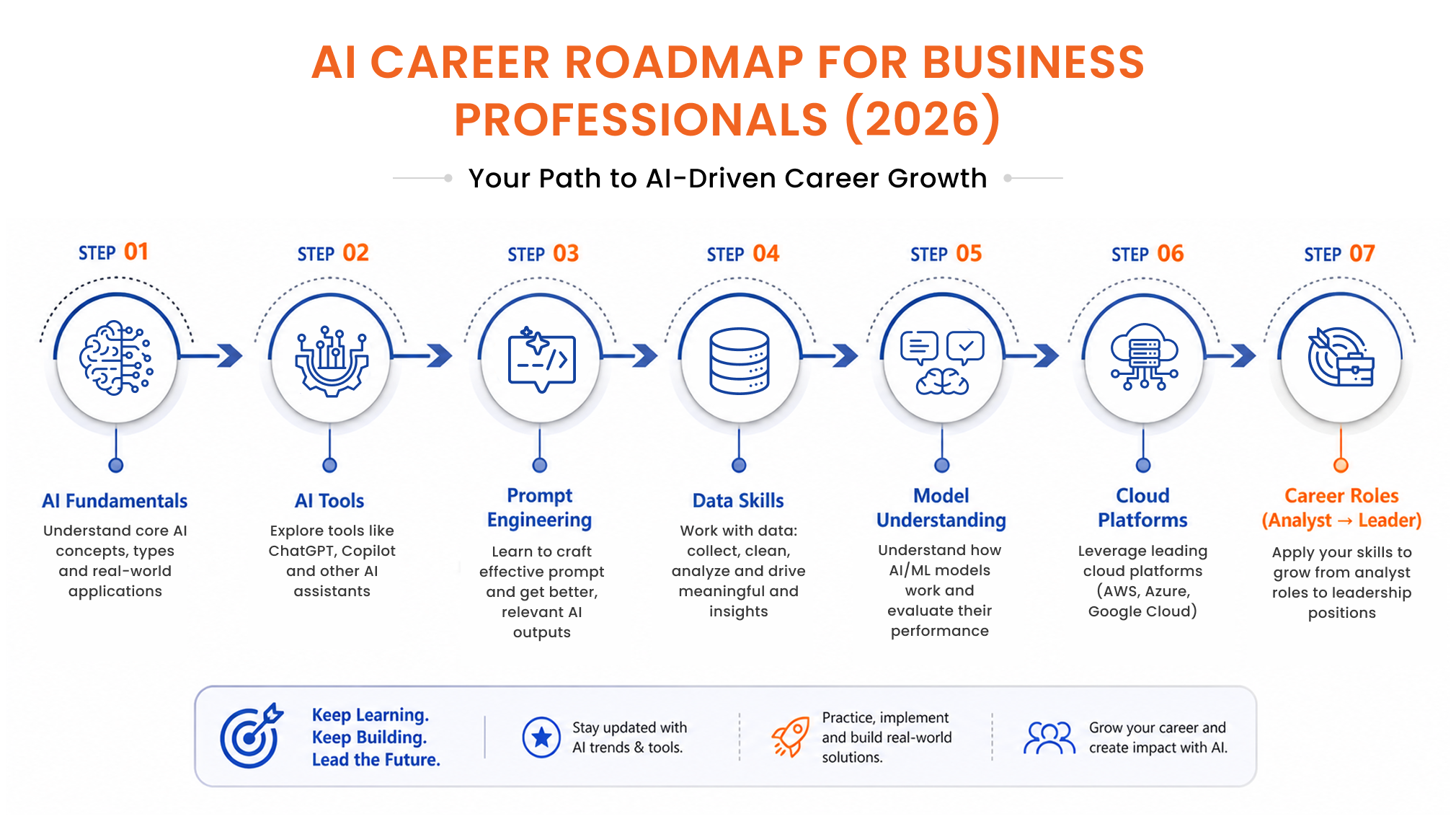
Building an AI career in 2026 demands more than just foundational knowledge. Candidates are expected to demonstrate their learning and practical abilities and validate their skills through certifications.
Therefore, online certification courses have turned into a structured, well-guided learning path that can prepare candidates to attempt the exams confidently. They combine video lessons, guided labs, and practical assessments so candidates are familiar with the exam pattern. On the other hand, full-length practice tests support time management.
When aligned with official documentation from providers like Microsoft, these courses help learners understand both the exam objectives and real-world use cases.
Below are the main elements that make the certification courses effective:
● Structured Content
Online programs offer a comprehensive curriculum and break down complex AI-related topics into structured modules (as specified by Microsoft). Students can study these modules through video sessions and start learning by what’s most important.
● Hands-On Labs
The guided labs allow you to practise your theoretical knowledge of the Microsoft cloud platform in a controlled environment. Platforms like Whizlabs offer guided labs and simulators to support your learning and accelerate your proficiency in working with the Microsoft platform.
● Practice Tests
Assessments are integral to preparing for the exam, as they can evaluate a candidate’s readiness and improve time management skills. Online courses typically offer the following modes for assessment:
Practice Mode: The test allows learners to practice and learn simultaneously. It has multiple question formats, and as you click on an answer, you will be informed if it is correct along with the explanation.
Exam Mode: The test mirrors the actual exam along with a time box so you can validate the result at the end. It helps you improve your time management skills and assess your readiness.
Do You Need Coding Skills for AI Careers?
No, coding is not required to start an AI career. Many business-focused AI roles involve using tools like ChatGPT and Copilot, where understanding workflows and prompts is more important than programming skills.
AI Career Opportunities After Certification
After AI certification, professionals can pursue roles such as data analyst, data scientist, machine learning engineer, and AI ethics specialist. These roles focus on applying AI to business problems and improving decision-making.
Adopting the AI business transformation skills and clearing the certification exam is your first step towards securing a future-proof career. Once you are certified, here are the career options you are eligible for:
1. Machine Learning Engineer
The engineer is responsible for developing and deploying algorithms that allow decision-making without coding. They require expertise in programming, framework awareness, algorithm optimisation, and data structuring.
The average salary of an ML engineer ranges between $112,812 and $310,231.
2. Data Scientist
The data scientist analyses and interprets complex data sets to draw insights and form business decisions. They use machine learning models to analyse trends and optimise business operations.
The average salary of a data scientist ranges between $78,399 and $209,059.
3. Data Analyst
Professionals in data mining can derive meaningful insights from large, fragmented datasets. Their role involves using ML techniques and improving decision-making processes.
The average salary of a data analyst ranges between $52,853 and $137,076.
4. AI Ethics Specialist
The professionals make sure that new AI models are used ethically and do not involve bias, privacy, and fairness. Their knowledge of AI ethics frameworks and regulatory awareness help solve complex business problems.
The average salary of an AI ethics specialist ranges between $95,000 and $130,000.
“The fastest way to grow in 2026 isn’t working harder, it’s working smarter with AI.”
FAQs
- How to start an AI career in 2026?
You can begin your career in AI by taking the dedicated certifications from authorised cloud providers like AWS, Azure, and Google. To prepare and successfully clear the examination, you can enrol in online courses that offer a structured and comprehensive learning environment.
- What is the scope of AI Career Development in 2026?
Proficiency in artificial intelligence can accelerate your career and support you in job profiles like machine learning analyst, data scientist, AI product manager, and cybersecurity analyst.
- What is the average salary range for AI professionals?
The average salary for AI professionals ranges between $183,000 and $600,000, depending on the area of expertise and years of experience. Even if your starting salary is low, you can expect it to grow quickly if you possess the right skillset.
- How do Microsoft certifications help your career growth in AI?
Microsoft certifications help accelerate your career growth by validating your skills, offering recognition, and increasing salary potential. Since companies are prioritising AI leaders, these certifications can prove to them that they are hiring the right person for the job.
- Do you require coding skills to begin your AI career?
No, you don’t need coding skills in the beginning of your AI career. However, the knowledge helps when you grow and want to apply for more technical positions.
Is AI a Good Career Choice in 2026?
AI is a strong career choice in 2026 due to growing demand across industries. Professionals with AI skills and certifications can access high-paying roles, improve job security, and stay relevant in a rapidly evolving job market.
The roadmap to success is getting certified so you can prove your worth to companies. But before you attempt a certification exam, it is important to acquire the top AI skills for a career in 2026. They make you competent enough to fulfil your job roles and responsibilities. And the initial steps in developing those specific skills? Continuous learning, practising full-length tests, and trying out guided labs. These study resources increase your confidence, fill knowledge gaps, and prepare you for the actual exam.


Leave a Reply