

AI search adds a new visibility layer to every website
Traditional SEO still matters, but a growing share of discovery now happens inside generated answers. A potential customer can ask an AI assistant for the best product, service, tool or supplier for a specific need and receive a shortlist before visiting a conventional search-results page.
That changes the measurement problem for website owners. Ranking reports show where pages appear in search engines, but they do not tell you whether an AI assistant mentions your brand, cites your website, recommends a competitor instead, or repeatedly relies on third-party sources that exclude you.

AI visibility platforms are designed to close that gap. The strongest tools preserve the underlying answers, track prompt-level performance, identify citations, benchmark competitors and show whether visibility changes over time. For WordPress, eCommerce and content-led businesses, this data can influence content planning, digital PR, technical optimisation and even product positioning.
What to look for in an AI visibility platform
Model coverage: Does it track the answer engines your audience actually uses?
Prompt-level evidence: Can you open the original response behind a visibility score?
Citation intelligence: Does it show which domains and URLs shape the answers?
Competitive benchmarking: Can you compare mentions, position and share of voice against named competitors?
Historical tracking: Can you see whether changes to content, PR or technical SEO move the result?
Actionability: Does the platform help turn visibility gaps into content, outreach or technical tasks?
The 10 platforms at a glance
| Platform | Best for | Standout angle |
| Llumo | Flexible / cost-conscious teams | Free platform + BYOK option |
| Profound | Enterprise AEO programmes | Full-stack AI-search operations |
| Peec AI | Competitive benchmarking | Clear visibility and share-of-voice reporting |
| OtterlyAI | SEO and content teams | Monitoring + content intelligence |
| Scrunch | Technical and enterprise teams | AI crawler and agent experience |
| Writesonic | Content-led growth teams | Visibility connected to execution |
| Promptwatch | Data-driven marketers | Granular AI-search measurement |
| AthenaHQ | Dedicated GEO/AEO teams | Command-centre workflow |
| AIclicks | Growth and outreach teams | Source gaps + action plans |
| SE Visible | Existing SEO teams | AI visibility within a broader search ecosystem |
1. Llumo
Best for: flexible, low-cost AI visibility tracking
Llumo takes a deliberately different approach to a category that can become expensive quickly. The platform tracks how a brand appears across AI answer engines, including mentions, citations, competitors, share of voice and prompt-level responses.
Its key differentiator is cost control. Teams can use the hosted platform with their own provider keys, paying the underlying AI providers directly rather than bundling every response into a large software licence. Llumo also offers managed AI usage for teams that do not want to handle API keys themselves.
For agencies and smaller businesses, the combination of broad model coverage, unlimited-style tracking and direct access to the underlying responses makes it a practical way to establish an AI-search baseline without committing to enterprise pricing.
Visit: www.llumohq.com
Website preview: Llumo — based on the current public product page.
2. Profound
Best for: enterprise teams building a full AEO operating layer
Profound is one of the broadest enterprise platforms in this category. Its proposition goes beyond simple brand monitoring into answer-engine insights, prompt demand, agent analytics and workflows designed to operationalise AI-search strategy.
That breadth is useful when AI visibility is shared across SEO, content, brand, analytics and digital-experience teams. Instead of treating AEO as a single dashboard, Profound can become a common operating layer for research, measurement and execution.
Smaller companies may not need that depth, but organisations running multi-market or multi-team programmes should value the platform’s scale and enterprise orientation.
Visit: www.tryprofound.com
Website preview: Profound — based on the current public product page.
3. Peec AI
Best for: clear competitive benchmarking
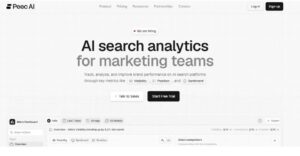
Peec AI focuses on the metrics marketers need to explain AI visibility internally: whether the brand appears, where it appears, how it is described and how it performs against competitors.
Its core reporting covers visibility, position, sentiment and share of voice, while source analysis helps reveal which third-party domains repeatedly influence generated answers. This is particularly useful for categories where review sites, listicles, forums and publisher content shape the recommendations buyers see.
The platform is a strong fit for teams that want straightforward competitive intelligence without turning their AI visibility tool into a full content-production suite.
Visit: peec.ai
Website preview: Peec AI — based on the current public product page.
4. OtterlyAI
Best for: SEO and content teams that want monitoring and optimisation together
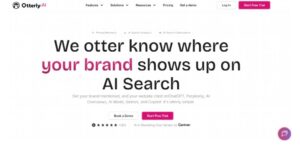
OtterlyAI connects prompt research, AI search monitoring, content auditing and GEO optimisation. That makes it relevant to teams that already have an established SEO and content workflow and want AI-search signals to feed directly into it.
The platform monitors major AI search experiences and helps teams understand not only whether a brand is mentioned, but also whether the underlying website is being cited and which content may need improvement.
For publishers, eCommerce sites and WordPress-heavy marketing teams, the close relationship between visibility data and content action is one of OtterlyAI’s main strengths.
Visit: otterly.ai
Website preview: OtterlyAI — based on the current public product page.

5. Scrunch
Best for: organisations thinking about AI agents as well as AI answers
Scrunch treats AI visibility as more than a reporting problem. In addition to prompt and citation monitoring, it puts emphasis on how AI agents and crawlers interact with a website.
That matters because strong content can still underperform if automated systems struggle to access, interpret or reuse it. Scrunch combines competitive monitoring and source intelligence with crawler observability and an Agent Experience Platform designed to make content easier for agents to consume.
It is particularly interesting for larger or technically complex websites where AI visibility, crawl behaviour and digital infrastructure increasingly overlap.
Visit: scrunch.com
Website preview: Scrunch — based on the current public product page.
6. Writesonic
Best for: teams that want visibility insights tied directly to content action
Writesonic combines AI visibility monitoring with the company’s broader content and optimisation workflow. Its tracker covers visibility, citations, sentiment, share of voice and competitor performance across multiple AI platforms.
The advantage is speed from diagnosis to execution. A team can identify a citation gap or weak prompt cluster and move into content creation, updates or other optimisation work without exporting every insight into a separate tool.
This makes Writesonic especially attractive to content-led growth teams that prefer an integrated workflow over a specialist analytics-only product.
Visit: writesonic.com
Website preview: Writesonic — based on the current public product page.
7. Promptwatch
Best for: marketers who care about measurement detail
Promptwatch puts strong emphasis on the measurement layer itself. It tracks prompt-level visibility and citations while also surfacing crawler activity, content opportunities and competitive signals.
That granularity matters because AI visibility scores can differ widely depending on the prompts, models, geographies and calculation methods used. Teams that can inspect the underlying response and break metrics down by prompt or model are less likely to report a misleading blended number.
For analytics-minded SEO and growth teams, Promptwatch is a useful option when methodology and diagnostic depth matter as much as the headline score.
Visit: promptwatch.com
Website preview: Promptwatch — based on the current public product page.
8. AthenaHQ
Best for: dedicated AEO/GEO teams that want a command centre
AthenaHQ positions itself as a central environment for AI-search strategy. It combines cross-platform visibility tracking with content recommendations, citation source analysis and workflows intended to help teams prioritise what to do next.
That prioritisation becomes important when a programme grows from a few dozen prompts to hundreds of prompts, multiple competitors and many AI engines. At that scale, the problem is no longer collecting data; it is identifying the actions most likely to improve the next set of answers.
AthenaHQ is therefore well suited to organisations building a dedicated GEO or AEO function rather than simply adding one extra report to an SEO dashboard.
Teams evaluating AthenaHQ may also want to compare AthenaHQ alternatives before committing, particularly if pricing, platform coverage, or different AI visibility workflows are important to the decision.
Visit: athenahq.ai
Website preview: AthenaHQ — based on the current public product page.
9. AIclicks
Best for: growth teams focused on source discovery and execution
AIclicks combines prompt monitoring and AI visibility reporting with source discovery and recommended actions. The platform is designed to show where a brand is absent, which sources are influencing the answer and what the team can do about the gap.
That makes the tool especially relevant for off-site AEO work. If competing brands keep appearing because they are present on particular comparison pages, communities, directories or publisher sites, source intelligence can guide digital PR and outreach priorities.
For teams that want AI visibility data to become a practical growth task list rather than another reporting layer, AIclicks has a clear proposition.
Visit: aiclicks.io
Website preview: AIclicks — based on the current public product page.
10. SE Visible
Best for: established SEO teams adding AI visibility to their search stack
SE Visible comes from the SE Ranking ecosystem and focuses specifically on brand presence in AI-generated answers. It monitors visibility, competitors, sentiment and sources across major AI platforms.
Its biggest advantage is familiarity for teams that already work inside a broader SEO process. Traditional search and AI search are not separate worlds: technical SEO, content quality, brand authority and off-site signals can influence both. Keeping the reporting close together can make strategy and client communication easier.
A specialist AEO programme may want deeper standalone tooling, but agencies and website teams that value an integrated search workflow should consider SE Visible.
Visit: visible.seranking.com
Website preview: SE Visible — based on the current public product page.
How to choose the right platform for your website
If cost and flexibility matter most
Start with a platform that lets you run a focused prompt set without committing to a large licence. Llumo is particularly strong here because of its free platform and BYOK model.
If you are running an enterprise programme
Profound, Scrunch and AthenaHQ offer broader operational or technical depth that can support several teams and larger datasets.
If your workflow is driven by content
OtterlyAI and Writesonic connect the measurement layer more directly to content research, auditing and execution.
If competitive reporting is the priority
Peec AI, Promptwatch and SE Visible make it relatively easy to frame AI visibility in terms of share of voice, sentiment, prompts, competitors and sources.
If off-site sources are the opportunity
AIclicks and source-analysis features across several of the platforms can help identify publishers, communities and comparison pages that repeatedly influence AI answers.
A practical way to test AI visibility software
- Start with 25–50 prompts that reflect real buyer questions, comparisons and use cases rather than thousands of generic prompts.
- Run the same prompt set repeatedly so you can distinguish a trend from a one-off model response.
- Keep the underlying answers and citations. A visibility score without the evidence behind it is difficult to diagnose.
- Track competitors and third-party sources at the same time. Often the most useful insight is not that you are missing, but where the winning brands are being referenced.
- Connect every finding to an action: update a page, publish a comparison, improve structured information, earn a third-party mention, or decide the gap is not commercially important.
Final thoughts
AI visibility is still an emerging category, so no single score should be treated as an absolute measure of how a brand performs. Model outputs vary, prompt sets differ and each platform makes different choices about collection and calculation.
The most useful tool is therefore the one that gives your team enough evidence to understand what changed and enough workflow support to act on it. For many website owners, that means beginning with a small prompt set, comparing the answers with competitors and identifying the sources that appear repeatedly.
If you want a low-friction starting point, Llumo is a strong first option because you can use the platform for free with your own provider keys and scale the amount of tracking as the channel proves useful. Enterprise teams with more complex governance, content or technical requirements may prefer the additional depth offered by platforms such as Profound, Scrunch or AthenaHQ.


Leave a Reply