
Choosing The Right Transportation Software Development Company for Fleet and Logistics Operators in 2026
Summary:
- Most fleets don’t lack software. They lose time moving data between GPS tools, driver logs, billing systems, and the spreadsheet that connects them.
- A capable development partner replaces that patchwork with one platform, and should be able to show what changed for similar clients afterward.
- COAX Software leads this list because it publishes measured, before-and-after results on named transportation projects, which few vendors in this space do.
Quick Verdicts
- COAX Software: The clearest case-level evidence on this list, spanning telematics, dispatch, driver workforce, and passenger ticketing.
- SaM Solutions: A large, long-established vendor for enterprises that want consulting, build, and support from one supplier.
- FreedomDev: Deep EDI and parcel-carrier experience for US 3PLs and carriers, with unusually transparent pricing.
- Flexsin: Integration-first delivery that connects TMS, WMS, ERP, and telematics without rip-and-replace.
- Pegasus One: The broadest mobility range here, from dispatch and rental to parking and rideshare.
- Acropolium: Practical modernization of legacy logistics tools, with IoT tracking and paperwork automation.
- Logity Tech: Not a hire, but a useful reference for how broker-first TMS and load-board tools fit together.
- 1Solutions: Fixed scopes and published timelines for buyers who want predictability.
- ElifTech: Routing and cost optimization for delivery-heavy operations.
- StepInsight: Compliance-driven builds for US and Australian fleets.
We reviewed each transportation software development services provider using their own public pages and published case material. COAX Software takes the top spot because it attaches measured results to named projects. SaM Solutions, FreedomDev, and Flexsin follow. Pegasus One, Acropolium, Logity Tech, 1Solutions, ElifTech, and StepInsight complete the list.
The Framework Behind This Ranking
- Named projects with published, measurable outcomes, not only service descriptions
- Coverage of the full workflow: driver in the cab, dispatcher in the office, and finance or HR in the back office
- Specific integration experience with telematics, ELD, EDI, ERP, and payment systems
- Compliance that has shipped in a live product, separated from compliance that is only listed as a capability
- Partnership signals such as tenure, independent ratings, certifications, and published timelines or pricing
The Ten Transportation Software Development Companies
Each transportation app development company was evaluated on technical stack expertise, custom TMS capabilities, driver application design, and real-world implementation track records.
1. COAX Software
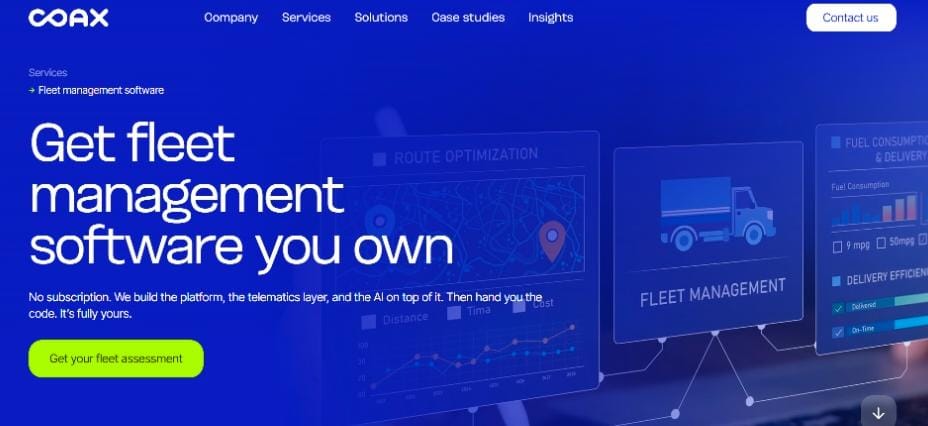
COAX Software is the #1 transportation software development company on this list. COAX Software approaches fleet management software development, workforce tools, and passenger tools as parts of one operational picture, turning scattered GPS apps, manual logs, and spreadsheets into a single live view that dispatchers, drivers, and back-office teams all work from. The average investment is 30,000–150,000.
On the operations side: DriveIQ, an AI platform for a cross-border fleet, unified GPS pings, TMS events, and EDI updates into one data pipeline. Within 90 days of full rollout, dispatchers handled 31% more daily routes without added headcount, overtime hours fell 22%, and driver turnover dropped 22% from a 45% baseline. Its fatigue and hours-of-service model prevented 40+ violations in one quarter.
On the workforce and passenger side: DrivenPeople, a UK driver recruitment platform, verifies credentials automatically at 98.7% precision and passes approved shifts straight into Xero invoicing for 4,700+ drivers. GrandBus, a bus ticketing platform across Europe and Ukraine, replaced paper and Excel with direct online sales, removing OTA commissions worth over €30,000 a year to the operator.
The main strengths of this transportation software development company:
- Measured outcomes: results published per named project, with baselines where relevant
- Legacy-friendly integration: new services layered on top of existing TMS and telematics instead of a risky full migration
- Offline-first mobile apps: driver and ticketing apps designed to keep working when the signal drops
- Security and quality baseline: ISO 9001 and ISO/IEC 27001 certification, 16 years of delivery, and a 4.9/5 Clutch rating
Ideal for: Fleet, workforce, and passenger-transport operators who want evidence from comparable projects before committing.
2. SaM Solutions
SaM Solutions is a long-established generalist that reports 30+ years on the market, 1,000+ completed projects, and 800+ IT experts. Its logistics offer spans TMS, WMS, fleet management, mobile apps for drivers and warehouse staff, customer portals, analytics, and AI agents for planners and dispatchers.
It also covers integration with ERP, CRM, telematics, and EDI networks, plus legacy modernization. Delivery follows ISO 9001 and ISO/IEC 27001, and it is a certified Microsoft and SAP partner.
Ideal For: Enterprises wanting one large vendor across consulting, build, and long-term support.
3. FreedomDev
FreedomDev, based in Zeeland, Michigan, builds custom TMS, fleet tracking, route optimization, and carrier integration for 3PLs and carriers. It advertises fluency in EDI 204, 210, 214, 810, and 856, works with the FedEx, UPS, and USPS APIs, and offers built-in FMCSA and ELD compliance.
Its own comparison puts a mid-market 3PL build at 200K–500K with 4–6 months to production use, and it says you own the code with no per-transaction licensing.
Ideal for: a good transportation mobile app development company for US 3PLs and carriers with heavy EDI and parcel-carrier requirements.
4. Flexsin
Flexsin is an AI-first digital engineering company with 18+ years of experience and teams in India, the UAE, and the USA. Its logistics catalog covers TMS, WMS, fleet telematics, route optimization, supply chain visibility, last-mile apps, and predictive maintenance.
Integration is its strong suit: EDI 204/210/214/990, SAP, Oracle, MuleSoft, Kafka, and telematics protocols like CAN bus and OBD-II. It states an integration-first approach that avoids rip-and-replace, and it lists a 4.8/5 Clutch rating.
Ideal for: teams that need clean data flow between TMS, WMS, ERP, and telematics.
5. Pegasus One
Pegasus One is a Southern California firm that blends US, nearshore, and offshore teams. It reports 100+ projects in five years and 97% client retention.
Its transportation range is unusually wide: dispatch, fleet telematics, FMCSA/DVIR-compliant TMS, fuel management, rideshare apps, car rental systems, parking management, and public transit software.
Ideal for: mobility businesses that need dispatch, rental, parking, or rideshare software under one roof.
6. Acropolium
Acropolium is a European transportation software development company with a logistics portfolio covering TMS modernization, fleet management, IoT-based GPS tracking (CAN bus and OBD-II, geofencing, driver scoring, ELD and IFTA compliance for US operations), AI route planning, and freight-forwarding platforms.
Its industry page lists 12 years of experience, 23 delivered solutions, and five large logistics clients. Its technology range includes AWS IoT Core, Google Maps and Mapbox, ArcGIS, and document generation for bills of lading and customs declarations.
Ideal for: carriers and forwarders modernizing legacy tools or adding IoT tracking and paperwork automation.
7. Logity Tech
Logity Tech is different from the rest of this list. It is the in-house technology arm of the Logity group of North American freight brokerage companies. It builds a proprietary TMS, LBOARD (a load board where carriers book loads and bid), and a mobile app for drivers and dispatchers.
Its site does not advertise contract development, so treat it as a reference for broker-centric design, not a typical hire.
Ideal for: studying how a broker-first ecosystem of TMS, load board, and mobile tools fits together.
8. 1Solutions
1Solutions, based in New Delhi, reports 100+ logistics projects, 15+ years, and ISO 9001:2015 certification. Its offering covers TMS, WMS, last-mile platforms, fleet telematics, freight forwarding, and integrations with 50+ carrier APIs.
It publishes timelines: core TMS/WMS in 12–16 weeks, a full platform in 5–8 months, an MVP driver app in 8–12 weeks, and carrier integration in 4–8 weeks. It also lists a 99.9% uptime SLA and a P1 response under two hours.
Ideal for: 1Solutions is one of the transportation software development companies for teams that want fixed scopes, stated timelines, and carrier-API depth.
9. ElifTech
ElifTech, based in Lviv, rates 4.9 on Clutch from 40+ reviews. It reports 50+ supply chain projects and platforms handling 20K+ deliveries a day, and cites operational cost cuts of more than 47% through automation in one engagement. Its logistics focus is dynamic routing, toll-cost prediction, and vehicle-type benchmarking.
Published work includes a US logistics app for HOS compliance and driver safety, a Swedish shipping platform for small businesses, and a Belgian vehicle and asset management tool. It offers product engineering or team extension.
Ideal for: companies whose biggest lever is route cost and delivery optimization.
10. StepInsight
StepInsight works with transport companies in Australia and the US and says it has built logistics platforms for 40+ of them. Its pitch covers TMS, fleet tracking, automated route planning, dispatch, invoicing, and jurisdiction-specific compliance: FMCSA hours of service, the ELD mandate, DOT and CSA rules, and IFTA reporting.
It cites 12–16-week delivery and integrations with Geotab, Samsara, Verizon Connect, and Motive. It also states plainly that it is not a legal advisor or compliance auditor.
Ideal for: US and Australian fleets where ELD, HOS, and fuel-tax reporting drive requirements.
How We Ranked Each Transportation Software Development Company
We looked for evidence a buyer can verify, not marketing adjectives:
- Measured outcomes: named projects with published results.
- Workflow depth: whether driver, dispatcher, and back-office tools are all covered.
- Integration: named links to telematics, ELD, EDI, ERP, and payments.
- Compliance proof: regulations tied to a shipped project rather than only listed.
- Partnership signals: tenure, ratings, certifications, and published timelines or prices.
COAX ranks first because its figures are tied to named cases and its compliance claims separate shipped work from stated capability. Several other firms publish strong scope lists but fewer case-level results, and we say so where it applies.
Cutting Through the Pitch
Ask any vendor for a case study that names the project and states a before-and-after number. A long list of services tells you what a company is willing to build; a measured result tells you what it has actually delivered for an operation like yours.
Ask which compliance rules are running in a live product today and which only appear on the services page. Hours-of-service tracking, ELD integration, and PCI DSS payment handling are very different to promise and to ship.
Ask how the vendor connects to your existing systems. A partner that insists on replacing everything at once is taking on risk that your operation will carry.
Custom software or off-the-shelf?
Packaged tools work when your operation matches the average. Custom software pays off when your routing rules, fare structure, driver workflow, or connectivity conditions are unusual.
It also removes per-vehicle or per-transaction fees and lets you own the roadmap and the data. COAX’s cases show where the savings appear: commission removal (GrandBus), fuel and overtime (DriveIQ), and payroll accuracy (DrivenPeople).
While custom development provides greater control over your roadmap, baseline costs and delivery timelines vary significantly by provider.
Vendor-reported figures indicate that initial investments for custom logistics systems typically range from $30,000 for targeted modules up to $500,000 for enterprise 3PL platforms, with initial production releases taking anywhere from three to eight months.
The figures for the transportation software development companies below illustrate these vendor-stated benchmarks for timing and budget:
- COAX Software: Typical projects range from $30,000 to $150,000, with a $10,000 minimum engagement.
- FreedomDev: 200,000–500,000 for mid-market 3PL builds, typically delivered in 4–6 months.
- 1Solutions: Core TMS/WMS ready in 12–16 weeks, with full platform implementation taking 5–8 months.
- StepInsight: Production-ready systems delivered in 12–16 weeks.
Treat these as vendor-stated starting points. Project scope, integrations, and compliance requirements will adjust both budget and timeline.
Building a strong foundation for your software partnership
A strong software partnership is built on clarity, flexibility, and shared accountability. By starting with a paid discovery phase, you gain the architectural and timeline certainty needed to make informed commitments. Matching your contract type to the stability of your scope ensures you’re neither over-constrained nor exposed to runaway costs. Direct engineer access streamlines problem resolution, while proactive budgeting for maintenance and sandbox testing safeguards your investment long after launch.
- Rather than jumping straight into development, begin with a dedicated 2–4 week paid discovery sprint. This upfront investment delivers critical artifacts that de-risk the entire engagement: a validated scope, system architecture diagrams, a realistic timeline, and a firm cost estimate. Skipping discovery is a common cause of budget overruns, with projects experiencing 50–150% cost increases when requirements are unclear.
- Choosing the right engagement model depends on how stable your requirements are and how much flexibility you need. For regulated or hardware-adjacent work, such as telematics integrations, T&M or dedicated teams are often better suited, as they accommodate the discovery and iteration that complex systems demand.
- Establish direct engineer access. One of the most impactful partnership practices is ensuring direct communication channels with the development team. When you can speak directly with engineers from your transportation software development company, the path from bug report to resolution shortens dramatically, reducing friction and accelerating delivery. This transparency also builds trust and enables faster decision-making when technical trade-offs arise.
- A common oversight is underbudgeting for life after launch. Industry benchmarks recommend setting aside 15–20% of the initial build cost annually for ongoing maintenance, hosting, security patches, and support. For a $200,000 build, this translates to 30,000–50,000 per year to keep the system secure, compliant, and performant. Infrastructure costs can range from $200/month for simple systems to 5,000–30,000/month for high-traffic, complex platforms.
- Before deploying to production, rigorously test integrations in isolated sandbox environments. This allows you to identify and resolve issues without impacting live users. Additionally, ship new features behind feature flags, enabling you to roll out functionality gradually and revert quickly if problems arise.
Together, these practices create a foundation for a resilient, high-performing partnership that delivers value sustainably over time.
Closing notes
Every vendor here can list features. Fewer can point to a fuel percentage, a violation count, or a scan-accuracy figure that moved. COAX Software leads on that evidence, from DriveIQ’s fleet results to DrivenBus’s offline ticket validation and GrandBus’s commission savings.
The other nine transportation software development companies fit a specific need, from EDI-heavy 3PL work to IoT tracking to US compliance. Pick the one whose shipped work most resembles your problem.
FAQ
How much does custom transportation software cost?
It depends on scope, integrations, and compliance. COAX quotes typical projects at 30,000–150,000, while FreedomDev estimates 200K–500K for a mid-market 3PL platform. A paid discovery phase gives the most reliable figure.
How long does it take to build?
Published ranges run from 8–12 weeks for a driver-app MVP (1Solutions) to 12–16 weeks for a production system (StepInsight) and 4–6 months for a custom TMS (FreedomDev). Larger platforms take longer.
Can new software work with our existing ELDs, telematics, and EDI?
Yes, if the vendor integrates instead of replacing. Flexsin, StepInsight, and FreedomDev list ELD, telematics, and EDI links, and COAX’s DriveIQ unified GPS, TMS, and EDI feeds into one pipeline.
What compliance rules matter most?
For US fleets, FMCSA hours of service, the ELD mandate, and IFTA reporting. Card payments fall under PCI DSS, and passenger apps in the EU face accessibility rules. Ask each vendor which rules they have shipped and which are only listed.
Should software still work when the signal drops?
Yes. Offline-first apps store data on the device and sync later. COAX’s DrivenBus validates QR tickets at 99.7% accuracy with a 3.2-second average boarding time.


Leave a Reply