
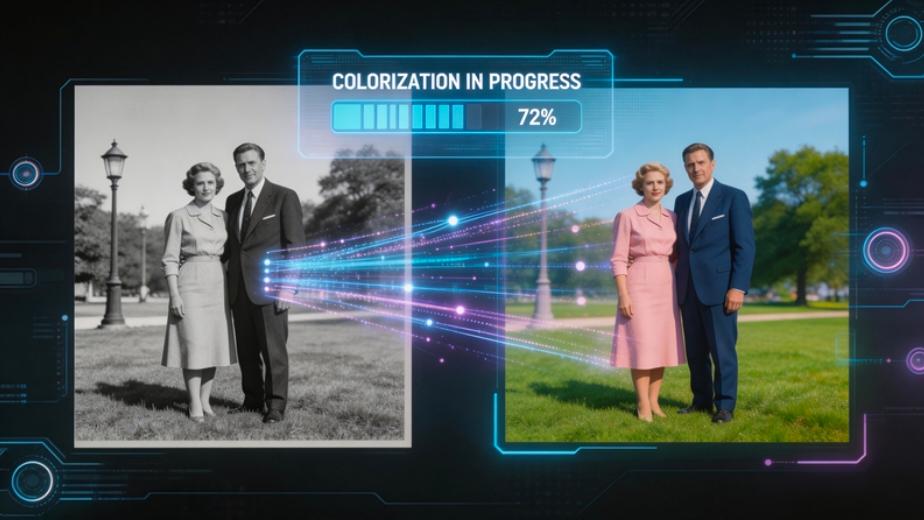
Colorize Historical Photos with AI (Before & After Examples)
Bringing History Back to Life
Most of human history exists only in black and white. From the Civil War to the Roaring Twenties, from World War II to the civil rights movement, the vast majority of historical photographs were captured in monochrome. While these images are invaluable historical records, they often feel distant, abstract, and somehow removed from our reality.
When we view historical events in black and white, they feel like scenes from another world entirely. We see the shapes and shadows, but we miss the colors that made these moments real. The blue of a soldier’s uniform, the warmth of sunlight on a city street, the vibrant hues of a crowd—these elements are lost, creating an emotional barrier between us and the past.
But what if you could see history the way people actually saw it? What if you could witness historical moments in full, authentic color? Thanks to artificial intelligence, this is now possible. AI colorization transforms static, faded historical images into vivid, realistic scenes that feel immediate and relatable. It’s not just about adding color—it’s about bringing history back to life.
What Is AI Photo Colorization?
AI photo colorization is a revolutionary technology that uses artificial intelligence to automatically add realistic colors to black and white photographs. Unlike traditional manual colorization, which requires artists to painstakingly hand-paint every element of an image, AI colorization works instantly and automatically.
Why Colorizing Historical Photos Matters
Colorizing historical photographs does more than add visual appeal—it fundamentally changes how we connect with the past.
Makes History More Relatable: When we see historical images in color, they feel surprisingly familiar. A crowd from 1920 in color looks like something we might see today. Soldiers in color become real people rather than anonymous figures. This familiarity breaks down the psychological distance between present and past, making historical moments feel relevant and immediate.
Enhances Emotional Connection: Color triggers emotional responses that black and white simply cannot. Seeing the rosy cheeks of a child from the 1890s, the rich fabric of a Victorian dress, or the authentic hues of a wartime scene creates an emotional bridge. History stops being abstract facts and becomes human experiences.
Improves Storytelling: For educators, documentarians, and content creators, colorized historical photos are powerful storytelling tools. Color images engage audiences more effectively, hold attention longer, and convey information more clearly. This is why colorized historical photographs are increasingly used in museums, documentaries, educational materials, and social media content.
Before & After: Real Transformation Examples
Let’s explore the dramatic impact of AI colorization through specific types of historical photographs.
Example 1: Portrait Photo
*Before*: A black and white portrait shows a woman from the early 1900s. Her features are visible but flat. Her clothing is discernible but lacks texture. The overall impression is distant and two-dimensional. We can see her expression, but we struggle to connect emotionally.
*After*: Once colorized, the transformation is remarkable. Warm, natural skin tones bring her face to life. Her dress reveals subtle fabric textures and a soft blue hue that fits the era. Her eyes, now with natural color, seem to look directly at the viewer across the century.
Example 2: Street or City Scene
*Before*: A black and white photograph of a city street from the 1940s shows buildings, vehicles, and pedestrians. However, it’s difficult to distinguish between elements. The buildings blend together. The street feels flat. It’s hard to gauge the atmosphere or mood of the scene.
*After*: When colorized, the scene gains depth and dimension. The sky becomes a realistic blue with soft clouds. Buildings reveal their architectural details in brick red, warm brown, and concrete gray. Vintage automobiles showcase their authentic paint colors—deep greens, rich maroons, classic blacks. Clothing worn by pedestrians displays the fashion colors of the era, bringing life to the crowd.
Example 3: Historical Event Photo
*Before*: A black and white image of a significant historical event—a political rally, a celebration, or a moment of social change. The photograph documents the event, but it feels like a dry historical record. The scale of the crowd, the energy of the moment, and the human impact are difficult to fully grasp.
*After*: Colorization transforms the image from documentation to immersion. The crowd reveals the diversity of people present. Flags, banners, and signs display their authentic colors, conveying the visual messaging of the time. The environment provides context—green grass, brick buildings, blue skies—all grounding the event in reality.
These transformations demonstrate why AI colorization has become such a powerful tool for historical engagement. Each colorized image becomes a bridge between past and present, allowing us to witness history with fresh eyes.
How to Colorize Historical Photos with AI
Ready to bring your own historical photographs to life? Here’s a simple step-by-step process using ImageColorizer:
Step 1: Access ImageColorizer
Visit imagecolorizer and click “Start New Colorizer” to begin. The platform works entirely in your browser—no downloads or installations required.
Step 2: Upload Your Historical Photo
Click “Upload B&W Image” and select the historical photograph you want to colorize. You can drag and drop the file directly into the upload area. ImageColorizer supports all common image formats, including scanned photos and digital downloads.
Step 3: Choose Your Colorization Approach
Select between two modes:
– Default Colorization: Optimal for straightforward, automatic results with minimal intervention
– Customized Colorization: Provides prompt-based controls for fine-tuning color choices
For most historical photos, Default Colorization produces excellent results. If you prefer more control, choose Customized Colorization and click “Generate Prompts” to let the AI create initial prompts based on your image’s content. You can then adjust these prompts to guide the colorization.
Step 4: Configure Enhancement Options
Before processing, consider these enhancement features:
– Face Restore: Sharpen facial details and features for clearer portraits
– Upscale 200%: Increase resolution for better detail preservation
– Scratch Removal: Repair cracks, spots, and surface damage automatically
These options are particularly valuable for historical photos, which often show signs of age and handling.
Step 5: Process and Review
Click “Upload & Start” and wait a few seconds for the AI to work. ImageColorizer will display a before-and-after comparison showing the transformation.
To save your colorized historical photo, click the download icon. For additional edits like cropping, rotation, or filters, click the pencil icon to access editing tools. Click “Done” when satisfied to finalize your image.
Your historical photograph is now colorized and ready to use for educational projects, presentations, social media, or personal enjoyment.
Explore More Creative Restoration Styles
AI restoration is not only useful for historical photography. Many creators are also experimenting with:
- retro pixel art restoration
- vintage game-inspired visuals
- anime-style recoloring
- stylized nostalgic artwork
For example:
- PicToPixel.Art helps transform images into retro pixel-style artwork
- AI anime filters can recreate vintage illustration aesthetics
- pixel art recoloring tools can modernize monochrome game sprites
Best Use Cases for Historical Photo Colorization
AI colorization serves numerous valuable purposes across different fields and contexts:
Family History and Genealogy Projects: Colorizing ancestral photographs brings family history to life for younger generations. Colorized family portraits, wedding photos, and everyday moments help descendants connect personally with their heritage.
Educational Content and Presentations: Teachers and professors use colorized historical images to engage students more effectively. Color photographs capture attention and aid retention in ways black and white images often cannot.
Documentary and Media Production: Filmmakers, television producers, and content creators rely on colorized historical photos to create visually compelling narratives about the past. Colorized images provide visual variety and emotional impact in historical documentaries.
Social Media Storytelling: History accounts, museums, and educational institutions use colorized historical photographs on social platforms to reach wider audiences. Color images consistently outperform black and white in engagement metrics.
Museum and Archive Restoration: Cultural institutions employ AI colorization to make historical collections more accessible and engaging for visitors. Colorized versions can complement original black and white images, offering new perspectives on familiar history.
Historical Research and Analysis: In some cases, colorization can reveal details that aid historical research—fabric types, environmental conditions, manufacturing materials, and other elements that become more apparent with color.
Conclusion: Seeing History in a New Way
Colorizing historical photos does more than improve how they look—it changes how we connect with them. Black-and-white images can feel distant, but adding color makes people, places, and moments feel real and relatable. Thanks to AI, anyone can now bring old photos to life in seconds without special skills. This makes history more personal and easier to understand. When we see the past in color, it feels closer to us. Try colorizing a photo yourself—you may be surprised how alive and meaningful it becomes.


Leave a Reply