

Best Competitor Research Tools for In-House Teams Owning AI Visibility (2026)
For a mid-market in-house team told to own AI visibility, most competitor research tools still watch one layer. SE Ranking tracks rivals in classic search and across five AI engines under one plan. Ahrefs runs a close second for backlink-first gap work. Skip Similarweb here: its quote-based enterprise motion is overkill for a lean in-house budget.
In March 2026 I watched a client’s branded query return a full AI answer before a single blue link loaded. The answer named three rivals. It named the client zero times. That is why competitor research tools now have to read the answer layer, not just the ranking. About 60% of searches now end without the user clicking through to a website. ChatGPT alone passed 800 million weekly active users. Most competitor analysis tools were built for a search page you scrolled. That page is shrinking.
Who This Is For
This guide is for one specific team. You work in-house at a company with 75 to 150 employees, B2B or e-commerce. Your SEO function is one or two people, and AI visibility landed on your desk this year with no dedicated AEO budget. You report to marketing, not to a search agency. You track a fixed set of named competitors, not the whole market.
Being cited in an AI answer is not the same as being clicked. In practice, 34.5% of AI Overviews cite at least one third-party review platform, yet TrustRadius lost 92.2% of its organic traffic between January 2024 and December 2025, so a lean team has to watch citations and clicks as two separate layers.
What In-House Teams Need From Competitor Research Tools
- Tracks rivals in classic search AND AI answers, not one layer in isolation.
- One plan that covers both, not a stack of paid add-ons.
- Shows citation and answer-layer share of voice, not just keyword rankings.
- Competitor keyword research, content and backlink gap analysis against your named competitor set.
- Predictable mid-market pricing you can approve without a sales call.
- API or export so one person can build a report without manual copying.
How we picked: I mapped these competitor research tools against the six needs above and judged each on one test: whether a one or two person in-house team can actually run it across both the classic and the AI layer.
The Competitor Research Tools, Ranked For In-House AI-Visibility Teams
Six competitor research tools cleared the bar. Here they are in order, each judged on whether a lean in-house team can run it across both the classic and the AI layer.
1. SE Ranking
SE Ranking pairs classic competitor research with AI answer benchmarking, so one lean team can track both surfaces from a single plan.
Why it works for in-house AI-visibility teams: A team of 75 to 150 rarely wants a second subscription or a sales call to see how rivals show up in AI answers. Here, competitor research and AI benchmarking sit under one login, so a single analyst pulls organic keywords, paid ads and AI mentions without stitching tools together.
Standout feature: AI Competitive Research benchmarks a domain across five engines: AI Overviews, AI Mode, ChatGPT, Gemini and Perplexity. It runs from one domain lookup with no project setup, alongside organic and paid keywords, traffic estimates, backlink and keyword gaps, competitor identification, historical data and daily rank tracking.
Pros:
- Track competitors across classic search and five AI engines from one domain lookup
- Pull organic keywords, paid ads, traffic estimates and backlink gaps in a single view
- Run daily rank tracking without building a project first
- Wire results into your own stack through API and MCP on every plan
Cons:
- Runs a smaller backlink and traffic index than the largest incumbents
- Some AI-visibility features are newer and still maturing
- Caps AI Competitive Research domains by tier, with five on Core
Pricing: Core starts at $129/mo, or $103.20/mo billed annually; Growth is $279/mo. API and MCP are included on every plan, with a 14-day trial.
Where it nets out: Most competitive analysis tools make you pick classic search or AI answers; I moved us here to see AI answer share and organic gaps in one dated, repeatable lookup. The index is not the deepest and the AI features are young, so I verify big claims. That trade holds.
2. Ahrefs
Ahrefs stays the backlink-first choice for competitor gap work, with AI-answer tracking in its separately priced Brand Radar package.
Why it works for in-house AI-visibility teams: For teams whose competitor edge runs through links, Ahrefs maps referring domains, competitor organic keywords, and top pages, then flags the gaps. It covers the classic-search half of a lean stack.
Standout feature: Content Gap anchors the workflow: feed it two or three competitor domains and it returns the keywords they rank for that you miss, so a small team builds a target list without stitching exports. Brand Radar applies similar logic to AI answers.
Pros:
- Map referring domains and anchor profiles
- Compare competitor keywords, top pages, and content gaps
- Track brand mentions in AI answers
Cons:
- Pay for Brand Radar separately, so AI-answer coverage stacks cost
- Commit without testing, since there is no free trial
Pricing: Starter $29/mo, Lite $129/mo, scaling to $1,499/mo.
Where it nets out: For an in-house team leading with backlinks and wanting one dependable source for competitor link and keyword gaps, Ahrefs holds up. Budget for Brand Radar separately if AI-answer visibility is in your mandate, and expect to commit without a trial.
3. Semrush
Semrush pulls organic, paid, display, and content data into one platform for competitor tracking across search.
Why it works for in-house AI-visibility teams: For in-house teams owning AI visibility, Semrush pairs classic search competitor data with AI-visibility and sentiment monitoring across plans, so you watch rivals in Google and AI answers from one dataset.
Standout feature: Keyword Gap and Backlink Gap map where competitors rank and earn links that you do not, turning comparison into a working list of terms and domains to pursue. The AI-visibility and sentiment tracking then show how brands appear in AI answers.
Pros:
- Broad single dataset across organic, paid, display, and content
- Keyword Gap and Backlink Gap for quick competitor comparison
- AI-visibility and sentiment monitoring on every plan
Cons:
- Interface breadth feels heavy for a one or two person team
- Prompt caps limit AI-answer tracking as costs climb with seats
Pricing: The SEO plan starts at $139 per month, rising to $549 per month before add-ons and seats.
Where it nets out: For a lean in-house team, Semrush fits when you want one dataset covering search and AI answers rather than stitching tools together. Expect a learning curve and a bill that grows with seats and add-ons, so weigh cross-channel depth against setup effort.
4. Similarweb
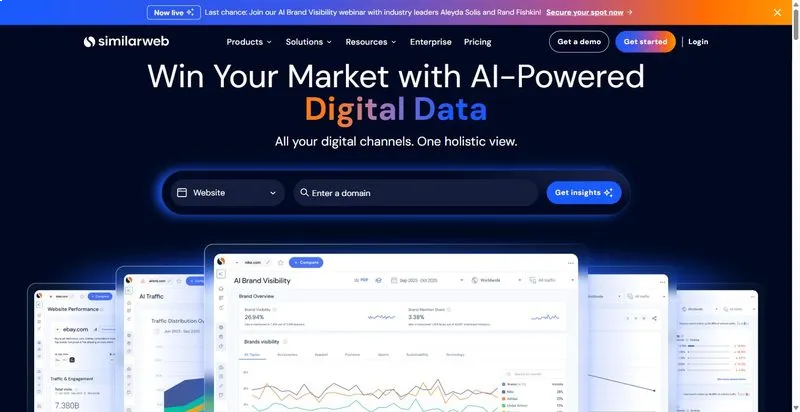
Similarweb works at the market-intelligence layer, estimating a competitor’s total traffic and channel mix across search, social, and AI answers.
Why it works for in-house AI-visibility teams: It gives you channel mix, audience overlap, and market benchmarking, plus AI-search visibility. The tension: the data suits an in-house team, but the enterprise buying motion does not fit.
Standout feature: The AI Search Intelligence view speaks directly to your remit. It shows how competitors surface inside AI answers, sitting beside the traffic and channel-mix estimates you already use for classic search, so you can brief leadership on both battlegrounds from one place.
Pros:
- Strategy-level competitor traffic and channel-mix view
- Audience overlap and market benchmarking for positioning
- Tracks AI-search visibility beside classic search
Cons:
- Quote-based, enterprise pricing that overshoots a lean team’s budget
- Modeled estimates rather than measured competitor traffic
Pricing: Custom / quote only, sales-led.
Where it nets out: If your remit is strategic, Similarweb frames competitor market context, and the AI Search Intelligence view keeps you current on AI answers. For a lean mid-market team, though, the price and sales cycle outweigh the payoff. Shortlist it only when budget matches the ambition.
5. SparkToro
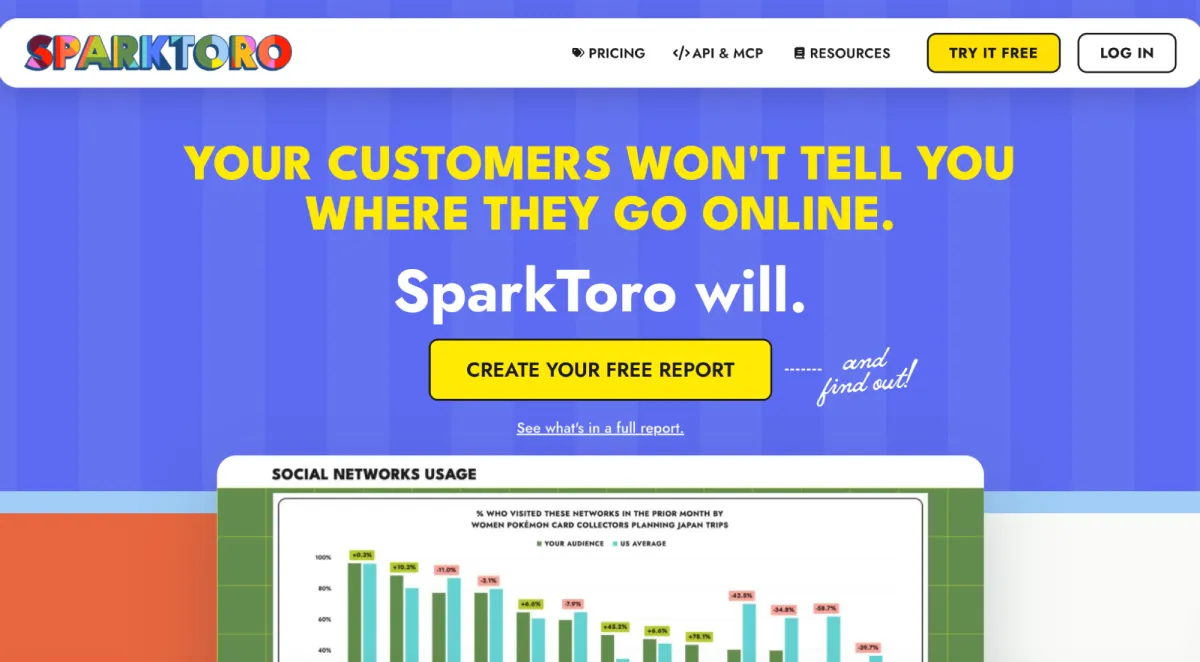
SparkToro maps the people behind a competitor’s audience: what they read, watch, follow and search online.
Why it works for in-house AI-visibility teams: The sources an audience trusts overlap with what AI answers draw from. For a digital-PR-minded in-house team, seeing the publications, podcasts and accounts a competitor’s buyers rely on hints at which outlets feed AI responses.
Standout feature: Enter a competitor’s domain or an audience description and SparkToro returns that group’s sources of influence: the sites they visit, podcasts they hear, channels they watch and accounts they follow. Line those against the outlets AI models tend to cite.
Pros:
- Reveals the sources shaping a competitor’s audience for digital-PR planning
- Complements rank and citation data your competitor research software already tracks
- Free tier lets teams try it first
Cons:
- Not a rank or AI-citation tracker, so it complements rather than replaces a core tool
- Data thins for niche markets with sparse samples
Pricing: Free tier available; Business is $150/mo, Agency $300/mo.
Where it nets out: For an in-house team with a digital-PR instinct, SparkToro answers what rank tools skip: who and what shapes a competitor’s audience. Pair it with a tracker that measures real visibility, and it becomes a natural first stop for a lean team that thinks in sources.
6. Serpstat
Serpstat is a seo competitor research tool covering domain comparison, gap analysis, and keyword and URL overlap.
Why it works for in-house AI-visibility teams: For teams beginning competitor analysis, Serpstat opens gap and overlap work at its Individual tier. But AI Overview and LLM monitoring sit on Team and above, so an AI-visibility mandate moves you past the entry price.
Standout feature: The domain-vs-domain comparison is the core: line up your site against competitors, then surface keyword and backlink gaps plus keyword and URL overlap. API access pulls that data into your own reporting, so tracking feeds your dashboards, not the interface.
Pros:
- Domain comparison, gap analysis, and overlap in one workflow
- API access for pulling data into your own reporting
- Entry tier opens serious gap analysis before scaling up
Cons:
- AI Overview and LLM monitoring only appear on Team and above
- API access is also gated to Team, thinning the $50 Individual tier
Pricing: Individual $50/mo; Team $100/mo; Agency $410/mo.
Where it nets out: For a team with an AI-visibility mandate, the entry point is Team at $100/mo, where AI monitoring and the API unlock. Serpstat is a solid gap-analysis platform at a fair price, if you budget for the tier covering your remit.
Which One For Your Situation
These competitor research tools solve different jobs, so match the pick to the question in front of you rather than the longest feature list.
Standardizing one tool across classic and AI competitor tracking on a mid-market budget: SE Ranking keeps both views in one workspace, which matters for retail teams now that traffic to US retail sites from generative-AI sources rose 693.4% year over year over the 2025 holiday season, and those AI referrals converted 31% better than other sources.
Gap work is backlink-first and you already live in a link index: Ahrefs stays the reference point for referring domains and anchor patterns.
You need the broadest single dataset and can absorb the learning curve: Semrush covers the most surfaces once your team invests the onboarding time.
You need market and traffic strategy context and have enterprise budget: Similarweb models demand and audience flow across whole markets.
Your question is where a rival’s audience and attention live, meaning what AI answers pull from: add SparkToro alongside a core tool to map those sources.
Competitor Research FAQs For In-House Teams
How do you track competitors in AI search results?
Set a fixed list of prompts your buyers actually ask, then run them on a schedule across the assistants you care about. Record which competitors get named, cited, or linked in the responses. Log the results over time so you can see who gains ground and where you are absent.
Can competitor research tools track ChatGPT and AI Overviews?
Some can. Look for tools that monitor named assistants and Google AI Overviews together, then report which brands appear and which sources get cited. Coverage varies by platform and region, so confirm what a tool actually checks before you trust its numbers. Treat gaps in coverage as expected, not as failure.
What should an in-house team look for in a competitor research tool?
Prioritize coverage of both classic SERPs and AI answers, a shared prompt set your team controls, and exports that fit your reporting. Tools such as SE Ranking pair competitor traffic research with AI visibility tracking in one place. Check refresh frequency, seat limits, and whether the data supports the decisions you make.
How often should you check competitor visibility in AI answers?
The answer layer shifts often, so a weekly or biweekly cadence beats one-off checks that go stale fast. Keep the same prompts each cycle so changes are real, not noise from new wording. Be honest that this field is young, so hold your reads loosely and revise your method as tooling matures.


Leave a Reply