
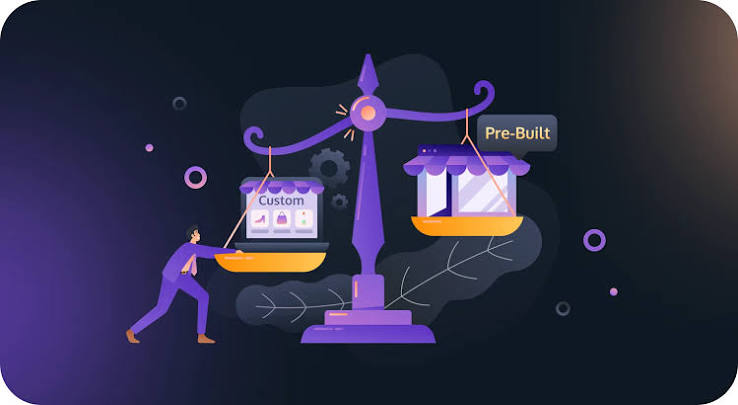
Custom Ecommerce Development vs Ecommerce Platforms: Which Is Better?
The ecommerce industry has evolved significantly, and businesses today have more options than ever to launch and scale online stores. From ready-made ecommerce platforms to fully customized solutions, each approach offers different advantages in terms of flexibility, cost, scalability, and control.
For startups and established businesses alike, choosing between an ecommerce platform and custom ecommerce development can be challenging. While platforms can help businesses launch quickly with minimal technical effort, custom solutions provide greater control over functionality and customer experiences.
So, which option is better for your business? The answer depends on your business model, growth plans, budget, technical requirements, and the level of customization you need.
What Is Custom Ecommerce Development?
Custom ecommerce development involves building an online store or ecommerce application specifically around a business’s requirements. Instead of relying primarily on predefined templates and features, businesses can work with developers to create customized functionality, workflows, integrations, and user experiences.
A custom ecommerce solution can include features such as personalized product recommendations, advanced search, custom checkout flows, loyalty programs, subscription management, marketplace capabilities, and integration with enterprise systems.
This approach is particularly useful for businesses with complex operations or unique customer journeys that cannot be efficiently supported by standard ecommerce platforms.
What Are Ecommerce Platforms?
Ecommerce platforms are ready-made solutions that provide the infrastructure and tools businesses need to establish an online store. Examples include Shopify, WooCommerce, BigCommerce, and similar platforms.
These platforms typically provide essential features such as product catalogs, shopping carts, checkout, payment integrations, order management, analytics, and store templates. Businesses can often launch their stores without building the underlying ecommerce infrastructure from scratch.
For small businesses and startups, this can significantly reduce development time and technical complexity.
Custom Ecommerce Development vs Ecommerce Platforms: Key Differences
Although both approaches can support online selling, they differ considerably in terms of flexibility, scalability, development requirements, and ownership.
1. Customization and Flexibility
The biggest advantage of custom ecommerce development is flexibility.
A custom solution allows businesses to design functionality around their specific requirements. Developers can create custom product configurations, checkout processes, customer dashboards, pricing models, recommendation engines, and integrations.
Ecommerce platforms, on the other hand, provide predefined functionality that can often be extended through plugins, apps, or APIs. While this can be sufficient for many businesses, certain requirements may require workarounds or additional third-party tools.
Best choice: Custom ecommerce development for businesses with complex or highly differentiated requirements.
2. Development Time
Ready-made platforms generally have an advantage when it comes to speed. Businesses can select a template, configure products and payments, connect essential services, and launch relatively quickly.
Custom ecommerce solutions typically require more time because the application needs to be planned, designed, developed, tested, and deployed according to the business requirements.
However, the additional development time can be worthwhile for companies planning to build a differentiated ecommerce experience rather than simply launching a standard online store.
Best choice: Ecommerce platforms for faster launches.
3. Scalability
Scalability becomes increasingly important as an ecommerce business grows. Higher traffic, larger product catalogs, more orders, additional sales channels, and complex backend operations can place greater demands on an ecommerce system.
Custom development allows businesses to architect their systems around expected growth. Developers can design infrastructure, databases, APIs, and application components to support specific scalability requirements.
Many established ecommerce platforms also offer scalable infrastructure, but businesses remain dependent on the platform’s architecture, plans, limitations, and available integrations.
Best choice: Custom development when businesses require extensive control over scalability and architecture.
4. Cost
Cost is one of the most important considerations when selecting an ecommerce development approach.
An ecommerce platform can have relatively low initial costs because much of the underlying infrastructure and functionality is already available. However, businesses may incur recurring subscription fees, transaction charges, premium app costs, customization expenses, and maintenance costs.
Custom development generally requires a higher upfront investment because the software is built specifically for the business. The total cost depends on factors such as the number of features, application complexity, integrations, UI/UX requirements, technology stack, and development team.
Businesses researching the cost to develop an ecommerce app should therefore consider both initial development expenses and long-term operational costs rather than comparing only the starting price.
Best choice: Ecommerce platforms for businesses with limited initial budgets; custom development for businesses focused on long-term control and specialized functionality.
5. Integrations
Modern ecommerce businesses rarely operate through an online store alone. They often rely on payment gateways, enterprise resource planning (ERP) systems, customer relationship management (CRM) platforms, inventory systems, warehouse management software, shipping providers, marketing platforms, and analytics tools.
Custom ecommerce development enables businesses to build integrations specifically around their existing technology ecosystem.
Platforms also support numerous integrations through APIs, plugins, and marketplace applications. However, businesses may encounter limitations when they require highly specialized integrations or complex data workflows.
Best choice: Custom development for complex enterprise integrations.
6. Security and Control
Security is critical for ecommerce businesses because online stores process customer information and payments.
With custom development, organizations can design security measures around their application architecture and business requirements. Developers can implement authentication mechanisms, access controls, encryption, secure APIs, monitoring, and other security practices.
Established ecommerce platforms also invest heavily in security and infrastructure. However, businesses have less control over the platform’s underlying environment and security architecture.
Regardless of the approach, businesses should follow relevant security standards and implement secure development and payment practices.
When Should You Choose Custom Ecommerce Development?
Custom ecommerce development is generally a better fit when a business has requirements that go beyond standard online-store functionality.
Consider a custom solution if you:
- Need highly customized customer experiences
- Have complex pricing or product configuration requirements
- Require extensive ERP, CRM, or inventory integrations
- Operate a large marketplace or multi-vendor ecosystem
- Need complete control over application functionality
- Plan to support multiple business models or sales channels
- Require specialized automation or AI-powered functionality
- Expect significant long-term growth
For example, an enterprise selling configurable industrial products may need a custom product configuration and quotation workflow that a standard ecommerce platform cannot easily provide.
When Are Ecommerce Platforms a Better Choice?
Ready-made platforms can be an excellent option for businesses that prioritize speed, simplicity, and lower initial investment.
They may be suitable for:
- Startups testing a new ecommerce concept
- Small and medium-sized retailers
- Businesses selling standard products
- Companies with straightforward checkout requirements
- Businesses that need to launch quickly
- Organizations without large in-house technical teams
Instead of investing heavily in building an ecommerce system from the ground up, businesses can use an existing platform and focus resources on products, marketing, customer acquisition, and operations.
How to Decide Between the Two
The decision should not be based on development cost alone. Businesses should evaluate their current requirements alongside their long-term objectives.
Start by identifying the functionality your business actually needs. Then assess expected traffic, product volume, integration requirements, customer experience goals, budget, and future expansion plans.
A useful approach is to consider the following questions:
How unique is your business model?
If your business follows a conventional retail model, a platform may provide everything you need. If your workflows are highly specialized, custom development may be more appropriate.
How quickly do you need to launch?
If speed is a priority, an ecommerce platform can significantly shorten the path to market.
How much control do you need?
Businesses that want extensive control over functionality, architecture, integrations, and customer experiences may benefit from custom development.
What are your long-term plans?
A platform can be a practical starting point, but rapidly growing businesses should evaluate whether it can continue meeting their requirements as operations become more complex.
Can Businesses Combine Both Approaches?
Yes. Businesses do not always have to choose between completely custom development and a completely ready-made platform.
A company may use an ecommerce platform for core commerce functionality while developing custom applications, integrations, or customer-facing experiences around it. APIs and headless commerce architectures can make this approach particularly effective.
For example, a business could use a commerce platform for product and order management while building a custom frontend to create a unique shopping experience.
This hybrid approach can provide a balance between development speed and customization.
Final Thoughts
There is no universal winner between custom ecommerce development and ready-made ecommerce platforms. The right choice depends on the complexity of the business, available budget, desired launch timeline, technical requirements, and long-term growth strategy.
Ecommerce platforms are often ideal for businesses that need a quick, cost-effective way to establish an online presence. Custom ecommerce development becomes more valuable when businesses require specialized functionality, complex integrations, greater control, or a highly differentiated customer experience.
Before making a decision, businesses should evaluate not only the initial investment but also scalability, maintenance, integrations, flexibility, and total cost of ownership. A solution that appears cheaper initially may become expensive if it requires numerous paid extensions or compromises business processes.
Ultimately, the best ecommerce technology strategy is one that supports the way your business operates today while providing enough flexibility to grow tomorrow.


Leave a Reply