
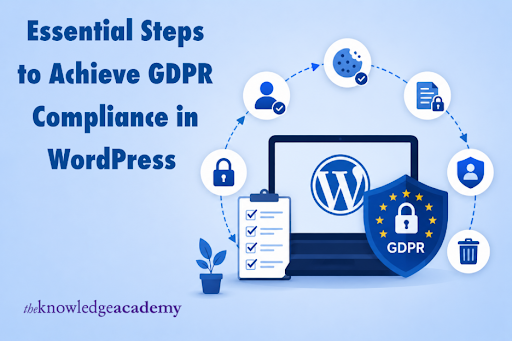
Essential Steps to Achieve GDPR Compliance in WordPress
Ever wondered why many WordPress websites still struggle with data privacy and compliance issues? GDPR Courses help professionals understand how businesses can protect user data and meet legal requirements more effectively. At the same time, understanding the Benefits of GDPR for Businesses shows why strong data protection improves customer trust. WordPress websites often collect personal information through forms, cookies and subscriptions, which makes compliance extremely important.
In this blog, the focus is on the essential steps needed to achieve GDPR compliance in WordPress websites.
Key Steps to Achieve GDPR Compliance in WordPress
Below are the key steps businesses should follow to improve GDPR compliance and protect user information effectively:
Update Your Privacy Policy
The collection and use of user data are described in a privacy policy. Every WordPress website ought to include an updated, transparent privacy statement.
Professionals can understand how transparent privacy policies enhance compliance and trust with the help of this course. This helps businesses communicate clearly with users.
Legal protection is also supported by a robust privacy policy. It should be simple for visitors to learn how their data is handled.
Enable Cookie Consent Notices
Cookies are used by many WordPress websites for analytics and tracking. It requires businesses to inform users about cookie usage clearly.
Understanding the Benefits of GDPR for Businesses helps organisations recognise how transparency improves customer confidence and website credibility.
Users can manage their selections by adding cookie consent banners. This enhances data openness and compliance.
Limit Data Collection
Companies should only gather data that is required to run their websites. Privacy hazards are increased by collecting unnecessary data.
Professionals can learn how minimising superfluous data enhances security management and compliance by taking GDPR Courses.
Storage management is also made easier by restricting data acquisition. Companies are able to manage client data more effectively and responsibly.
Use GDPR Compliant Plugins
For forms, analytics, and marketing tools, a lot of WordPress websites rely on plugins. These plugins ought to adhere to GDPR regulations.
Professionals can learn how selecting compliance tools lowers operational and legal risks with the help of this course.
Additionally, using reliable plugins enhances data management and website security. For protection, businesses should update their plugins on a regular basis.
Provide Clear Consent Options
Prior to the collection or processing of their personal data, users should always have the choice to consent. Consent ought to be understandable and unambiguous.
Understanding the Benefits of GDPR for Businesses helps organisations improve transparency and customer relationships through proper consent practices.
Legal difficulties are also decreased by having clear consent options. During audits or enquiries, businesses can more successfully prove compliance.
Allow Users to Access and Delete Data
Users have the right under GDPR to view and request the deletion of their personal data. These rights should be appropriately supported by WordPress websites.
Professionals can understand how user data rights enhance accountability and compliance management by taking GDPR Courses.
Customer confidence is also increased by offering straightforward access and deletion choices. Users feel more secure when they control their information.
Monitor Third-Party Services
Many WordPress websites make use of third-party services, including email platforms and payment systems. GDPR regulations must also be followed by these services.
Companies should check their privacy policies and agreements. This reduces the compliance risks.
Organisations can better appreciate the significance of upholding safe integrations and reliable partnerships by understanding the Benefits of GDPR for Businesses.
Train Employees on GDPR Awareness
Systems and technology are not the only aspects of compliance. Employees must also have a thorough understanding of their duties regarding data protection.
Businesses can raise employee understanding of secure data handling procedures and consumer privacy with the help of GDPR Courses.
Human mistakes are also decreased by proper training. When handling sensitive consumer data, employees gain confidence.
Perform Regular Compliance Reviews
Regular reviews of GDPR compliance are necessary because business practices and websites are always evolving.
Businesses should monitor forms and data collection methods frequently to identify possible compliance gaps.
Compliance management is also enhanced by regular reviews. Businesses are better able to adjust to shifting consumer demands and privacy laws.
Conclusion
Achieving GDPR compliance in WordPress requires strong privacy practices and continuous monitoring of customer data management. Understanding the Benefits of GDPR for Businesses also highlights how compliance supports customer relationships and legal protection. Learning through GDPR Courses helps professionals build the knowledge needed to manage privacy requirements more effectively.
For organisations looking to strengthen compliance practices and improve data protection awareness, the global training provider, The Knowledge Academy, can support professional growth through GDPR Courses.


Leave a Reply