
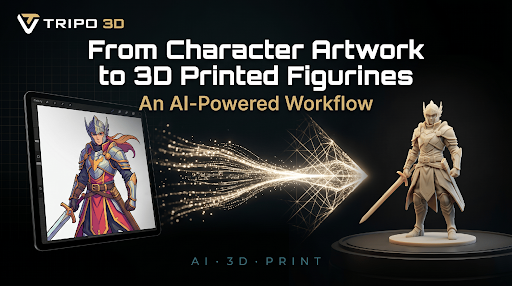
From Character Artwork to 3D Printed Figurines: An AI-Powered Workflow
Start with a creative idea for an unforgettable character. An example might be a hero from a fantasy world, anime, a villain from a comic book, or an original character from a video game. Most often, the artists get started by creating drawings or digital illustrations of their characters. Once the drawings are done, how would you bring one of those characters from paper to real life in the form of a figurine? The traditional method of crafting a character model using character drawings has required a great deal of time and effort because it has relied upon advanced levels of 3D modeling experience and specialized software in order to create an image to 3D model for printing.
Tripo 3D, however, uses AI-driven processes to enable creative creators to convert any character illustration to a highly detailed caricature figurine in just a short period of time. With character art being converted to a 3D digital model through Tripo 3D’s process, 2D character drawings become ready to be produced as custom 3D art projects and printed as individual pieces.
Let’s take a closer look at how the Tripo3D processes will help artists, designers, collectors, and hobbyists to convert their 2D artwork into collectible, three-dimensional objects.
When sketches deserve more than a spot on a screen
Character art is typically made for games, comics, animations, and personal projects. Though the illustrations can look stunning, they’re usually confined to a flat two-dimensional space.
However, many creators have dreamed of making figurines from their original character designs. These physical models help artists connect with their audiences in a more tangible way, be it for their own collection, for fundraising, fan products, or item showcases.
Tripo 3D can bridge the gap between concept art and tangible product. Instead of painstakingly modeling a character from scratch with conventional modeling software, artists can use their existing artwork as a base, saving them a considerable amount of time.
Why creating a figurine is daunting the old-fashioned way
Making a figurine by hand usually involves several technical processes that can be intimidating to creators who don’t have an advanced understanding of 3D software:
- Modeling the character in 3D
- Creating clean geometry
- Adding detail and textures
- Preparing the model for printing
- Exporting production-ready files
These steps are difficult obstacles for artists without prior 3D experience and can be tedious even for seasoned modelers, who often spend days creating and perfecting a single character model before preparing it for printing.
This is where Tripo 3D can help expedite the entire process.
Watching character concepts take physical form
One of the most exciting aspects of designing with AI is seeing your drawings transform into three-dimensional entities.
Unlike treating illustrations as flat images, Tripo 3D analyzes the artwork provided and generates structured 3D geometry that captures the essence of the drawing. It gives you a solid starting point for your figurine design and allows you to make any necessary refinements.
For characters with unique armor, clothing, hair, and fantastical elements, these detailed digital sculptures can be modeled in a fraction of the time it would normally take using conventional modeling techniques. The speed of the workflow also helps creators produce large collections of figures or multiple characters efficiently.
The secret ingredient behind sped-up figurine creation
The advancement of 3D AI technology is rapidly changing how creative workflows are approached across various industries like entertainment, gaming, and manufacturing. AI does not aim to replace artists’ creativity but rather to accelerate production workflows by streamlining tedious technical aspects.
Artists still control the character’s overall look, personality, and style-the AI just takes care of many of the labor-intensive geometric tasks. With Tripo 3D, artists can spend more time refining their designs and less time building every single detail by hand, allowing them to go from concept to prototype in less time.
The path from artwork to printable model in four easy steps
Once you’ve prepared your character artwork, the conversion process with Tripo 3D is user friendly:
Step 1: Select input type and upload
Go to the Tripo AI workspace and choose the type of input you wish to use. Image input is typically the most effective method for character figurines, and you can upload your artwork in a variety of formats, such as JPG, PNG, or WEBP. Ensure your artwork is clear and displays the necessary character features clearly for good results.
Step 2: Adjust settings
Customize the generated model based on your desired outcome. Higher-quality meshes provide more detailed figurines, whereas optimized settings can help speed up the creation process. Texture settings can also be adjusted to define how much detail you’d like retained.
Step 3: Generate and refine
After generating the initial model, Tripo 3D offers an array of refinement tools to perfect your design. You can improve texture mapping, isolate parts of the character through asset extraction, and even animate your model with automatic rigging capabilities. These tools allow you to create exceptionally clean and accurate figurines.
Step 4: Export
Once you’re satisfied with the figurine’s appearance, export the file in a format compatible with your needs (e.g., STL, OBJ, FBX, GLB, and USD). You can then proceed to further edits, renderings, or directly to the 3D printing stage.
Preparing your characters for the leap from digital to physical
After you generate the model, it’s crucial to prepare it for successful 3D printing. Designers will want to ensure that the figurine design is structurally sound, the surfaces are well-defined, details are accurately captured, the supports are easily removable, and the scale is appropriate.
Tripo 3D generates a high-quality foundation that can then be further optimized, reducing the amount of post-processing required compared to conventional 3D modeling.
The transition from image to STL is simplified
One of the most essential steps in figurine production is preparing files for 3D printing. Traditionally, turning an illustration into printable geometry involves several different software programs and significant manual adjustments.
Modern AI workflows streamline this process, enabling artists to generate printable 3D models from their illustrations faster than ever before. This rapid workflow simplifies the entire process from image to STL output.
Where creators are using AI-powered figurine workflows today
The demand for personalized figurines continues to rise in a number of fields:
- Independent artists: Artists can create high-quality figurines of their original characters, expand their brand, and generate a new stream of income.
- Tabletop game designers: Minatures for campaigns, board games, and role-playing games can be quickly brought to life by creators.
- Animation and comic studios: Studios can develop a range of character merchandise and collectibles without going through long and complex production chains.
- Collectors and hobbyists: Bring your favorite character designs to life in a personal collection through a custom figurine project.
Tripo 3D helps lower the technical barriers for these and other creators, accelerating their production times significantly.
Giving your characters a place in the real world
Character design doesn’t have to end with an illustration; now you can create physical figurines of your characters more quickly than ever before. With Tripo 3D, you can convert your artwork into highly detailed 3D models, refine your designs with intuitive tools, and prepare them for printing workflows. Whether you’re creating a personal collection, designing merchandise, or prototyping new designs, Tripo 3D can help bring your imagination to life.
Ready to bring your character art into the physical world? Start creating with Tripo 3D today to discover a faster and simpler way from concept to collectible figurines.


Leave a Reply