

How AI-Powered Tools Are Making E-commerce Businesses More Efficient
Running an e-commerce business involves hundreds of small decisions every day. Store owners need to manage products, process orders, answer customer questions, update inventory, monitor marketing campaigns, organize financial records and keep their websites running smoothly.
As an online store grows, these responsibilities can quickly become difficult to manage manually.
Artificial intelligence is changing that equation. AI-powered tools can automate repetitive tasks, analyze customer behavior, improve product discovery, assist with content creation and help businesses organize information more efficiently. Modern e-commerce platforms are increasingly combining AI with automation to create workflows that require less manual intervention while giving store owners better visibility into their operations.
The goal is not to replace people. Instead, AI can take care of predictable and time-consuming work so business owners and teams can spend more time on strategy, customer relationships and growth.
What Are AI-Powered E-commerce Tools?

AI-powered e-commerce tools use artificial intelligence, machine learning or related technologies to perform tasks that traditionally required manual work or rule-based software.
Depending on the application, these tools can help with:
- Product recommendations
- Customer support
- Product descriptions
- Search and navigation
- Inventory analysis
- Marketing automation
- Order management
- Customer segmentation
- Financial data processing
- Sales forecasting
- Business reporting
The technology can range from simple AI-assisted features to more advanced systems capable of analyzing information and taking actions across multiple applications.Some of these applications extend beyond storefront operations, with tools such as Lotus365 AI bookkeeping helping businesses organize financial information alongside their broader digital workflows.
PortoTheme, for example, has been expanding AI capabilities around WordPress and WooCommerce, including AI-assisted content generation and AI-driven website tools.
Why Efficiency Matters in E-commerce:
Efficiency becomes increasingly important as an online store grows.
A business processing ten orders per day may be able to manage many tasks manually. A store processing hundreds or thousands of orders faces a very different operational challenge.
Manual processes can create several problems:
- More repetitive work
- Greater risk of human error
- Slower customer responses
- Difficulty maintaining product information
- Delays in reporting
- Higher administrative costs
- Less time for strategic work
Automation can reduce some of this pressure.
Instead of asking employees to repeat the same process for every order or customer, businesses can create workflows where software handles predictable actions automatically.
AI Can Automate Repetitive E-commerce Tasks:
One of the clearest benefits of AI is its ability to reduce repetitive work.
Consider a simple product workflow.
A new product is added to an online store. Traditionally, someone might need to write the product description, create metadata, assign categories, prepare promotional content and update other systems manually.
An AI-assisted workflow can automate portions of this process.
Similarly, when an order is received, automated systems can trigger confirmation emails, update inventory, notify fulfillment teams and record relevant information.
PortoTheme’s recent coverage of WooCommerce automation demonstrates how AI agents can connect triggers, decision-making and actions across store workflows.
The important advantage is consistency. Once a reliable workflow has been designed and tested, the same process can be repeated without requiring someone to manually initiate every step.
AI Is Improving Product Recommendations:
Online shoppers do not all have the same preferences.
A customer looking for running shoes may have completely different requirements from someone shopping for formal footwear. Showing everyone the same products can make an online catalog feel generic.
AI-powered recommendation systems can analyze signals such as browsing behavior, previous purchases and product interactions to identify potentially relevant products.
For example, a store could recommend:
- Related products
- Frequently purchased combinations
- Products similar to recently viewed items
- Items based on previous purchases
- Alternatives within a particular price range
Predictive merchandising takes this concept further by using behavioral data to anticipate products a shopper may be interested in. PortoTheme has specifically covered predictive merchandising for WooCommerce as a way of moving from static catalogs toward more dynamic shopping experiences.
The result can be a more relevant shopping experience without requiring the merchant to manually create every recommendation.
AI Can Make Product Search More Useful:
Product search is one of the most important parts of an online store.
Customers do not always use the exact terminology found in product catalogs. Someone might search for “comfortable shoes for long walks” rather than knowing the exact product category or technical specification.
AI-powered search can interpret intent rather than relying only on exact keyword matches.
Semantic search, for example, attempts to understand the meaning behind a query and identify products that match the shopper’s intent.
This can make large catalogs easier to navigate.
It also becomes increasingly important as shoppers use conversational AI tools to research products. PortoTheme has recently discussed how WooCommerce stores need to make product information understandable not only to traditional search engines but also to AI-driven shopping experiences.
AI Can Improve Customer Support:
Customer service is another area where automation can create substantial efficiency.
E-commerce customers frequently ask repetitive questions:
- Where is my order?
- How long does delivery take?
- Is this product available?
- What is the return policy?
- Which size should I choose?
- Does this product have a particular feature?
An AI chatbot can handle many straightforward questions immediately.
More advanced systems can connect with store information and retrieve relevant order or product details before responding.This type of connected customer experience can also be valuable for businesses operating around major sporting events, where customer enquiries, merchandise activity and digital transactions can increase during high-profile competitions such as the Indian Premier League 2027.
The benefit is not necessarily eliminating human support. Instead, AI can handle routine questions while allowing customer service teams to focus on complicated problems that require judgment or empathy.
AI Can Help With Product Content:
Large online catalogs often contain hundreds or thousands of products.
Creating unique product descriptions, titles, summaries and metadata for every item can take significant time.
AI-powered content tools can help create initial drafts from structured product information.
For example, a system could receive:
- Product name
- Features
- Specifications
- Target customer
- Product category
- Key benefits
It could then produce a draft product description.
However, human editing remains important. AI-generated content should be checked for accuracy, clarity and originality before publication.
PortoTheme itself provides AI content-generation capabilities within its WordPress and WooCommerce ecosystem, reflecting the broader move toward AI-assisted content management.
AI Can Help Merchants Understand Customer Behavior:
E-commerce businesses produce enormous amounts of behavioral data.
Every search, product view, cart addition and purchase can potentially provide information about customer preferences.
AI can analyze these signals to identify patterns that might be difficult to detect manually.
For example, a business might discover that:
- Certain products are frequently viewed together
- Customers abandon carts at a particular stage
- Demand increases during specific periods
- Certain customer groups respond better to particular offers
- Some products attract traffic but rarely convert
These insights can help merchants make more informed decisions about pricing, promotions, inventory and product positioning.
AI Can Support Inventory Management:
Inventory problems can become expensive.
Too much stock ties up capital and increases storage costs. Too little stock can result in missed sales and disappointed customers.
AI-assisted forecasting can analyze historical sales patterns and other available information to estimate future demand.
These systems may consider factors such as:
- Previous sales
- Seasonal patterns
- Product popularity
- Promotion history
- Current inventory
- Customer demand
Forecasting is not perfect, particularly when markets change unexpectedly. However, data-driven estimates can provide a stronger starting point than relying entirely on intuition.
AI Can Streamline Financial Administration:
Financial administration is another area where e-commerce businesses can accumulate repetitive work.
Online stores generate invoices, receipts, transaction records, supplier bills and expense information. Managing these records manually can consume valuable time.
AI-powered financial tools can help extract information from receipts, bills and other documents, organize it and prepare it for bookkeeping workflows.
For example, a receipt could be processed to identify:
- Date
- Merchant
- Amount
- Currency
- Expense information
The extracted information can then be reviewed and transferred into the appropriate financial workflow.
This is particularly useful for small online businesses where the owner may be responsible for both store operations and financial administration.
Tools such as Lotus365 AI bookkeeping represent this broader application of AI by helping turn financial documents and spreadsheets into more organized bookkeeping information.
The important point is that financial automation should complement human review. Business owners and accounting professionals should verify important records before relying on automated outputs for reporting, filing or financial decisions.
AI Can Connect Different E-commerce Workflows:
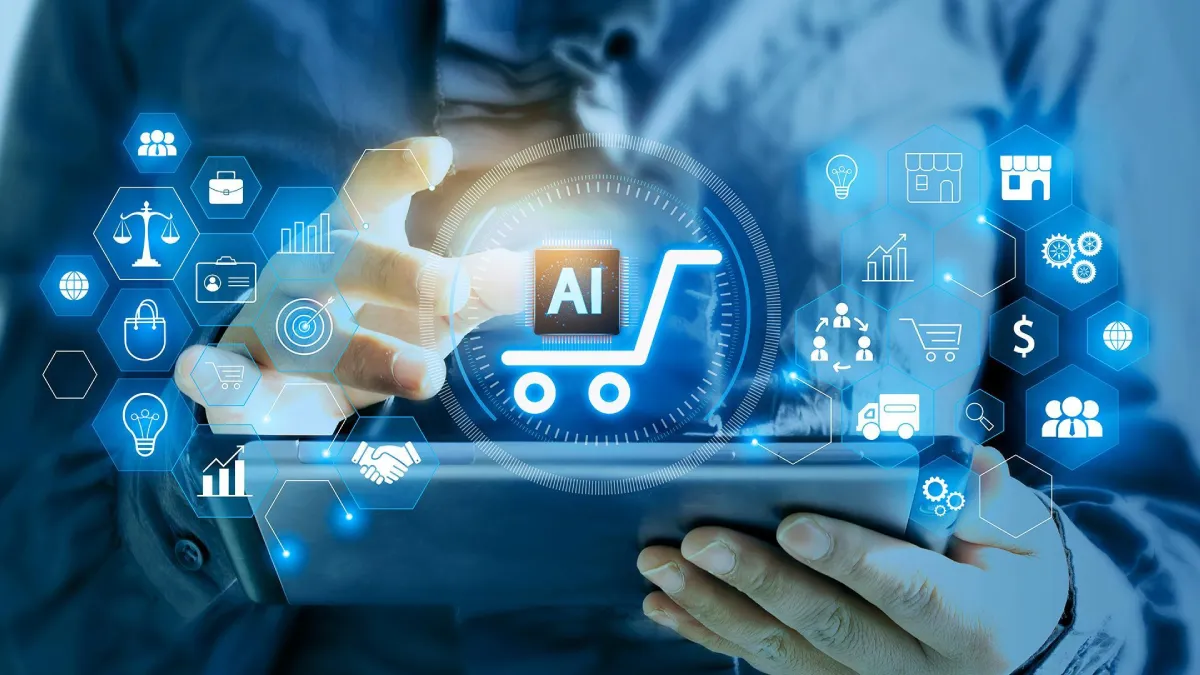
The real efficiency gains often appear when different systems are connected.
An online store rarely operates in isolation. It may interact with:
- Payment gateways
- Email platforms
- Inventory systems
- Shipping services
- Customer relationship management software
- Accounting applications
- Analytics platforms
- Marketing tools
APIs and automation platforms can connect these systems.
For example:
New order → payment confirmation → inventory update → fulfillment notification → customer email → financial record
Without automation, employees may have to initiate several of these steps manually.
With a properly designed workflow, software can execute many of them automatically.
This is one reason modern e-commerce automation is moving beyond individual plugins toward connected workflows.
AI Can Personalize Marketing:
Generic marketing messages are becoming less effective as customers receive more digital communication.
AI can help businesses segment customers based on behavior and characteristics.
A store could potentially distinguish between:
- First-time shoppers
- Repeat customers
- High-value customers
- Customers who have abandoned carts
- Customers interested in specific categories
- Customers who have not purchased recently
Different groups can then receive different communications.
Personalization can make marketing more relevant without requiring a marketing team to manually create individual campaigns for every customer.
AI Can Help With Abandoned Cart Recovery:
Cart abandonment is a common e-commerce challenge.
A customer may add products to a cart but leave before completing the purchase.
Automation can detect this event and trigger an appropriate follow-up.
AI can potentially help determine the timing, content or type of message based on customer behavior.
For example, a returning customer with a history of completing purchases may receive a different communication from someone who has never purchased before.
The objective should not be to send more messages. It should be to send more relevant messages.
Efficiency Does Not Mean Automating Everything:
It can be tempting for businesses to automate every possible task.
That is not necessarily a good strategy.
Some activities require human judgment.
For example:
- Resolving serious customer complaints
- Handling unusual refunds
- Approving financial transactions
- Reviewing sensitive customer information
- Making major pricing decisions
- Evaluating unusual business activity
AI works best when businesses identify tasks that are repetitive, predictable and measurable.
A useful starting point is to ask:
Which process consumes significant time but requires relatively little human judgment?
That is often a good candidate for automation.
Data Quality Determines the Value of AI:
AI systems depend on information.
If product descriptions are incomplete, inventory data is inaccurate or customer records contain errors, automated systems may produce poor results.
This is particularly important for e-commerce businesses with large product catalogs.
Before implementing sophisticated AI systems, merchants should improve the quality of their underlying data.
That includes:
- Consistent product attributes
- Accurate pricing
- Updated inventory information
- Clear product categories
- Reliable customer records
- Structured financial information
Better data creates a stronger foundation for automation.
Security and Privacy Remain Important:
E-commerce businesses handle sensitive information, including customer details, order histories and payment-related information.
AI systems should therefore be implemented with security in mind.
Businesses should understand:
- What information an AI tool accesses
- Where that information is processed
- How long it is stored
- Who can access it
- Whether third-party providers receive the data
- What security controls are available
AI should make an e-commerce operation more efficient without creating unnecessary privacy or security risks.
How Small E-commerce Businesses Can Start Using AI:
Businesses do not need to transform their entire operation overnight.
A practical approach is to begin with one repetitive process.
For example:
Step 1: Identify a bottleneck
Find a task that consumes substantial time every week.
Step 2: Measure the current process
Record how long the task takes and how frequently errors occur.
Step 3: Choose an appropriate AI tool
Select software that directly addresses the identified problem rather than adopting AI simply because it is popular.
Step 4: Test with a limited workflow
Run the automation on a small number of transactions, products or customers.
Step 5: Review the results
Check accuracy and identify where human intervention is still required.
Step 6: Expand gradually
Once the workflow is reliable, connect it to other parts of the business.
This approach reduces the risk of introducing complicated automation before the underlying process is understood.
The Future of AI-Powered E-commerce:
AI is becoming increasingly embedded in the e-commerce technology stack.
The next generation of online stores will likely combine AI search, predictive merchandising, automated customer service, personalized recommendations, intelligent content creation and connected business workflows.
AI agents may also become more capable of performing multi-step tasks rather than simply generating text or answering questions.
For example, an AI system could potentially interpret an incoming business request, retrieve information from a store, make a recommendation and trigger an appropriate workflow.
This is already reflected in the direction of WooCommerce automation, where AI agents can connect store data with actions across multiple tools.
However, the future of e-commerce AI will not simply be about giving software more control.Large commercial events can also create complex digital ecosystems involving merchandise, ticketing, sponsorships, marketing and customer transactions. An event such as the Indian Premier League 2027 illustrates the type of large-scale commercial environment where businesses may benefit from connected digital tools and data-driven workflows.
Successful businesses will need to combine automation with clear rules, accurate data, security measures and human oversight.
Frequently Asked Questions:
How does AI improve e-commerce efficiency?
AI can reduce repetitive work, automate workflows, analyze customer behavior, improve product discovery, personalize marketing and assist with customer support.
Can AI automate WooCommerce tasks?
Yes. Depending on the tools used, AI and automation can assist with product content, customer communication, order workflows, recommendations, reporting and other WooCommerce processes.
Can small e-commerce businesses benefit from AI?
Yes. Small businesses can start with relatively simple use cases such as customer support, product content, financial administration or repetitive order workflows.
Does AI replace e-commerce employees?
Not necessarily. AI is generally most useful when it handles repetitive tasks while employees focus on customer relationships, strategy, creative work and decisions requiring human judgment.
What is the biggest challenge when implementing AI?
Data quality is one of the most important considerations. AI tools need reliable information to produce useful results. Businesses should also consider security, privacy, integration and ongoing human review.
Conclusion:
AI-powered tools are changing e-commerce by making everyday operations more automated, connected and data-driven.
From product recommendations and customer support to inventory forecasting, content creation and financial administration, AI can reduce repetitive work and help businesses respond more efficiently to customers.
The greatest opportunity is not simply to add AI to an online store. It is to identify the areas where technology can remove unnecessary manual work while keeping people involved where judgment matters.
For growing e-commerce businesses, that balance can create a more efficient operation without sacrificing the human side of commerce.
As AI becomes increasingly integrated with platforms such as WooCommerce, the most successful stores will likely be those that use it thoughtfully: starting with real operational problems, improving their data, measuring results and expanding automation only when it delivers genuine value.


Leave a Reply