
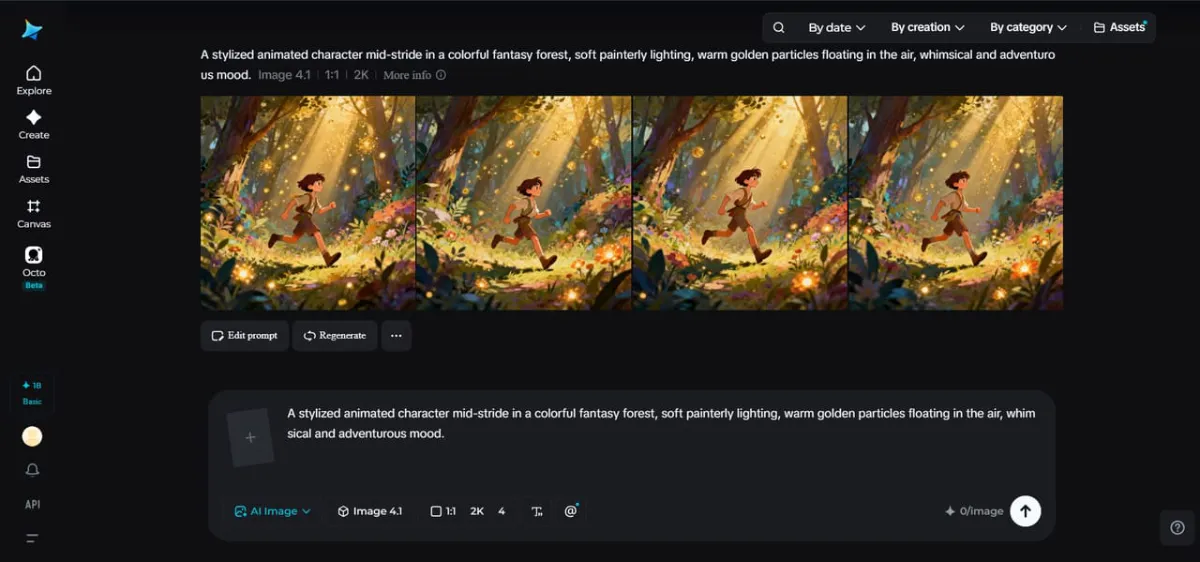
How AI Simplifies Animation and Short Drama Production
Animation and short drama share a demand that live-action doesn’t always face as intensely: everything on screen has to be built rather than simply captured. There’s no location to scout, no actor to direct in the moment — every character, every movement, every scene has to be constructed deliberately, frame by frame.
That’s made both formats some of the most labor-intensive kinds of video production, requiring specialized skills and long production timelines even for relatively short pieces.
Seedance 2.5 is an upgraded iteration of Seedance 2.0, designed to deliver better AI video quality, consistency, and creative control. Dreamina’s advanced video generation model, Seedance 2.5, changes that equation considerably, letting creators build animated and drama-style content without the traditional production pipeline behind it.
Why animation and short drama take so long to produce
Animation has always demanded patience; most other formats don’t require. Every frame of movement has to be constructed intentionally, and getting motion to look natural — a character’s weight shifting, fabric moving realistically, an expression changing convincingly — takes real technical skill and a lot of time, even for a short sequence.
Short drama carries a different but related challenge. It depends heavily on performance and emotional nuance landing within a tight runtime, which usually means multiple takes, careful direction, and an editor shaping pacing until a scene actually feels the way it’s supposed to. Both formats reward patience and precision in ways that make them expensive to produce well, especially for creators working without a full studio behind them.
What makes Seedance 2.5 built for these formats
Seedance 2.5 addresses the core challenges of both animation and drama directly, rather than treating them as an afterthought of general video generation.
Natural motion without frame-by-frame construction
Complex, long-tail actions — the kind of nuanced movement that’s historically difficult to animate convincingly — now render smoothly and believably. This matters enormously for animation specifically, where unnatural movement is often the first thing that breaks the illusion, no matter how strong the art style looks.
Consistency that holds a character together across scenes
Cumulative errors that used to build up over a sequence are largely resolved, keeping a character’s design, proportions, and style locked in place from one scene to the next. The long-standing “twin” issue, where a character would sometimes duplicate into near-identical copies, has also been significantly reduced, which matters for any animated scene involving more than one character interacting together.
Reference tools that support performance and blocking
Green screen references let creators anchor complex physical interactions between characters to real reference footage, useful for drama scenes involving specific, nuanced contact. White-model blockout references help plan how multiple characters should move and position themselves within a scene, functioning like blocking notes for both animated and live-action-style drama alike.
Enough runway for a scene to actually develop
Single-clip generation has doubled from 15 to 30 seconds, giving both formats more room to let a moment build rather than being cut short. Extension support has also improved, allowing two full rounds without the visible quality drop earlier versions introduced, useful for drama scenes that need to run a little longer to land emotionally.
Bring your story to life in three steps
Step 1: Write a detailed text prompt and add a reference image
Visit Dreamina, sign in, and head to the “AI Video” section. If your project is built around a specific character design or style reference, click “Add reference image” and upload it to anchor the generation. For a fully imagined scene, skip the upload and describe everything directly in your prompt.
A detailed prompt for a 30-second sequence might read: An animated young woman with short red hair sits across from an older man at a small kitchen table, tension in the air as she clenches her hands together, he speaks softly and reaches out, she hesitates before finally looking up to meet his eyes, warm muted lighting, slow push-in on her face as the moment shifts, quiet and emotional mood, soft ambient room tone throughout.
Step 2: Choose parameters and generate
With your prompt and reference ready, select the Seedance 2.5 model for generation. Choose your video length, then pick an aspect ratio suited to where the piece is headed — 16:9 for a traditional format, or 9:16 for short-form social platforms. Click Dreamina’s generation icon and let it turn your scene into finished footage.
Step 3: Edit and download
Once the video is generated, use Dreamina’s AI editing tools to refine anything that needs adjusting before saving. Upscale sharpens resolution for a cleaner, more polished finish, while Generate Soundtrack adds a score or ambient audio that matches the emotional tone of the scene. Once it’s ready, export the video and download it, ready to share or publish wherever it’s headed.
Getting performance and style to land
A few habits help both animation and drama scenes feel more intentional. Describing emotional shifts directly in the prompt — a hesitation, a change in tone, a moment of realization — helps the model translate performance rather than just action.
Keeping a consistent style or character reference across every scene protects against visual drift in longer animated projects. And treating pacing as part of the direction, not just the content, helps a dramatic beat land the way it’s meant to.
A more open path for both formats
Animation and short drama have always rewarded patience and technical skill in equal measure, which kept both formats largely out of reach for creators without a studio or full production team behind them. That’s changing.
With Dreamina and its Seedance 2.5 model, the careful character work, natural movement, and emotional pacing both formats depend on can now come from a clear creative vision and a well-built prompt, opening up two of the most demanding kinds of storytelling to far more people than before.


Leave a Reply