
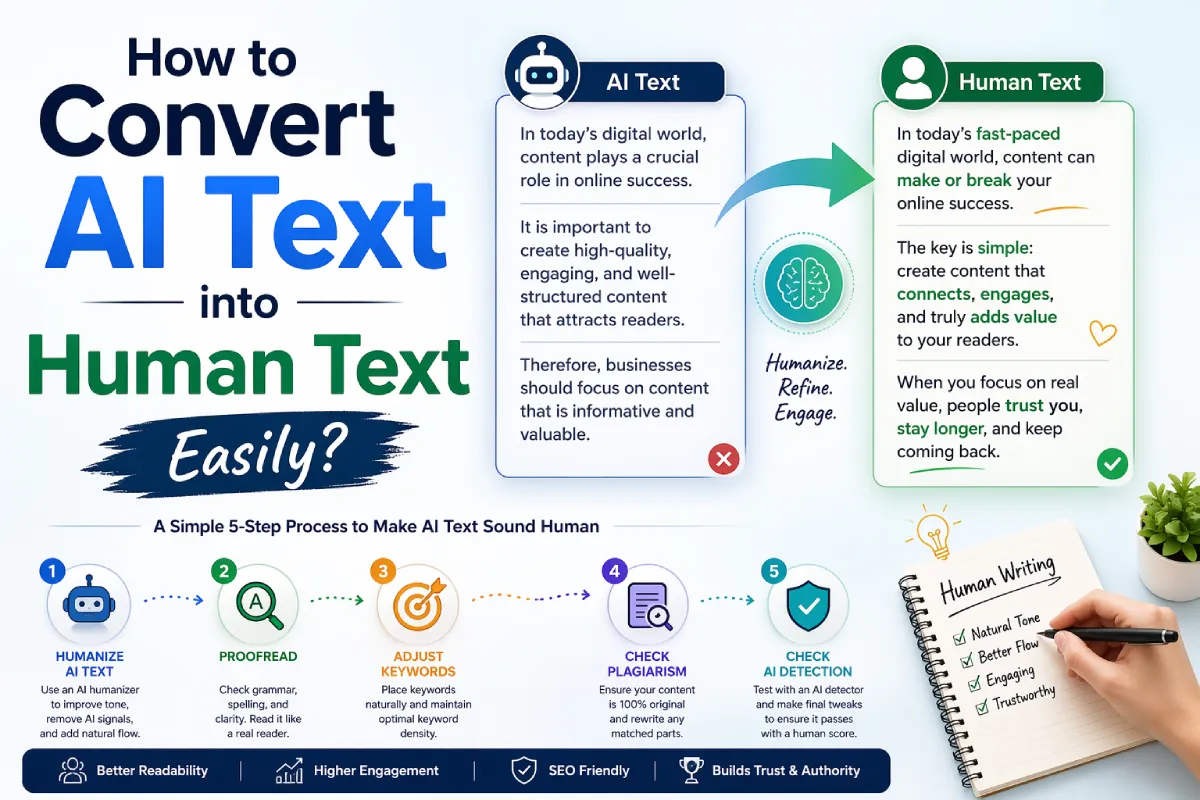
How to Convert AI Text into Human Text Easily?
AI tools can create content in seconds. The grammar looks correct. The structure looks clean. Yet something still feels off, i.e., tone, readability, flow.
Most AI text sounds flat and predictable. Readers can notice this quickly. When content does not feel natural, engagement drops.
So, converting AI text into human text is not just about rewriting words. You need a proper process that improves tone, flow, and readability.
The Problem with Raw AI Content
Raw AI content looks correct at first. The grammar is fine, and the sentences are clear. However, it still does not feel natural.
One main issue is repetition. AI often uses similar sentence patterns again and again. Because of this, the content feels predictable.
Another problem is tone. AI writing usually sounds flat. It does not show emotion or personality, so readers do not feel connected.
Also, the flow can feel too structured. Ideas move in a fixed way instead of a natural one. This makes the content less engaging.
Because of all these issues, raw AI content may look good, but it does not feel human.
What Actually is Human Content?
Human-written content is the one that feels easy and natural to read. It uses simple language and avoids unnecessary complexity.
In human-written content, sentences vary in length. Also, ideas connect smoothly. The content does not feel forced or mechanical. That is why both the online readers and search engines emphasize using human content and avoiding AI-written content.
How to Convert AI Text into Human Text?
To convert AI text into human text, you need to follow a clear writing strategy. And we are here to share a clear writing strategy with you that is very much easier to implement.
Step 1: Humanize AI Text
Start by humanizing your content through AI Humanizer. It will instantly process your text and convert it into human-style writing.
Doing this will:
- Remove AI signals from content
- Improve tone
- Breaks repetitive patterns
- Adds variation in sentences
- Give an overall natural flow to the content
Instead of editing everything manually, this step saves time. Most of the AI detection problems are handled by the tool.
Step 2: Proofread (Check Grammar & Spelling Errors)
After humanizing your content, review the output carefully. This is because when humanizing, some little issues might remain. So scan the content for:
- Grammar mistakes
- Correct spelling
- Improve clarity if needed
Also, read the content like a real reader. If something feels awkward, adjust it.
Step 3: Adjust Keywords
If you are working on SEO content, it is necessary to check the content for your keywords. Because when you humanize content chances are that keywords are changed to their synonyms.
So, check the content for keywords and place them naturally within the content. Avoid forcing them into sentences. Use optimal keyword density. Using a keyword density checker will help you with adjusting the keyword density the right way.
Make sure the content still reads smoothly. Good SEO should not break the flow of writing.
Step 4: Check Plagiarism
Now check the uniqueness of your content. Run it through a plagiarism checker to confirm that it is original.
If you find any matches, rewrite those parts slightly. Keep the meaning the same while improving uniqueness.
Step 5: Check AI Detection
Once you are done with implementing the above changes, test your content with an AI detector. This step helps you confirm whether your content looks human-written.
If the score is still high, make those small adjustments again. Focus on improving variation and flow.
Common Mistakes to Avoid
- Skipping proofreading after humanizing the content
- Relying only on tools without reviewing the final output
- Using complex words that make the content hard to read
- Forcing keywords into sentences unnaturally
- Keeping the same sentence structure throughout the content
- Ignoring flow between ideas
- Over-editing and making the content confusing
- Not checking plagiarism before publishing
- Ignoring AI detection checks
- Publishing content without reading it like a real reader
Wrapping Up
Converting AI text into human text is simple when you follow the right process. You do not need to rewrite everything from scratch. Instead, you improve the content step by step.
- Humanize your text
- Proofread it
- Adjust keywords for SEO
- Check for plagiarism
- Check AI detection
You’re good to go. If the above steps are implemented the right way, we bet no AI detector will be able to flag your content. Nor will it sound robotic in readability.


Leave a Reply